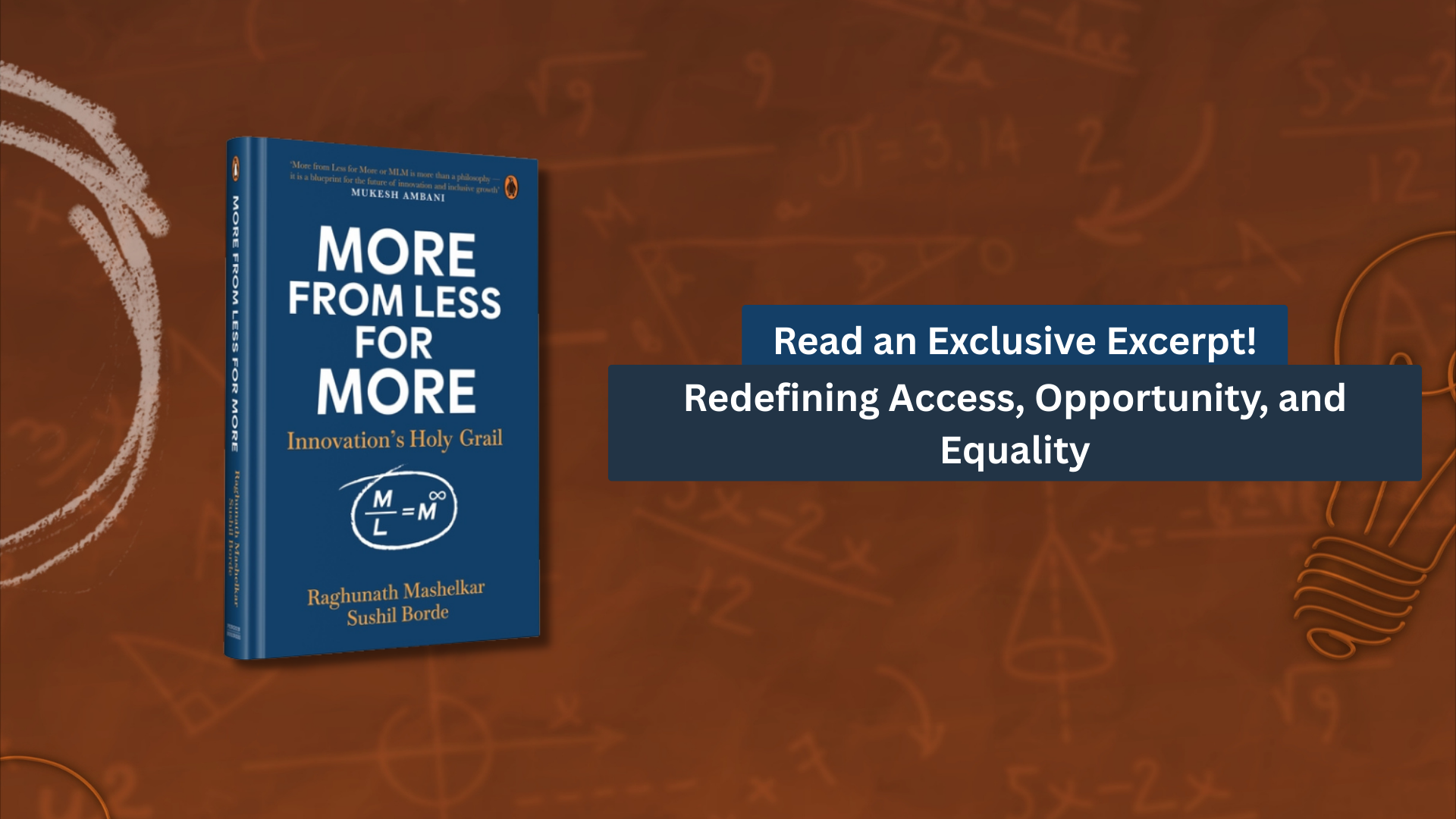
Read on for a glimpse into the powerful ideas explored in More from Less for More—a book that redefines inclusive innovation.
Five words.
They hold the key to the world’s sustainable future.
They combine three compelling priorities.
Equitability. Profitability. Sustainability.
This unique platform is humankind’s response to enhancing prosperity for the largest number of people, increasing wealth for innovators and protecting environmental integrity.
These three attributes hold the key to a new world.

In our pursuit of innovation, two dominant paradigms have emerged, both of which exacerbate inequality:
More from More for Less (MML): This MML strategy focuses on creating high-end, feature-rich products that are only affordable to the wealthy. It breeds exclusivity, creating a world where the inequalities of access rise exponentially.
Less from Less for More (LLM): This LLM approach caters to the masses but compromises quality, offering substandard products to the poor. While it increases accessibility, it denies dignity, aspiration and happiness to those who deserve better.
Both paradigms fail to address the fundamental need for equality—not just economic equality but the deeper, more profound equality of access, opportunity and respect.
On the other hand, the MLM strategy offers a transformative solution:
• More from Less: Leveraging technology, creativity and efficiency to reduce resource usage while enhancing quality.
• For More: Ensuring that the benefits of innovation reach the widest possible people, transcending economic and social boundaries.
This strategy is grounded in the belief that excellence should not be the privilege of a few but the right of all.
More from Less for More.
Reliance Digital Services Business—Jio: A Global MLM Next Practice
Jio is not just the best practice but the next practice of ‘More from Less for More’.
MLM has been most extensively showcased in the growth of Jio’s telecom network launched by Reliance Industries.
Within just a decade of its existence, Jio has demonstrated the unique combination of a large rollout scale, extensive influence and sustainable outcomes.
This challenging combination has been achieved through a strategic clarity of generating more from less—for more people, MLM for short.
This clarity has not just transformed Jio from scratch into one of the largest global digital services companies in compressed time; it has emerged as possibly the most visible MLM manifestation the world over. This single success has transformed MLM into a living reality with multi-decade implications for all stakeholders.
To get here, MLM at Jio climbed several walls of apprehension. More than a decade ago, there was a question about the sustainable profitability of the telecom service sector in India.
In the two decades leading to the Jio launch, several telecom companies had sold out, the industry had consolidated (fewer but larger players), and despite this—which should have made it easy for leading players to raise tariffs—competition had increased. Industry profitability had declined.
The perception was that voice telephony had been commoditized; WhatsApp calls had made voice-based services largely irrelevant; debt-driven telecom companies appeared to be driven to bankruptcy; and the share prices of most telecom companies had eroded.
There was no case for Reliance Industries to launch a new telecom service. Several analysts predicted that the group’s entry into this space would be marked by failure that could affect the parent’s cash flows. The surviving telecom companies were bleeding; there was no reason why the outcome would be different for Jio. The conclusion was that the more Reliance utilized its muscle—throwing good money after bad—the greater its loss and balance sheet embarrassment. The conclusion was that Reliance had mistimed.
Reliance held a contrarian position. The company believed that what most industry players had dismissed as a sunset certainty was a sunrise opportunity in disguise. Where most players perceived realities (grim), Reliance perceived possibilities (better). The Reliance perception difference was the way the company saw the world pan out: its entry into telecom through its Jio brand would not be about voice (which was dying anyway on account of free WhatsApp-based calls); it would be about data.
Data. The new oil. Consumers would want to watch movies on their smartphones; they would want to shop online; they would want to access social media through their phones; they would want to read off their personal device screens; they would want to be educated on their mobile phones; they would want to track, trade and transact.
Voice was so yesterday.
At Reliance, data was about tomorrow. The laptop would become secondary; the tablet would no longer be important; the mobile phone would slide into the centre of engagements. Besides, each time the consumer stepped onto the Internet, a digital trail would be created. Consumer preferences would be mapped. Purchase junctures would be studied. Price points would be analysed. The next time the consumer ventured onto the net, the mobile phone would be armed with insights to predict the nature of products likely to be consumed. The result was that the mobile phone was awaiting a reinvention.
Reliance recognized that doing the same thing with the same handset in the same way as everyone else would lead the company to the same outcome—obsolescence. The company needed to do something different using largely the same resources as everyone else. This insight represented the basis of Reliance’s entry into a space where it possessed no experience. What Reliance did not know was nominal; what it did know would prove game-changing. Voice had been commoditized; data had not been touched. This one insight represented the growth platform for a company seeking to transform a much-used electronic handset for a disruptive application.
Most felt there was nothing left to disrupt. The telecom industry had played out an entire cycle ending with bankruptcies, exits, declining revenues and suboptimal returns. There was a likelihood that the potential disruptor would be disrupted. Voice was finished. Data was unproven. Even if data was the next big opportunity, the data quantum the average Indian would consume would not justify an entry into the sector (assuming that voice would be non-surplus accretive).
Reliance made a different conclusion. If the future did not exist, it would have to be created. If the process was not conducive, the means would need to be changed.
***
Get your copy of More From Less for More on Amazon or wherever books are sold.