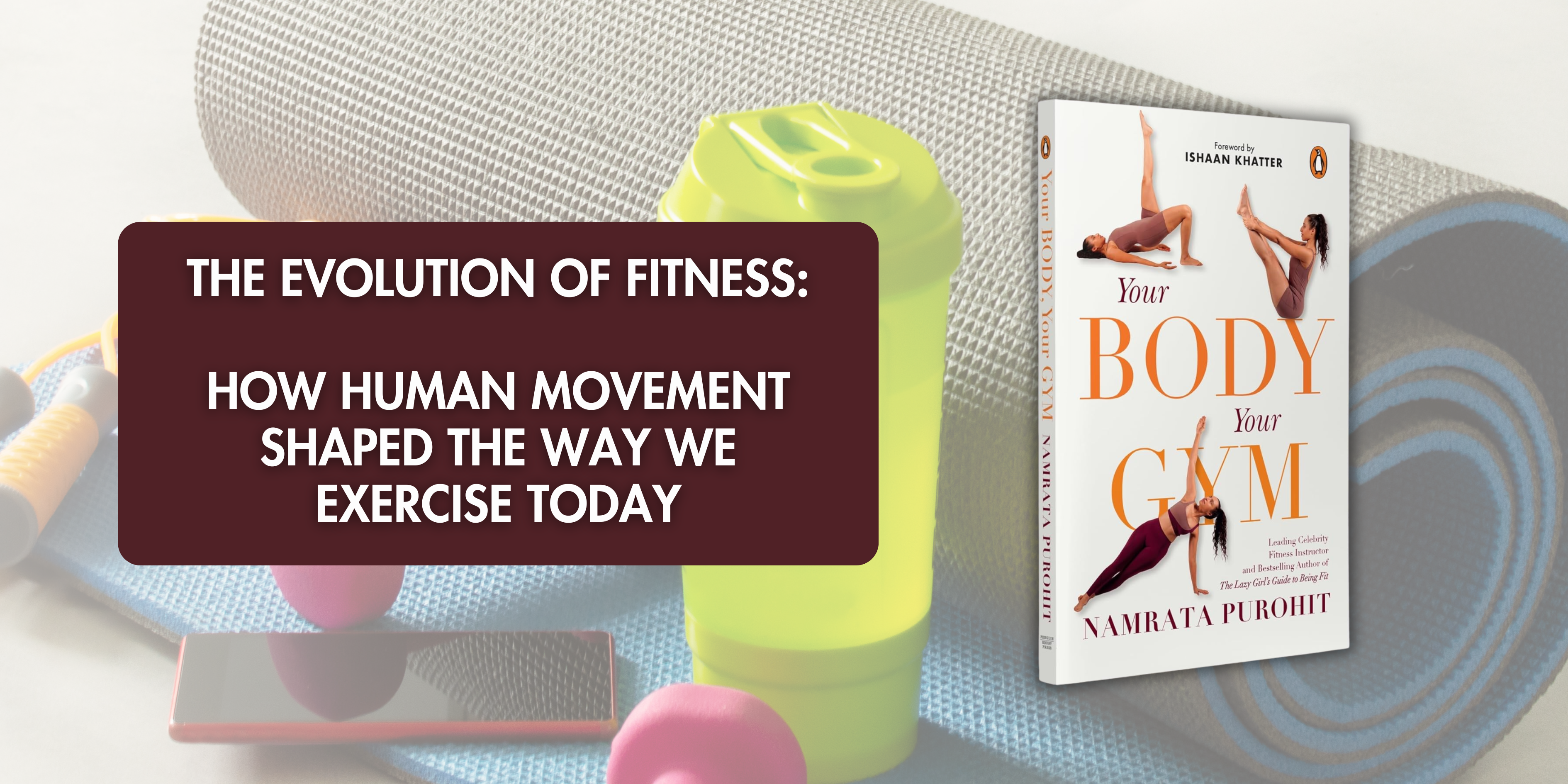
In Your Body, Your Gym, Namrata Purohit reminds us that fitness was never invented in a gym—it was built into human survival long before treadmills, dumbbells and workout apps ever existed.

***
Be like a mountain. Aim to reach beyond the clouds but have your feet well grounded.
Exercise, as we know it today, has evolved drastically over the years. Yoga in India, Tai Chi in China, Olympic training in Greece, some of the earliest forms of fitness go back by centuries. But as far as we remember, a defined regimen of exercise started somewhere in the 1960s with yoga, jazzercise, jogging and aerobics gaining popularity all over the world. However, physical activity has been a nonnegotiable part of our lives forever. The drive for being one’s fittest self goes back much further than we may even be able to define, back to a time when physical activity would not have been looked at as a workout but instead, as a way of life.
Centuries ago, there were no machines, weights or modern-day equipment. Still, people were in great shape. ‘Survival of the Fittest’ was not just a philosophical statement but the everyday reality—as witnessed by the evolution of humankind through the pages of history. To understand this better, let’s look back a little at the history of exercise and how it has evolved over the years.
Let’s travel all the way back, back to the primitive times, when mankind had to literally move to survive. During those times, physical development in all aspects followed a natural path. Human beings had to constantly be on the move, our ancestors had to learn how to navigate and survive in the wild by avoiding threats and seizing opportunities. As part of the survival plan, human beings had to know how to move efficiently, make tools and use natural objects, such as trees, stones and rocks, and learn how to defend themselves. At an early stage, we had to learn how to walk, run, balance, jump, climb, crawl, swim, lift, throw, catch and move in order to survive. The early human’s fitness levels and skills were not developed by a structured programme but instead revolved around their daily activities as they developed skills that were driven by necessity and practicality.
Another important part of human history and evolution is the agricultural revolution. Farming and raising cattle required immense amounts of daily activity and physical labour. Bending, squatting, twisting, lifting, pulling, pushing, reaching, tossing and catching were all part of a farmer’s daily routine. This ensured plenty of activity in many different planes and ranges of motion. However, these activities were more repetitive in nature and less unpredictable. The demand on the body and mind changed as compared to the primitive times. Activities were more defined and, in a way, less demanding. However, physical activity was still a way of life.
Preparation for war is another crucial part of our history that we cannot deny. Ancient military training was similar to the movements performed by people during primitive times but with a different end goal in mind and with more structure. Physical fitness was an important part of many ancient civilizations. Being physically fit and strong made men very valuable on the battlefield. At this stage, being physically fit not only meant having an attractive appearance but also showed power and strength and the body’s ability to adapt to various situations. They practised tasks such as running (on uneven terrains as well), jumping, throwing, crawling, climbing as well as combat training, thus developing skills and enhancing body movement through a more structured programme.
Around this time, sports and competitions testing physicality came into existence as well. All early records of these competitions show that the sports were based on natural everyday skills that were used in a more practical manner and related to movement in the wilds of nature or the skills needed for war. For example, there were races that tested speed, jumping like the long jump, throwing a javelin or discus, and even fighting. Athletes and even warriors developed specialized exercises to build strength and power. People trained using weights made of stone and metal as well as using their own body weight to do pushups, pull-ups and other moves that mimicked different tasks that the body might be put through.
In contrast, around the same time in India and China, there was an emphasis on physical fitness and exercise not only for military purposes but also for health. In India, yoga was developed, and while the exact date of its origin is still unknown, it has been practised for thousands of years. It emphasized the development of the mind, body and spirit as one. Indian philosophers also postulated that yoga played a vital role in controlling the mind and emotions through its physical experience, focus on breathing techniques and even nutrition. Through the practise of yoga and even martial arts, they found that people not only become fitter but healthier. For the first time, there was a relation drawn between the practise of physical activity (in this case, yoga or martial arts) and health and its ability to cure physical ailments.
At some point during the growth of our civilization, however, there was a temporary decline in the fitness levels of the general population, and only those eligible to join the military worked on their fitness levels. Materialistic goods and a lavish lifestyle led to a decline in physical activity. Entertainment and acquisition of wealth became a priority, and this impacted the general levels of fitness and health. This was especially evident in the Roman civilization. However, this change in priorities eventually took its toll as the Roman civilization was conquered by the physically superior Barbarians from Northern Europe. Therefore, despite the cultural setback, the focus shifted again towards physical health and fitness. Following this period, the Renaissance period dawned and there was renewed interest in cultural learning as well as the human body.
***
Get a copy from Amazon or wherever books are sold!