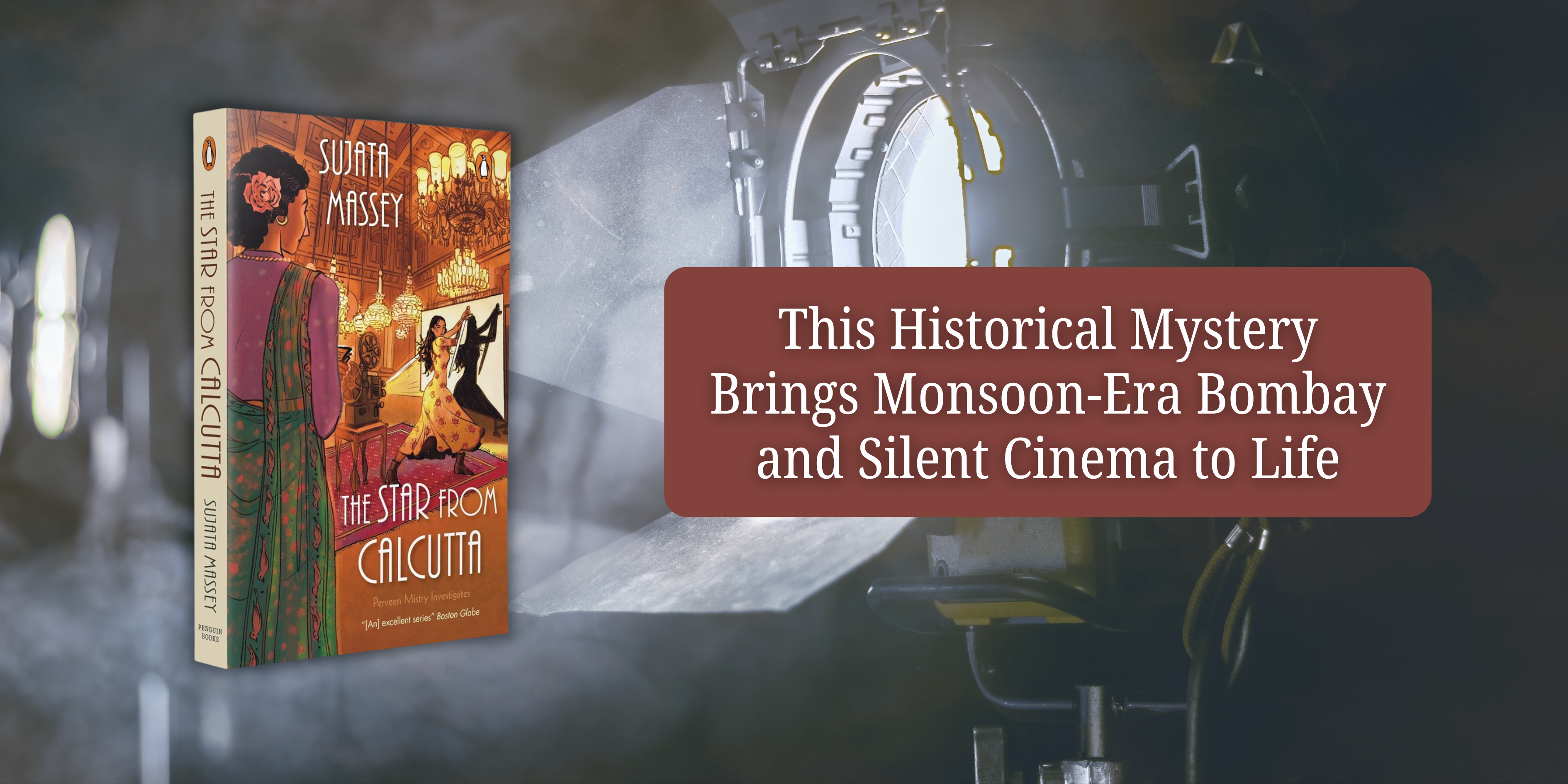
In The Star from Calcutta, Sujata Massey blends murder, monsoon-soaked Bombay and the frenzy of India’s silent film era into a historical mystery where every spotlight hides another secret.
***
CALL TO SET
Fall 1922
Sometimes Perveen Mistry felt like the only person in Bombay who didn’t care for the summer monsoon. Yes, the rain was a relief after springtime’s burning temperatures and thick humidity. A solid deluge was necessary for the life of plants and animals. Yet every year, from June through September, the ferocious rainfall brought floods that washed away shanties, houses, and even people. One couldn’t hang laundry in the morning without knowing whether it would be wetter by day’s end. Rainy season was like the worst legal opponent: someone with unlimited resources to draw out the battle.
Therefore, when Perveen awoke on a mid-September morning to a hammering sound on the roof, she was irritated. Three days had passed since she’d been able to get to the law office in South Bombay. She imagined a pile of damp, unread mail was moldering to bits inside. In that pile could be necessary work to finish . . . and perhaps a discreet letter from someone special.
She smiled, thinking of Colin Sandringham, in his flat close to the city center. By now, her secret paramour had probably finished his morning exercises and was either on to the newspapers or any one of the letters she’d sent him during the rainy season, when chance meetings between them seemed all but impossible. Resolutely, Perveen swung her feet from the bed down to the soft Agra carpet. She tied on the light summer-weight cotton dressing gown and trod along the black-and-white marble checkerboard hall and stairs.
The rain had been too fierce for the newspaper boy to come, so she had to make peace with rereading yesterday’s Bombay Chronicle and Samachar lying on the dining table. As usual, the family’s chief maid, Gita, had meticulously refolded the pages after her father’s inspection. Jamshedji Mistry, who was also the senior partner in their family law practice, always got the first read.
She wasn’t seated long before she heard the swift, soft footsteps of Hiba. The household’s baby-ayah carried in Khushy, who despite the early hour was already wearing a spotless white muslin frock and the creamy remnants of porridge on her cheek.
“Good morning!” Hiba greeted Perveen while placing the four-month-old on a small cotton mat on the floor for morning exercise. “Khushy’s glad to see her aunty’s come down. Rustom- sahib isn’t yet awake.”
Perveen smiled. Her older brother—Khushy’s father—was an infamous late sleeper. She picked up the small red ball that Hiba handed her and began rolling it back and forth with her bare foot—a morning exercise that benefited both aunt and niece, in a small way.
“Gah!” Khushy chortled, her tiny brown eyes fixed on the ball.
“Ball,” Perveen proclaimed in English, although the baby manual said that Khushy could not be expected to speak for several more months. “You are a clever one, aren’t you? Ba-a-all.”
After stretching out the word, she became suddenly uncomfortable.
“Let Khushy know her mother tongue,” Rustom had scolded Perveen and her parents at the dinner table a few nights earlier. The word “mother” had made Perveen wince, because Gulnaz, Rustom’s wife, was estranged from him and, at the moment, enjoying Paris with her parents. The fact was, the Mistrys had always spoken more English than Gujarati around the house—even Rustom himself. This was typical for ambitious Parsi families, who raised each generation to work and socialize closely with the British. Their staff, who were all from different religious and ethnic groups, spoke a mixture of English, Hindi, and Marathi.
Perveen kept rolling the ball as she turned to the newspaper. Amid advertisements for fail-proof umbrellas and anti-mildew powders, she saw a continuation of an article about the cotton market. Bombay’s chief commodity had lost value in recent years, and the impact of monsoon had been a slowing of orders worldwide. It was fortunate for the Mistry family that their specialty was in another field: construction. Perveen’s father, Jamshedji Mistry, had worked hard to persuade his family to let him take up the practice of law. But lawyers could work, regardless of weather, while her brother, Rustom, now in charge of the construction business, couldn’t keep his men working during the rains.
A sound in the hallway drew her attention away. Jamshedji Mistry had emerged from his study. It was his policy to be correctly dressed for a day of work, rain or shine. Today, he wore a lightweight gray wool suit that picked up the silver in his thick head of hair. Although fifty-four, he had the trim appearance and movements of a younger man.
***
Get a copy from Amazon or wherever books are sold!