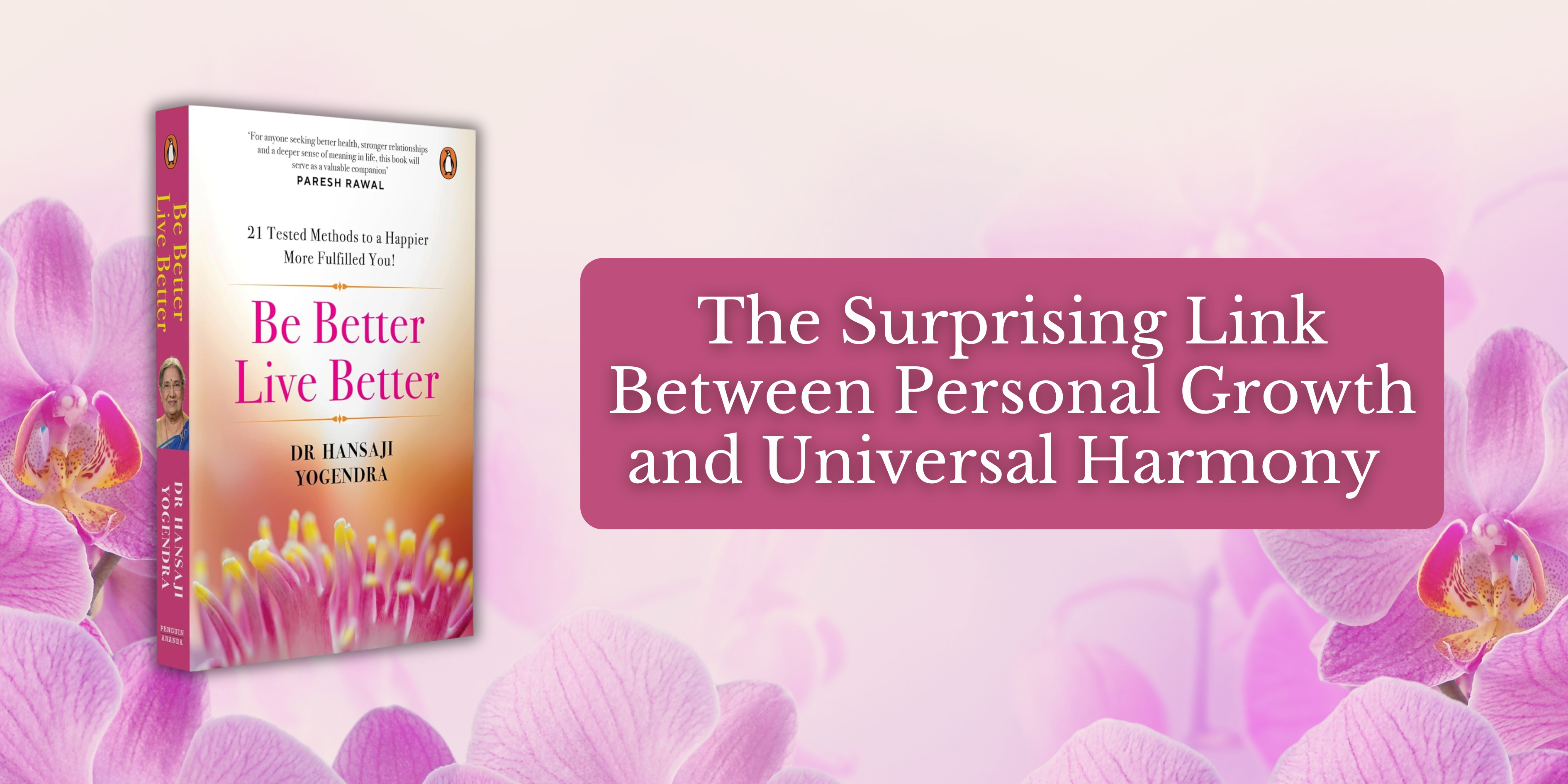
In Be Better, Live Better, Dr Hansaji Yogendra explores a powerful idea: that true happiness doesn’t come from chasing more, but from living in greater harmony with ourselves, with others and with life itself.
***
If you look closely enough, you will see that the universe is not a chaotic mess held together by chance. It is precise. Measured. Alive in its own way. It has its own survival instincts.
We often speak of evolution as a biological process. But existence itself evolves. The entire cosmos, from the tiniest particle to the largest galaxy, functions with remarkable balance. What continues to exist is that which fits into this larger harmony. What disturbs it fades.
Science has long pointed to something mysterious: the fine-tuning of the universe. If even one of the fundamental laws or constants of physics were altered just slightly, life could not exist. In fact, not even matter as we know it could hold together. There is a balance to everything.
It is deeply aligned with survival—not just for individual forms, but for the whole. And in this system, only what supports the balance, what adds to the stability of the whole, is allowed to stay. Everything else is either absorbed, transformed or dissolved. That is why what survives in this universe is not the strongest nor the fastest, but the most attuned.
Even destruction, when it happens, serves a purpose. Black holes consume, but in doing so, they also recycle. Supernovas explode, but in their death, they birth new elements that make life possible. The universe is not wasting anything. It is always, somehow, balancing itself.
So when we speak of stability, sustainability or harmony, we are not speaking in moral terms. We are speaking in universal terms. These are not human values. These are cosmic principles. The universe does not run on good or bad. It runs on what works.
And perhaps the real wonder is this: that we, as tiny fragments of this great whole, can even begin to sense this intelligence. Maybe our own longing for balance is not separate from the universe. Maybe it is the universe recognizing itself through us.
Among all that exists in the universe, living beings hold a unique position. Stones may rest, stars may burn, but it is life that breathes, grows, adapts and chooses.
We, as living beings, are not merely drifting particles in space. We are active participants in the unfolding of existence. But here is the truth: only those who contribute to that balance are sustained and supported by the universe. Like a tree that gives shade, a bee that pollinates or a mother who nurtures her young, when life supports life, it is preserved. It is allowed to thrive.
Imagine this universe as a vast ecosystem, or even a great company, if you will. In any thriving organization, those who add value, who contribute to growth and stability, are cherished. They are given more responsibility, more freedom, more opportunity. Those who don’t— who disrupt, consume or pull away from the collective purpose—are slowly phased out.
The universe works the same way.
It retains that which contributes to its harmony. It nurtures beings—plants, animals, humans—who participate in the symphony of balance. A forest that heals the earth will flourish. An animal that keeps an ecosystem in check will be preserved by nature. And a human who lives not just for personal gain but also in service of life, of growth and of others’ well-being will be supported by unseen hands.
In the Indian tradition, this principle is known as Dharma. It is not religion. It is not a duty imposed from outside. It is the inner alignment of a living being with the cosmic need. Dharma is that which holds, that which sustains. When a being—human or otherwise—functions in accordance with their dharma, the universe has a place for them. They are needed. They are upheld.
But when a life form becomes parasitic, when it consumes but does not contribute, takes but does not nurture, then slowly, over time, it loses its place in the larger scheme. Its presence becomes irrelevant to the grand balance, and nature lets it go.
So ask yourself: What does the universe want from me as a living being? It wants you to participate. To grow in a way that helps others grow. To live in a way that adds to the harmony. To think, speak and act in ways that stabilize, not disturb, this existence.
***
Get a copy from Amazon or wherever books are sold!