




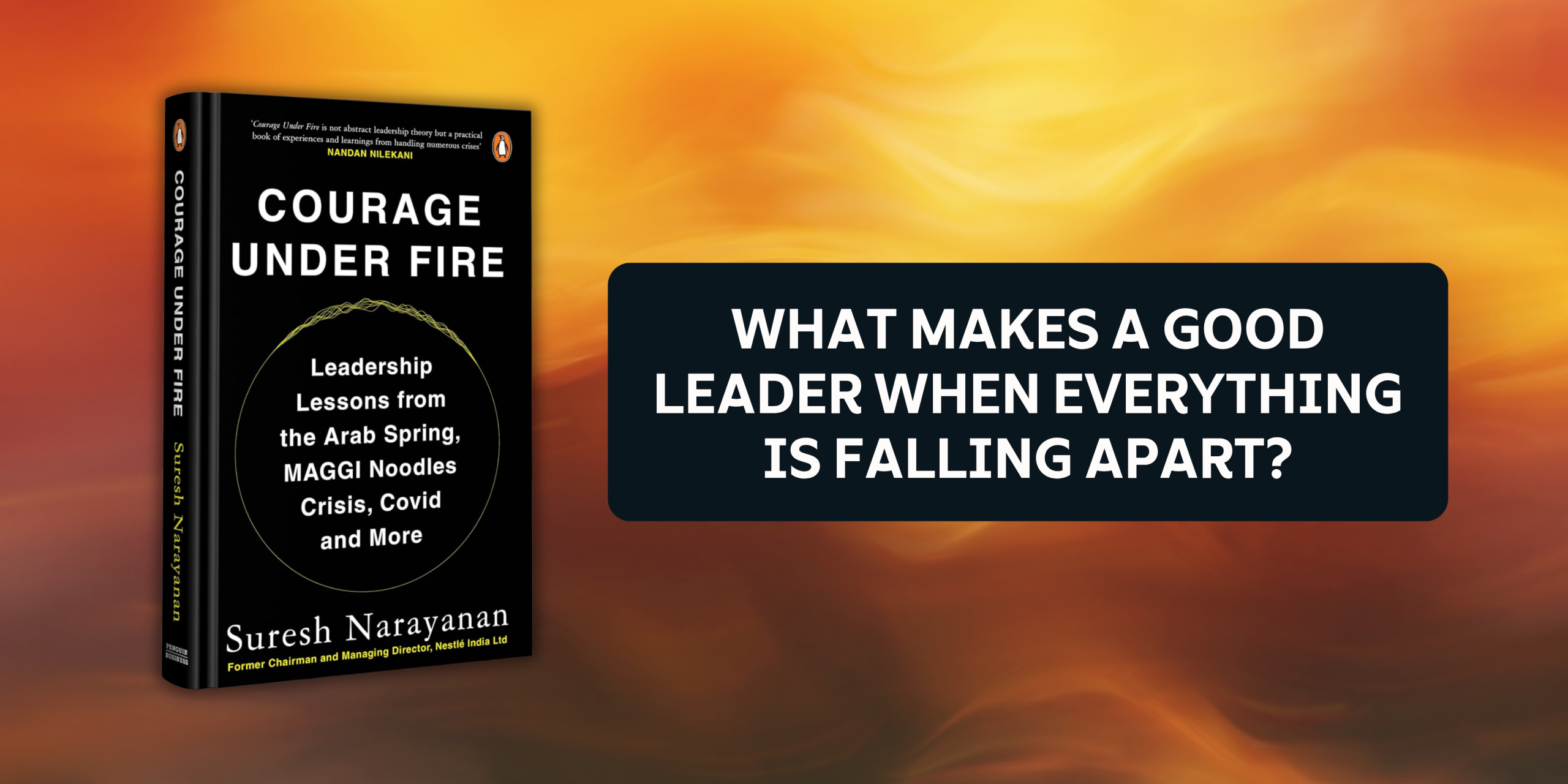
In Courage Under Fire, former Nestlé India Chairman Suresh Narayanan draws from four decades of experience to explore what leadership truly demands—especially when uncertainty is high and the stakes are even higher.

***
Why is leadership important? What makes someone a good leader? Is leadership a natural calling, or simply a role people learn to play? Are leaders born, or can leadership traits be developed over time?
All of these are meaningful questions. But for our purpose, we will focus on two:
What makes a good leader? And why is leadership especially important during a crisis?
At its core, leadership is simply about being human— consistently, in every situation, whether times are good or extremely difficult. When we strip away all the impressive titles and adjectives, leadership comes down to a few basics: trust, values, behaviour, credibility and outcomes.
Leadership starts with selfawareness. It is the ability to understand your own purpose, values, strengths and limitations. These inner foundations shape how you behave and how you make decisions. Over time, your actions—repeated again and again, day after day—form the basis of your leadership identity.
You can lead a team of ten or a team of ten thousand. In both cases, the impact you create can be hugely meaningful or barely noticeable. What matters is not the size of your team, but the depth of your influence—how you show up, how people experience you and how you help them navigate uncertainty.
In a crisis, this becomes even more important. People look to leaders for clarity, confidence and direction. A leader’s presence can steady a team the way a lighthouse guides a ship on a dark night.
Great leadership is not about position; it is about responsibility, authenticity and the ability to inspire trust— especially when it matters most.
When I travel, I often choose to visit colleges that are not considered ‘toptier’. Instead of A or A+ institutions, I make it a point to go to B or Crated schools. These places hold tremendous untapped potential—potential that often needs the right mentor, the right voice of encouragement, to come alive.
In my interactions with students from these institutions, I’ve noticed something important: there is very little difference between them and students from well known colleges. In fact, many from lesser known schools display more dedication, gratitude and enthusiasm. What they sometimes lack are opportunities and mentors who believe in them.
I experienced this again during a field visit from Jaipur to Kanauta in Rajasthan—a bumpy 40minute ride where I was accompanied by Soniya Ojha, a 25 yearold sales officer from Chhapra, in Bihar. Throughout the drive, she shared her story of leaving her small village and joining one of the world’s largest food and beverage companies. Her energy was infectious. At one point, she stopped and shyly asked, ‘Main kya bahut baat kar rahi hoon? Aap bilkul papa jaise ho’—’Am I talking too much? You remind me of my father.’
That simple, heartfelt moment reminded me how deeply young professionals value a guiding presence. It reinforced a powerful truth: mentorship matters. Even brief interactions can strengthen confidence, shape aspirations and help the next generation stay committed to their leadership journeys.
This is not to take away from premier institutes—they have produced many exceptional leaders. But experiences like these show that leadership is shaped far more by individual attitude and the mentors who influence that attitude, rather than the prestige of one’s institution.
An essential leadership trait is the willingness to take on difficult tasks. I am always impressed by young employees who volunteer for tough assignments. They show courage, initiative and a desire to grow. Mentors play a key role here, too—often, it is a leader’s belief in a young professional that gives them the confidence to raise their hand for the harder job.
Ultimately, whether in a classroom or a corporate field visit, I’ve learned that leadership potential exists everywhere. What unlocks it is mentorship, opportunity and the courage to take on challenges.