





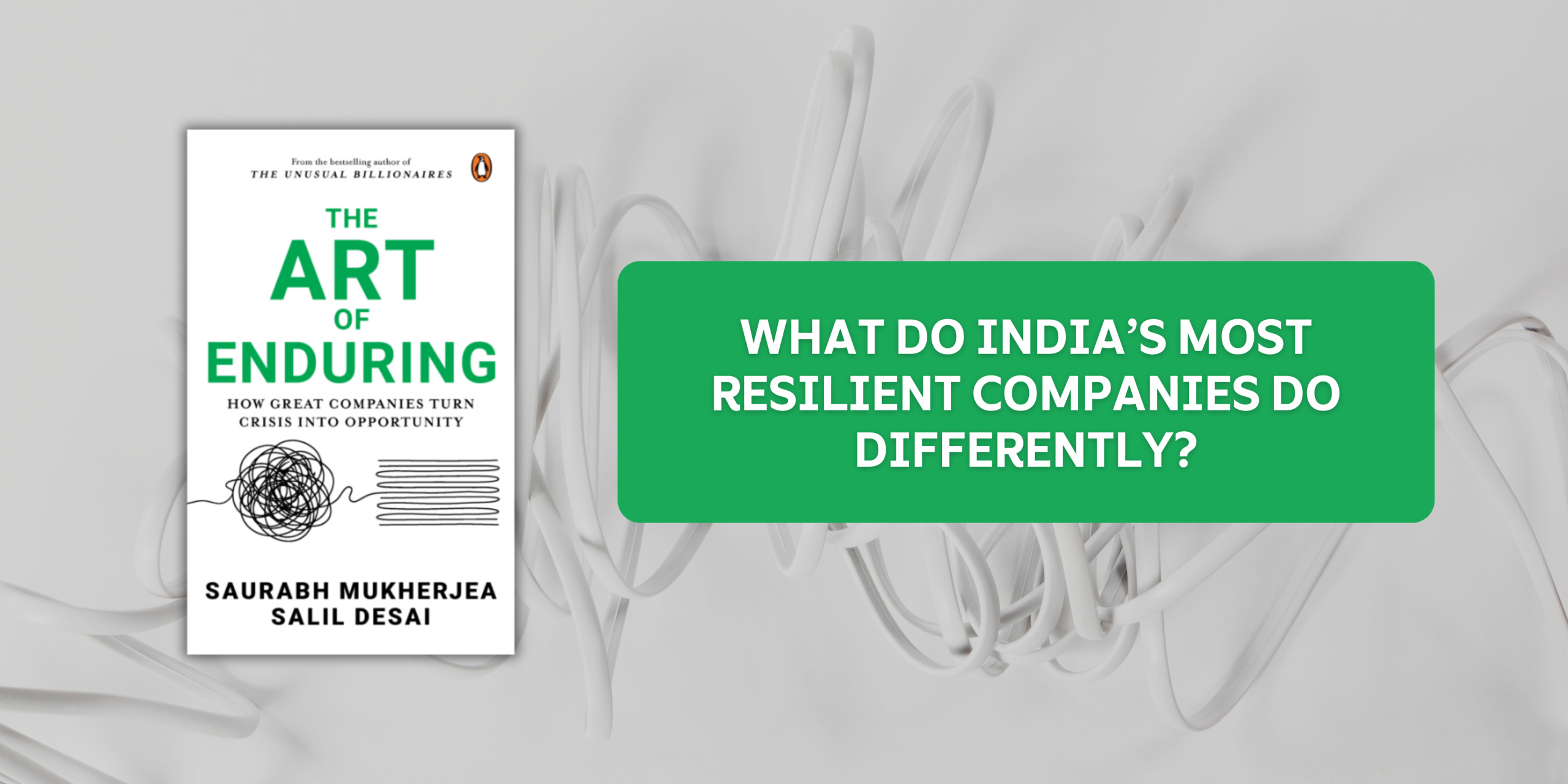
What separates a company that survives a crisis from one that emerges stronger because of it? In The Art of Enduring, bestselling author Saurabh Mukherjea and Salil Desai examine five remarkable Indian companies—Bajaj Finance, Titan, Dr Lal PathLabs, Divi’s Labs and Tata Elxsi—to uncover how they turned years of disruption into enduring competitive advantage.
***
Starting with Five Hundred
We start with the BSE500 index which comprises the largest 500 listed companies in terms of market capitalization. These companies represent the full spectrum of Indian industry, from steel and software to banks and beverages to chemicals and consumer goods. They represent a large enough sample with the ideal characteristics to which we can apply a standard measure of success or greatness. If greatness exists in corporate India, it should be found here.
From this elite group, we went looking for the truly exceptional. We applied filter after filter, each more demanding than the last. We asked: Which of these companies had generated returns on capital exceeding 15 per cent—not on average, not in most years, but in every single year for fifteen years? Which had grown faster than India itself, year after year, through demonetization and pandemics and wars? By the time we were done, 500 had become 51. And from those fifty-one, we chose five. This chapter explains how we found them—and why the filter had to be this brutal.
First Filter: Age
From our sample, the first filtering criterion we apply is age. We are looking for companies that have demonstrated solid financial performance over a long period of time—fifteen years in this case. It is therefore imperative that the companies themselves have been around for at least twenty-five years. So, as a first step, we eliminate all companies that are younger than twenty-five. This left us with 392 companies from the 500 we started with. These 392 companies span a wide spectrum of age—from about a dozen that are just about a quarter of a century old (like HDFC Asset Management, IndiaMart) to more than twenty that are older than a century (example, Indian Hotels, incorporated in 1902, or Berger Paints in 1923).
Second Filter: 15 per cent ROCE Hurdle—Every Single Year
In the next step, we use a set of three financial metrices to further shorten the list. Due to the differing nature of businesses, the metrics used for companies in the financial services sectors, such as banking, non-banking financial companies (NBFCs), insurance, etc., are different from those used for non-financial companies.
Let us start with non-financial companies, which are 332 in number from the 392 that cleared the age filter. The first metric we filter on is Return on Capital Employed (ROCE). As in The Unusual Billionaires, we set a minimum threshold of 15 per cent for the ROCE that a company must generate to make the cut. To make sure we select only the best of the best, we want a company that earned a ROCE higher than 15 per cent throughout the entire reference period—that is, in each of the fifteen years in our reference period. Applying this criterion shortens the list of non-financial companies from 332 to 73.
Why a 15 per cent ROCE threshold?
ROCE is what a company earns on the aggregate equity and debt capital invested in the business. Both equity and debt come at a cost and hence, for any company to create value, it is necessary for them to be generating a return that is higher than the cost of capital. The cost of debt is usually easy to determine and is the rate at which lenders are willing to provide funds to the company. The risk-free rate in India, as represented by the ten-year government security is about 6.5 per cent. Lending to corporates would naturally not be risk-free and they end up borrowing at higher rates. The State Bank of India’s Marginal Cost of Funds-based Lending Rate (MCLR†) is a good proxy for the rate at which an average business in India can borrow. The three-year MCLR in the recent past has been in the range of 8.5–9 per cent and is our proxy for the cost of debt.
The cost of equity can be measured in different ways, but a straightforward one is to first see what equity investors have earned from the broader market over a long period of time. That is because the returns from simple index investing is the minimum an investor in equities would expect. That becomes their opportunity cost of capital for providing equity capital to a company. Thus, long term index returns are a good proxy for the equity cost of capital. The total return from indices such as the Nifty or the Sensex has ranged between 12 and 15 per cent over the long term. And hence, the cost of equity must be in a similar range.
***