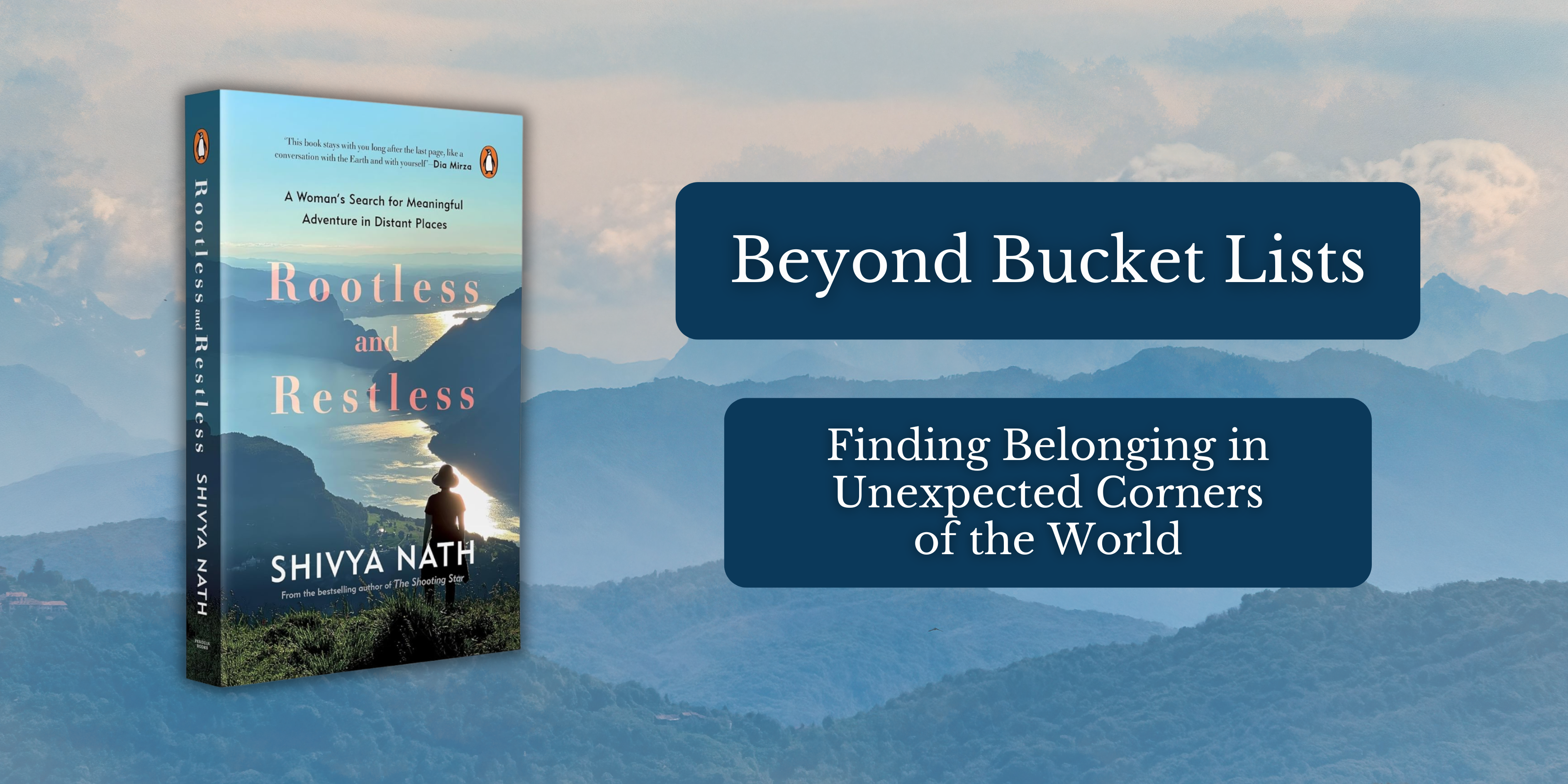
If you’ve ever wondered whether travel can truly change a person, Shivya Nath in Rootless and Restless offers a compelling answer through stories of friendship, adventure and discovery from some of the world’s most remote corners.
***
Perhaps the night I remember most fondly in Isfahan was our last one, when Amir’s mother and brother whipped up a vegan Persian feast for us, featuring the ubiquitous and scrumptious ghormeh sabzi, kebabs made from sprouted wheat and a sumptuous Instagram-inspired gooey chocolate cake. We sat at the dinner table till late at night, chatting about life in Iran and India and everything beyond. By now, I had noticed many times that Iranians of Amir’s mother’s generation, even though their words betrayed them, had a pervasive sadness in their eyes. Having experienced a much freer life in Iran before the revolution, these times must feel like wounds that never healed.
She didn’t talk a lot that night, so I was surprised to see her change the subject and say how much she loved Bollywood music. Could we play one of our favourite songs for her? I chose the sombre and somewhat apt ‘Kal Ho Naa Ho’ (a modern Bollywood classic on the transient nature of life) on my phone, but she said it was too dull. Could we play something upbeat? Well, the only upbeat Bollywood song I could find on my phone was ‘London Thumakda’ from the film Queen! As the late Labh Janjua’s voice bellowed on my phone speaker, the mood changed. ‘Angrezi padhdi, ghit-pit tu kardi . . .’ She got up, turned off the bright lights and let her body follow the beat. Soon, she was dancing with a fervour that spread through all of us. We danced together with careless abandon, to song after exuberant Bollywood song, like friends reunited aft er a long separation. What a night it was.
In his book Th e Discovery of India, Jawaharlal Nehru, India’s former Prime Minister, quotes an Iranian scholar:
‘The Iranians and Indians are like two brothers who, according to a Persian legend, had got separated from each other, one going east and the other to the west. Th eir families had forgotten all about each other and the only thing that remained in common between them were the snatches of a few old tunes which they still played on their flutes. It was through these tunes that, after a lapse of centuries, the two families recognised each other and were reunited.’
That night, it felt as though we had recognized the tunes in each other’s hearts.
We were in no mood to bid goodbye to our new-found friends in Isfahan, but our visa was running out. During our after-dinner readings with Ali, I had once asked him if I could buy a scroll or piece of Persian poetry or calligraphy as a keepsake. Something that captured a line or two of the words he’d read to us. He promised to look into it, but as the days went by, he seemed to have forgotten the ask, and I did too. On our last day however, he surprised me with a scroll of Persian poetry. It was Saadi’s words, and they read:
Shab o rooz raft bayad, qadam-e ravandegan ra
Cho be ma’mani residee, degarat safar nabashad
Th e traveller’s footsteps should always be on the go
So if you reach a shelter, you’re not a traveller, no more
With no home to hang it, I carried it in a folder in my backpack for some years, a reminder not just of the wanderer’s ways, but of the howzkhaneh life we had shared with our friends in Iran. Ironically, when the pandemic hit, and I found myself confi ned to one place, I had the words framed and hung on my wall. A traveller no more.
And so, carrying on in the wanderer’s ways, we once again embraced heartache-fi lled goodbyes and long bus journeys. We only had a few more days to make it to the Armenian border.
***
Get a copy from Amazon or wherever books are sold!