Publish with Us

Follow Penguin

Follow Penguinsters

Follow Penguin Swadesh

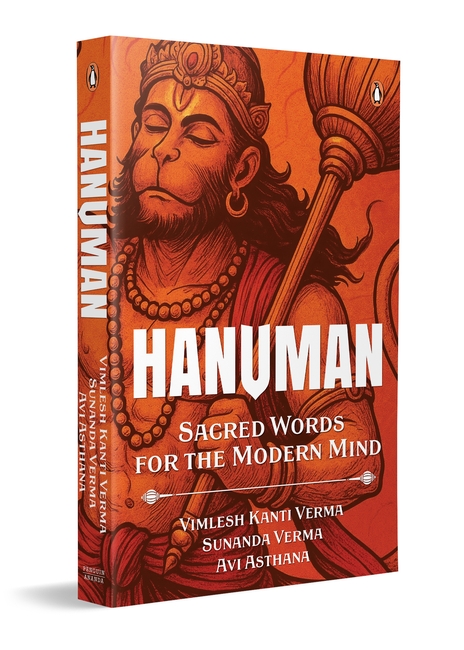
Hanuman: Sacred Words for the Modern Mind

Hanuman: Sacred Words for the Modern Mind

I Hanuman Chalisa, Sundarkand, Sacred Texts with Hindi–English Meaning for Daily Reading

Vimlesh Kanti Verma
,
Sunanda Verma
,
Avi Asthana
Select Preferred Format
Buying Options
Paperback / Hardback

A complete and comprehensive collection of the sacred texts of Hanuman
Hanuman is revered across India and is the deity in whom people place the greatest faith, honouring him as Sankatmochan, the one who liberates from all kinds of hardships and suffering. In moments of distress, his name is the first to be invoked.
This book brings together all major sacred texts related to Hanuman in one place, offering both their Hindi and English translations and the phonetic transliterations of the original texts. An index of the dohas and chaupais of the Sundarkand is provided to help readers locate references.
Additionally, this book explores fascinating questions about Hanuman, such as why Rama declared him greater than himself, the stories behind when and why Tulsidas composed the Hanuman Chalisa and Hanuman Bahuk, the number of Sundarkands Tulsidas wrote, why it is called Sundarkand and the significance of performing aarti after prayer, among others.

Imprint: India Penguin Ananda

Published: Jan/2026

ISBN: 9780143478324

Length : 368 Pages

MRP : ₹699.00

Hanuman: Sacred Words for the Modern Mind

I Hanuman Chalisa, Sundarkand, Sacred Texts with Hindi–English Meaning for Daily Reading

Vimlesh Kanti Verma
,
Sunanda Verma
,
Avi Asthana

A complete and comprehensive collection of the sacred texts of Hanuman
Hanuman is revered across India and is the deity in whom people place the greatest faith, honouring him as Sankatmochan, the one who liberates from all kinds of hardships and suffering. In moments of distress, his name is the first to be invoked.
This book brings together all major sacred texts related to Hanuman in one place, offering both their Hindi and English translations and the phonetic transliterations of the original texts. An index of the dohas and chaupais of the Sundarkand is provided to help readers locate references.
Additionally, this book explores fascinating questions about Hanuman, such as why Rama declared him greater than himself, the stories behind when and why Tulsidas composed the Hanuman Chalisa and Hanuman Bahuk, the number of Sundarkands Tulsidas wrote, why it is called Sundarkand and the significance of performing aarti after prayer, among others.

Buying Options
Paperback / Hardback

Vimlesh Kanti Verma

Vimlesh Kanti Verma, DPhil, FRAS (London), is a distinguished indologist and senior linguist with over five decades of teaching experience in applied linguistics. He has taught at the University of Delhi, the University of Toronto, the University of Sofia and the University of the South Pacific. His work has been recognized with major honours, including the Mahapandit Rahul Sankrityayan Award conferred by the President of India and the Hindi Videsh Prasar Samman from the Government of Uttar Pradesh. He has also been honoured twice by the Government of Bulgaria with its national awards, the 1300 Bulgaria and the Zlatna Lavrova Klonka. His website is www.vimleshkanti.org.

Sunanda Verma

Sunanda Verma is a cross-cultural global storyteller exploring diversity and connection. Born in Bulgaria, raised in Fiji and India, and nurtured in South Africa and Singapore, she is a translator, documentary film- maker and former television news producer, the author of the Namaste! series of books and Hindu Gods and Goddesses: An Introduction, and co-editor of Index: Sriramacaritamanasa of Goswami Tulasidasa and the Learner’s Hindi–English Thematic Visual Dictionary. Her writings on the Indian diaspora explore questions of identity, belonging and the emotional ties that bind language, memory and culture. Her website is www.sunanda.net.

Avi Asthana

Avi Asthana is an engineering student at Imperial College London, and has a deep interest in language, technology, innovation and cultural preservation. His work in phonetic transliteration enhances linguistic accessibility, making sacred texts more approachable across scripts.

error: Content is protected !!