Publish with Us

Follow Penguin

Follow Penguinsters

Follow Penguin Swadesh

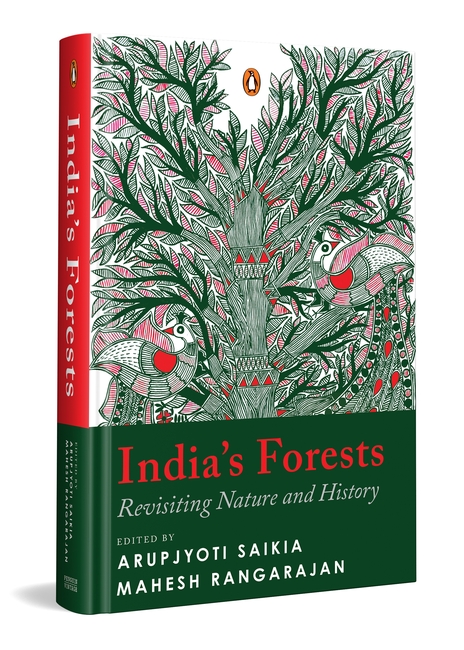
India’s Forests

India’s Forests

Revisiting Nature and History

Arupjyoti Saikia
,
Mahesh Rangarajan
Select Preferred Format
Buying Options
Paperback / Hardback

India’s Forests brings together essays by some of the country’s leading scholars with a fresh view of nature and history. These reappraisals of Indian forests and their many lives in past and present matter more than ever today.
Born of years of sustained reflection, the essays here view forests not as passive unchanging backdrops to the past but as living, contested spaces.
Forests were shaped and in turn deeply influenced by power, culture and society. They could mean very different things to different people who often were in contest over meaning as much as control of the space or the resource.
The volume spans from prehistory through ancient and early modern India into the present. It is also alive to the impact of the colonial era while tracing the changing fortunes of tribal and hill peoples.
They are ecological lifelines and sites of legend, memory, and scientific knowledge. Material remains and life cycles of animals and plants matter, so too do social and literary imaginations.
Forests have been continually redefined through conflict, negotiation, and care. Attentive to the changing meanings across time and place, the book asks us fundamental and unsettling questions: what are forests for?
India’s Forests will inform as well as stimulate thought for all who are concerned with the fate of forests now as much as about the country’s past.

Imprint: Vintage Books

Published: Feb/2026

ISBN: 9780143473206

Length : 360 Pages

MRP : ₹999.00

India’s Forests

Revisiting Nature and History

Arupjyoti Saikia
,
Mahesh Rangarajan

India’s Forests brings together essays by some of the country’s leading scholars with a fresh view of nature and history. These reappraisals of Indian forests and their many lives in past and present matter more than ever today.
Born of years of sustained reflection, the essays here view forests not as passive unchanging backdrops to the past but as living, contested spaces.
Forests were shaped and in turn deeply influenced by power, culture and society. They could mean very different things to different people who often were in contest over meaning as much as control of the space or the resource.
The volume spans from prehistory through ancient and early modern India into the present. It is also alive to the impact of the colonial era while tracing the changing fortunes of tribal and hill peoples.
They are ecological lifelines and sites of legend, memory, and scientific knowledge. Material remains and life cycles of animals and plants matter, so too do social and literary imaginations.
Forests have been continually redefined through conflict, negotiation, and care. Attentive to the changing meanings across time and place, the book asks us fundamental and unsettling questions: what are forests for?
India’s Forests will inform as well as stimulate thought for all who are concerned with the fate of forests now as much as about the country’s past.

Buying Options
Paperback / Hardback

Arupjyoti Saikia

Arupjyoti Saikia is a professor of history at the Indian Institute of Technology Guwahati. He held the Agrarian Studies Programme Fellowship at Yale University and visiting fellow positions at Cambridge University and School of Oriental and African Studies, University of London.

Saikia is the author of Forests and Ecological History of Assam, 1826-2000 (OUP, 2011), A Century of Protests: Peasant Politics in Assam since 1900 (Rutledge, 2014) and The Unquiet River: A Biography of the Brahmaputra (OUP, 2019). His A Century of Protests won the Srikant Dutt book prize awarded by the Nehru Memorial Museum and Library, New Delhi in 2015. The Unquiet River was short-listed for Kamala Devi Chattopadhayay Book Award in 2020 and long listed for Atta Galatta-Bangalore Literature Festival Book Prize in 2020 and got ‘Honorable Mention’ for Ananda Kentish Coomaraswamy Book Prize in 2021 given by the Association of Asian Studies.

Mahesh Rangarajan

More By The Authors

error: Content is protected !!