Africans are the fastest-growing immigrant group to the United States. Only a tiny fraction in the 1960s, they represented ten percent of documented immigration in 2022. Without attracting much notice, immigration from Africa has the potential to change American society for the better.
This book provides an expert analysis of the myths and realities surrounding African immigration today. Neeraj Kaushal argues that in the second half of the century, Africans will account for the largest share of immigrants to the United States. Challenging the view that African emigration is driven by poverty, war, and disaster, she demonstrates that the continent’s sizable and growing middle-class has both the aspirations and the means to relocate. First- and second-generation African immigrants are often highly skilled, and the children of Black African immigrants reach higher educational attainment than US-born whites and earn comparable incomes.
Kaushal explores the political, economic, and demographic consequences, considering to what extent African immigrants can overcome American racial hierarchies and how their presence might change what it means to be Black in America. Through eye-opening empirical data, this book makes an optimistic case that the United States will continue to be a nation of immigrants.

Whether you are a newly minted MBA or a project manager at a Fortune 500 company, data science will play a major role in your career. Knowing how to communicate effectively with data scientists in order to obtain maximum value from their expertise is essential. This book is a compelling and comprehensive guide to data science, emphasizing its real-world business applications and focusing on how to collaborate productively with data science teams.
Taking an engaging narrative approach, Winning with Data Science covers the fundamental concepts without getting bogged down in complex equations or programming languages. It provides clear explanations of key terms, tools, and techniques, illustrated through practical examples. The book follows the stories of Kamala and Steve, two professionals who need to collaborate with data science teams to achieve their business goals. Howard Steven Friedman and Akshay Swaminathan walk readers through each step of managing a data science project, from understanding the different roles on a data science team to identifying the right software. They equip readers with critical questions to ask data analysts, statisticians, data scientists, and other technical experts to avoid wasting time and money. Winning with Data Science is a must-read for anyone who works with data science teams or is interested in the practical side of the subject.

Budding entrepreneurs face a challenging road. The path is not made any easier by all the clichés they hear about how to make a startup succeed—from platitudes and conventional wisdom to downright contradictions.
This witty and wise guide to the dilemmas of entrepreneurship debunks widespread misconceptions about how the world of startups works and offers hard-earned advice for every step of the journey. Instead of startup myths—legends spun from a fantasy version of Silicon Valley—Rizwan Virk provides startup models—frameworks that help make thoughtful decisions about starting, growing, managing, and selling a business. Rather than dispensing simplistic rules, he mentors readers in the development of a mental toolkit for approaching challenges based on how startup markets evolve in real life.
In snappy prose with savvy pop-culture and real-world examples, Virk recasts entrepreneurship as a grand adventure. He points out the pitfalls that appear along the way and offers insights into how to avoid them, sharing the secrets of founding a startup, raising money, hiring and firing, when to enter a market and when to exit, and how to value a company.
Virk combines lessons learned the hard way during his twenty-five years of founding, investing in, and advising startups with reflections from well-known venture capitalists and experts. His candid advice makes Startup Myths and Models an ideal guide for those readers just embarking on the startup life and those looking for their next adventure.

Our brains are wonderful tools, but they are nonetheless prone to misjudging information and making suboptimal decisions. In many situations, we act without fully considering why we are behaving in a certain way. We like to feel good about ourselves; we interpret the world using stories instead of statistics; and we make instinctive judgments and then stick to them. How can we think more clearly and make better decisions—in business and in life?
This book is a practical and accessible introduction to mental models, teaching readers how to harness their power to think more clearly, make better decisions, and learn more effectively. The essential step in applying these concepts and frameworks, Jaime Lester shows, is to pause. Take a moment to reflect on the options, decide on the optimal approach before launching into action, and reexamine the process regularly. Drawing on a variety of academic disciplines as well as cognitive and behavioral research, Lester offers step-by-step templates to improve readers’ critical thinking and decision making. He guides readers through honing their reasoning in areas including finance, economics, statistics, and daily life and draws broader lessons for cultivating a prudent investment approach as well as personal well-being and happiness. Written in a conversational and witty style and featuring memorable examples and illustrations, Pause to Think shares essential lessons and tools for all readers interested in the power of mental models.
What do Warren Buffett and Friedrich Nietzsche have in common? Why does Baruch Spinoza’s understanding of irrational emotions help explain financial markets? How did Voltaire’s success in a bond lottery arbitrage shape his writing? Can David Hume teach an investor when to buck the consensus and when to heed it?
Exploring these questions and many others, Ethan A. Everett reveals the surprising lessons we can learn about investing from major philosophers. Demystifying ideas and texts that can often seem intimidating or irrelevant, he shows how philosophical concepts can be fruitfully applied to financial markets. Everett shares how philosophers’ insights have informed his development as an investor, and he considers how great investors have embodied philosophical wisdom in their own endeavors.
Inviting and engaging, The Investment Philosophers presents evergreen insights in language that is accessible to readers who are beginning their journeys in finance and philosophy. Ranging from the birth of modern securities markets in seventeenthcentury Amsterdam to recent trends like meme stocks, this book shows why a philosophical perspective can prove invaluable to challenging common assumptions in finance.
Hackathons—participatory gatherings in which people with various backgrounds and experiences come together to address a challenge or create something new in a limited period of time—have become an important part of today’s technological, social, and business landscapes. They originated in IT and have since spread into other fields including medicine, law, biology, environment, education, and civic engagement. How and why can hackathons drive innovation? How can they challenge the status quo? What role can they play in an organization’s strategy? Under what conditions are hackathons most effective, and what are their limitations?
Maciej Ryś—a hackathon leader and scholar with extensive experience in the field— offers a step-by-step guide to organizing successful hackathons and understanding their dynamics. He examines the evolution of hackathons from niche programming marathons to versatile platforms fostering technological advancements, entrepreneurial ventures, and social change. Drawing on extensive research, including observations and interviews from dozens of events worldwide, this book provides data-driven insights into the hackathon ecosystem. Ryś shares practical lessons for organizers, participants, and mentors ranging from planning to inclusivity and sustaining momentum afterward, emphasizing both individual and group levels. Readers will learn how to build better hackathons that attract more participants, and they will gain a deeper understanding of the dynamics of innovation. For both hackathon veterans and those new to the field, Sparks for Innovation helps readers develop new skills, discover new possibilities, and achieve new breakthroughs.
Will we one day inhabit virtual worlds? From the buzz around Second Life in the early 2000s to Mark Zuckerberg’s much-hyped quest for the Metaverse, there seems to be a clear pattern. After being touted as revolutionary, virtual worlds fail to meet expectations and fade into obscurity. Yet the dream of an immersive, independent, and interconnected virtual social universe still has the potential to transform the economy, reshape society, and profoundly affect the future of humanity.
This book contends that despite shifting trends, the virtual universe remains crucial to the technology of tomorrow—and might arrive sooner than we think. Through vivid examples and detailed case studies, Andreas Kaplan, a pioneering researcher of virtual worlds since the early 2000s, provides a comprehensive examination of the Metaverse and its far-reaching implications. He delves into key technologies such as artificial intelligence, blockchain, and extended reality and discusses ethical issues around privacy, identity, and governance. Kaplan examines business models, digital ownership, and corporate strategies alongside applications spanning marketing, research and development, human resources, and supply chain management. The book concludes by contrasting potential futures, from utopian promise (the Petaverse) to dystopian peril (the Metaworse) and everything in between. Written in an engaging, reader-friendly style, The Virtual Universe goes beyond the hype—and the doubting—to uncover the true potential of the Metaverse.

To be successful as an investor, one needs a framework. And no investing framework works without numbers. Although quantitative methods can be intimidating, they provide a major boost to the quality of analysis. Written for readers without a technical background, Finding Value in Numbers is an engaging and practical guide to how thoughtful investors can use numbers—not just for the sake of crunching data but for making better decisions.
Using a value investing perspective, Ehsan Ehsani shows how to deploy quantitative tools to identify and analyze investment prospects, demystifying the math that points to overlooked opportunities in the stock market, other securities, and beyond. Numbers help us grasp what a company is worth and why: the quality of a business, the durability of its competitive edge, and the reasonableness of its price. Combining practical frameworks with real-world examples, Ehsani walks readers through key concepts that enable robust analysis while explaining how to spot red flags. Along the way, he reveals how a disciplined, numbers-based approach can support both conviction and patience—two traits every successful investor needs. Blending quantitative insight with timeless investing wisdom, Finding Value in Numbers is an essential book for aspiring and professional investors looking to hone their skills as well as curious readers drawn to the inner workings of markets.
Many companies claim to prize innovation but struggle to support it in practice. CEOs call innovation their number-one priority in surveys, yet their employees say they are frequently frustrated in their efforts to create change. The biggest reason for this disconnect? Playing it safe. Leaders and organizations want to implement new ideas, but too often they are held back by the fear of failure, even though setbacks are intrinsic to the innovation process.
In No Fear, No Failure, Lorraine H. Marchand shows readers how to overcome the status quo that stifles creative thinking and to create a culture that encourages innovation. She provides a framework for sustained growth built on the “5C’s”: Customer First, Culture, Collaboration, Change, and Chance. Drawing on more than 120 interviews with leaders across industries, real-world case studies, and firsthand experience, Marchand demonstrates how to spark lasting transformation. She shares field-tested strategies, tactics, and tools that practitioners can use to embed creativity within organizational cultures, leverage innovation to ensure better results, and future-proof a company for the long haul. Practical and inspiring, No Fear, No Failure is a step-by-step guide for organizations of every type and size to drive growth by fostering a culture of innovation.
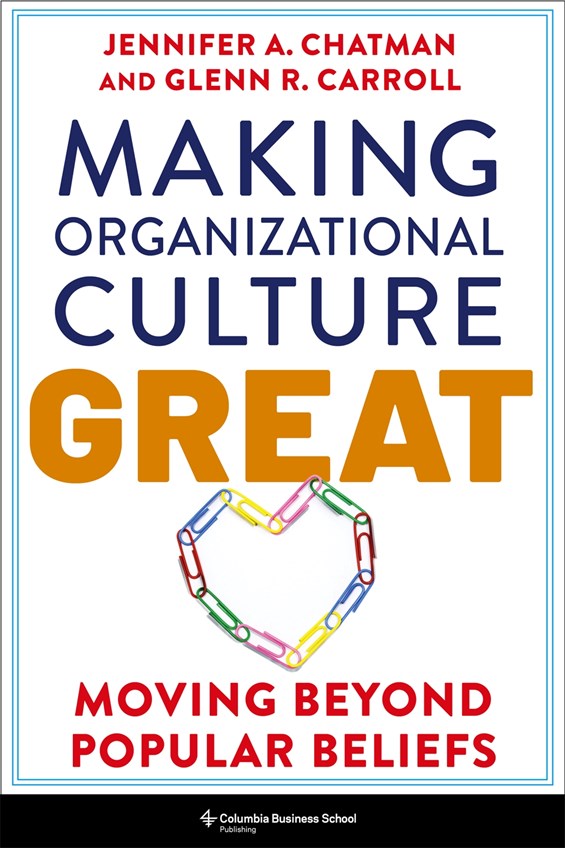
Leaders remain skeptical about the power of organizational culture even though extensive research shows that it is crucial to business success. Can a manager really influence an organization’s culture, or do executives just try to impose a culture on their employees? Is the concept of culture too vague to measure objectively and improve? What happens to valuable employees who feel left out by the prevailing culture? Even if a “good” culture makes team members happy, does it actually affect the bottom line?
This essential book answers the biggest questions about organizational culture, offering research-backed insights for leaders on shaping and managing an environment that spurs achievement. The management experts Jennifer A. Chatman and Glenn R. Carroll—a psychologist and a sociologist—draw on social-scientific findings to evaluate and debunk common misconceptions. They show how research on culture empowers managers to identify what really matters and deploy it productively. Chatman and Carroll also provide actionable levers to build and maintain organizational culture, from crafting a culture that supports strategic objectives to ensuring that it can adapt as conditions change.
Making Organizational Culture Great features compelling examples from companies and nonprofits including Apple, Genentech, Disney, Ford, Netflix, Maersk, Google, Cisco, Southwest Airlines, and many others. A practical guide for current and aspiring leaders, this book reveals how to manage culture consistently, comprehensively, and coherently.