Today, we are confronted with a lot of compelling career options, but with little guidance. The new age engagement models, such as working-from-home, freelancing, gig-workforce, moonlighting, co-working spaces, solopreneur and entrepreneur-in-residence, have ushered significant flux in both the formal and informal work settings. There are opportunities galore, and the democratization of technology has only exacerbated our quest for the most suitable career.
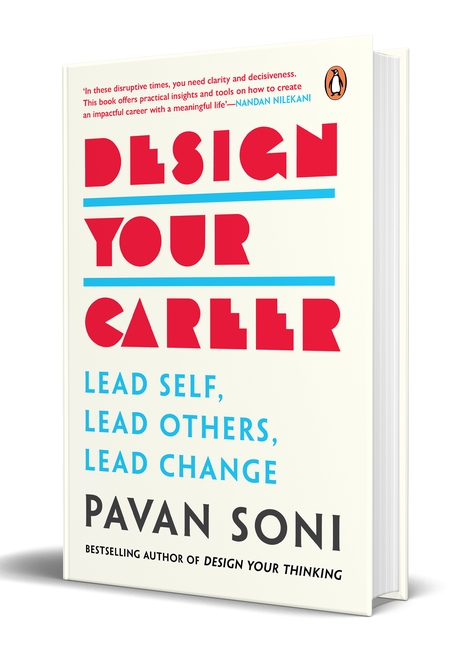
Design Your Career is the distillation of Pavan’s 550 workshops at over 175 organizations across five countries where he infers that human talent is grossly underutilized. This book is a humble attempt in offering hope and clarity to individuals who feel helpless amid all the chaos and to give them the appropriate tools and frameworks to guide their careers towards fulfilment.

Ro Krishna is the American son of Indian parents, educated at the finest institutions, equally at home in London’s poshest clubs and on the squash court, but unmoored after he is dramatically forced to leave a high-profile job under mysterious circumstances. He decides it’s time to check in for some much-needed R&R at Samsara, a world-class spa for the global cosmopolitan elite nestled in the foothills of the Indian Himalayas. A person could be spiritually reborn in a place like this. Even a very rich person.
But a person—or several—could also die there. Samsara is the Sanskrit word for the karmic cycle of death and rebirth, after all. And as it turns out, the colorful cast of characters Ro meets—including a misanthropic politician; an American movie star preparing for his Bollywood crossover debut; a beautiful heiress to a family fortune that barely survived Partition; and a bumbling white yogi inexplicably there to teach meditation—
harbors a murderer among them. Maybe more than one.
As the death toll rises, Ro, a lawyer by training and a sleuth by circumstance, becomes embroiled in a vicious world under a gilded surface, where nothing is quite what it seems . . . including Ro himself. Death in the Air is a brilliant, teasing mystery from a remarkable new talent.

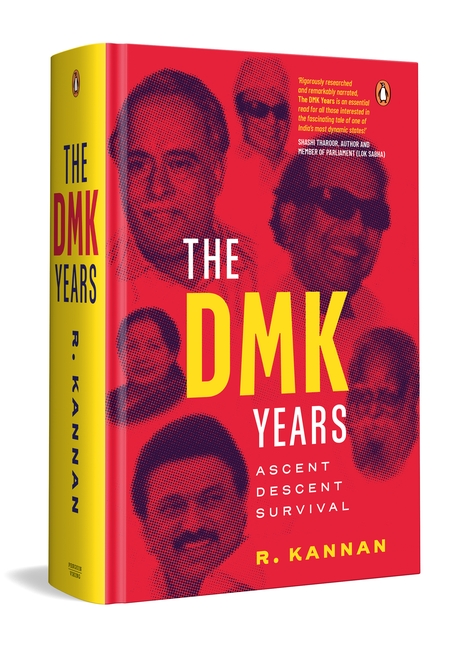
On 17 September 1949, C.N. Annadurai (Anna) founded the DMK after his split with Periyar E.V. Ramaswamy. The DMK slowly but surely caught the imagination of the Tamil masses. In 1962, faced with the prospect of a ban, the party shed its separatist agenda and in 1967, the DMK attained power for the first time in Tamil Nadu. Since then, it has remained a potent political force, first under M. Karunanidhi and recently under M.K. Stalin, who succeeded him.
Weathering many a political storm, including the 1972 split when its mascot, M.G. Ramachandran (MGR) broke away levelling corruption charges, its ejection from power in 1976 during the Emergency, the second dismissal in 1991 for its alleged dalliance with the Tamil Tigers of Sri Lanka, and the debilitating split in 1993, the party has proved resilient. It was voted back to power in Tamil Nadu in 2021.
The DMK’s pioneering public distribution system and welfare populism have been a model for other states. Of late, the party has touted its ‘Dravidian Model’ of development as a viable national alternative. Its renewed emphasis on Tamil cultural nationalism and cooperative federalism aims to counter the current majoritarian political narrative.
Yet, seventy-five years later, the DMK is more than ever under assault from caste and ultra-nationalist elements and persisting charges of unjust enrichment and dynastic politics.
At this pivotal moment in history, as the ethos of Indianness is being redefined, veteran political observer and commentator R. Kannan explores the trajectory of the DMK and its future direction. Drawing on a substantial body of first-hand accounts, The DMK Years narrates the story of the party objectively and in its entirety, making this volume essential to understanding the contours of Tamil Nadu politics.

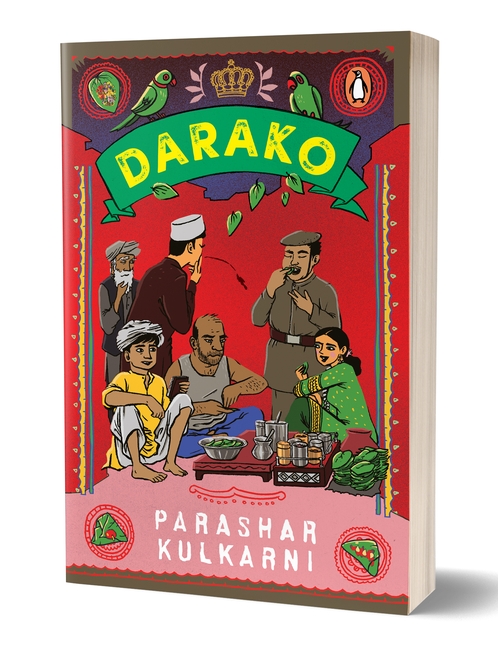
Brave and funny, set in colonial India, Darako features a paanwallah and his secrets, a spitting competition that grows to be a massive affair attracting talents from everywhere, an Afghan rebel who is a star spitter and a mystic, gun-running during the freedom struggle, a daylight murder and a tangy romance amidst the utter chaos. In this world, up is down, and down is up. With laugh-out-loud moments and a clever play with language, song and history, Darako uses satire to comment on religion, identity and freedom.
Dear reader,
If you have a heart, you will fall in love. And chances are, someone will end up breaking your heart. I wrote this book after someone broke mine.
What do you do when the only person you’ve ever loved with your whole heart decides to leave your life? You keep trying to run away from the hurt, but to no avail. This book is a product of all the running I did from heartbreak.
I feel everything too deeply, and when my heart broke, I collected all the broken pieces, and they fueled my art. This book is everything I wrote after someone I loved left me.
There’s too much heartbreak in these pages, but also too much hope and, more than anything, a promise that life can’t always hurt you.
I hope healing finds its way to you soon.
Love,
Rithvik
Renowned as a titan in global finance, Mark Mobius unveils a comprehensive guide to mastering the intricate landscape of financial investments. Drawing from his illustrious career spanning emerging markets and beyond, Mobius, with unparalleled expertise, demystifies the various financial instruments one can use to start their investing journey. From stocks and bonds to alternative assets, this book serves as an indispensable road map for understanding the diverse avenues of wealth creation. Dive into Mobius’s wealth of knowledge as he provides insightful descriptions and analyses of different investment tools, offering young investors a solid foundation for making informed financial decisions.
This book presents a brilliant reading of the unanimous decision of the nine-judge bench of the Supreme Court of India in the case of Justice KS Puttaswamy (Retd.) and Another vs. Union of India and Others (‘Puttaswamy’). The 2017 judgment protects the right to privacy as
a fundamental right, and guarantees the right to life with dignity, the right to personal liberty and the right to move the court against unconstitutional actions by the state.
The authors examine the implications of Puttaswamy to understanding labouring bodies (in their multiplicity) and their worlds of work. They explore the gendered dimensions of the right to privacy and its relation to labour rights, sexual safety, and bodily integrity, offering a dynamic interpretation of the right to privacy and related rights of dignity, liberty, and equality. Using the Constitution, Kannabiran and Jagani anchor labour rights in Puttaswamy to advance claims-making and emphasise collective struggles for justice and resistance to oppression as the most productive route to conceptualising an idea of justice in the realms of labour.
Further, the monograph emphasises the need to popularise constitutional conversations beyond the courts and holds valuable lessons for women’s and labour rights movements. Drawing from a range of scholarly works and case law to offer a fresh understanding of labour that doesn’t rely on gender binaries, the authors initiate conversations on human dignity, intersectional discrimination, and resistance to reinstating labouring bodies in workplaces. This work opens up new opportunities for feminist and labour studies scholars, trade unions, and courts to explore interdisciplinary intersections and frame claims for more just, fair, and equal working environments.
Kalpana Kannabiran and Devi Jagani’s work inspires both hope and anxiety, as they challenge us to build intellectual and on-ground solidarities that cross disciplinary boundaries, to support those who are most marginalised.
— Navsharan Singh, independent researcher, writer, and activist
Moovalur Ramamirtham Ammaiyar spent almost her entire life fighting against the devadasi system in Tamil Nadu, a practice that dedicated young girls to temples, where they were meant to be available for the sexual needs of priests and landowners. Sold off by her parents, and brought up to dedicate herself as a dasi, she managed to escape this fate and make a life for herself. Her battle against the devadasi system was met with considerable resistance, not only by those with vested interests in keeping the devadasis inside temples, but often by the devadasis themselves. But Moovalur persisted, taking her cause, and its wider ramifications into the broader politics of the Congress party, and later the Self-Respect Movement. Despite this, in the annals of recent Tamil history, she was hardly known, until the publication, in 2006 of Moovalur Ramamirtham: Vazhvum Paniyum (translated here as The Life and Work of Moovalur Ramamirtham Ammaiyar). Put together through interviews with her surviving relatives and fragments garnered from a handwritten manuscript, this is the first book to document the ‘braveheart’ of Dravidian history, Moovalur Ramamirtham Ammaiyar.
Why Would I Be Married Here? examines marriage migration undertaken by rural bachelors in North India, unable to marry locally, who travel across the breadth of India seeking brides who do not share the same caste, ethnicity, language, or customs as themselves.
Combining rich ethnographic evidence with Dalit feminist and political economy frameworks, Reena Kukreja connects the macro- political violent process of neoliberalism to the micro-personal level of marriage and intimate gender relations to analyse the lived reality of this set of migrant brides in cross-region marriages among dominant-peasant caste Hindus and Meo Muslims in rural North India.
Why Would I Be Married Here? reveals how predatory capitalism links with patriarchy to dispossess many poor women from India’s marginalized Dalit and Muslim communities of marriage choices in their local communities. It reveals how, within the context of the increasing spread of capitalist relations, these women’s pragmatic cross-region migration for marriage needs to be reframed as an exercise of their agency that simultaneously exposes them to new forms of gender subordination and internal othering of caste discrimination and ethnocentrism in conjugal communities. Why Would I Be Married Here? offers powerful examples of how contemporary forces of neoliberalism reshape the structural oppressions compelling poor women from marginalized communities worldwide into making compromised choices about their bodies, their labour, and their lives.
In this remarkable collection of essays about their mothers, women from Pakistan explore the many meanings of feminism and its varying interpretations through generations. How, they ask, do these meanings change, mould, attract and detract within and between generations? How do women bridge the cracks that emerge in these formations as they hold within them the joys, sorrows, conflicts and contradictions of their multiple feminisms?