How can the complexities of ancient India be comprehended?
This book draws on a vast array of texts, inscriptions, archaeology, archival sources and art to delve into themes such as the history of regions and religions, archaeologists and the modern histories of ancient sites, the interface between political ideas and practice, violence and resistance, and the interactions between the Indian subcontinent and the wider world. It highlights recent approaches and challenges in reconstructing South Asia’s early history, and in doing so, brings out the exciting complexities of ancient India.
Authoritative and incisive, this revised Penguin edition-with two new chapters-is essential reading for students and scholars of ancient Indian history and for all those interested in India’s past.

There is a time when we are growing but we merely grow and a time when we start understanding how things around us function. Some things make sense and some don’t, and we begin to ask why . . . Suddenly life takes on a meaning and we start searching for more meanings.
Over the course of more than three decades, Bela Bhatia’s work and concerns have brought her face-to-face with the harsh nature of people’s lives in India’s ‘forgotten country’—the hamlets, villages and slums—and the oppressive forces that rule and ruin the lives of Dalits, Adivasis, bonded labourers, women and other downtrodden groups. She has also witnessed how their everyday lives are pockmarked with violence and the brutality—often organized—they face when they resist.
India’s Forgotten Country captures Bela’s early years as an activist in rural Gujarat, her research on the Naxalite movement, her investigations of violations of democratic rights in different regions, and her recent years dealing with the ongoing conflict between the state and Maoists in Bastar. The essays build on first-hand investigations conducted in states ranging from Bihar and Telangana to Rajasthan and Nagaland, besides Kashmir. People such as Deepa Musahar, Kaliben, Muchaki Sukadi, Zarifa Begum, Tareptsuba and others have ample space in this book to speak for themselves.
These essays are stories of life, death and despair, but also serve as inspiring accounts of resistance, resilience, courage and hope.

In 2022, India, second only to the US, produced more unicorns than any other country in the world. Although ours is a vibrant ecosystem that encourages young minds to take the entrepreneurial plunge, the road ahead is full of pitfalls.
Unlocking Unicorn Secrets captures the entrepreneurial journeys of some of India’s new-age founders and looks at the challenges they faced and how they overcame them. It covers themes such as developing an idea, building out the minimum viable product (MVP), finding a co-founder, setting up the founding team, raising funds and scaling the business, among others. Through primary research and a series of interviews conducted with the founders of these billion-dollar companies, the authors weave a narrative that is both accessible and informative.
The book is a manifestation of the authors’ passion for inculcating the entrepreneurial mindset in our nation’s youth, which they do masterfully, by illustrating the success stories of India’s top unicorns.
Though Sun Tzu’s The Art of War was written 2,500 years ago, strategy is seen as a young discipline in business management. Over the last half to three-fourths of a century, strategy has carved its own niche in the larger business management realm. Strategy Huddle: Management Lessons from Sports draws out significant strategic management knowledge from twenty-seven different phenomena in diverse sports including soccer, basketball, marathon, boxing, chess and cricket. The practical applications of these strategies are shown through business case scenarios in this book. For new managers seeking to sharpen their strategic management concepts such as blue ocean, behavioural and network strategies as well as for strategic thinkers interested in understanding the deeper connections between strategy and sports, this book brings to the readers an enriching learning and strategic experience.

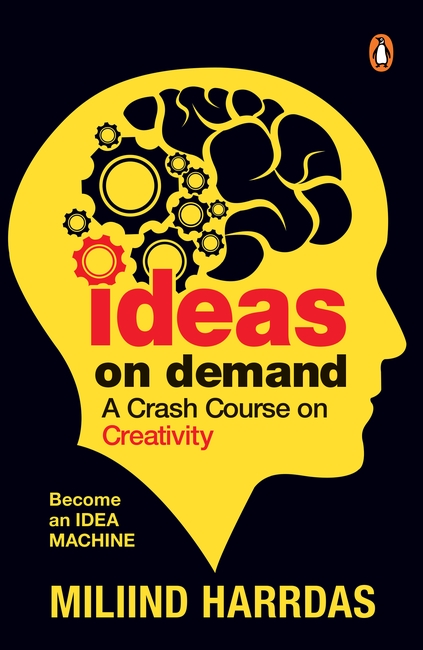
10x your ideas and accelerate your success
Do you feel stuck?
Do you feel that the lack of creativity is hurting your career growth?
As a marketer or startup, do you struggle to make your brand or business stand out?
Do you see the opportunities but don’t know how to make the most of them?
Do you believe that creativity is not your cup of tea?
Do you wonder, how innovators, inventors, and great creative minds can generate ideas on demand and create a wow?
How would your life change if you could generate creative ideas at will?
What if you could learn the creativity secrets practiced by great creative minds like Leonardo da Vinci, Einstein, Archimedes, Tesla, and business legends like Steve Jobs, Jeff Bezos?
Imagine having the ability to crack every challenge and open the door to an abundance of opportunities.
Imagine you being recognized as a go-to person for ideas.
The brains of creative people are wired differently.
But that’s just half the story. The good news is that you can rewire your brain too. As creativity is a skill and like any other skill can be learned by practicing in the right direction.
IDEAS ON DEMAND will show you the way to rewire your brain, become an idea machine, 10x your impact, and achieve your aspirations.
This book will help you:
• Understand 6 major creativity blocks and how to bust them
• Learn the exact techniques that creative people use to connect the different dots to generate wow ideas.
• Challenge assumptions to unshackle your creativity.
• Use constraints to boost your creativity.
• 10x your ideas and set yourself apart>
• Develop the unlimited self confidence to leap from your comfort zone to 10x zone.
With the help of some solid research findings, you will understand what exactly happens in the brain during the Eureka or Aha moments. How your subconscious mind plays a critical role in getting those wow ideas. You will also learn different ways to train your subconscious mind to flood you with ideas.
It will help you learn the techniques that creative people use to connect the different dots to generate wow ideas. Use constraints to boost your creativity and develop unlimited self- confidence to leap from your comfort zone to 10x zone.

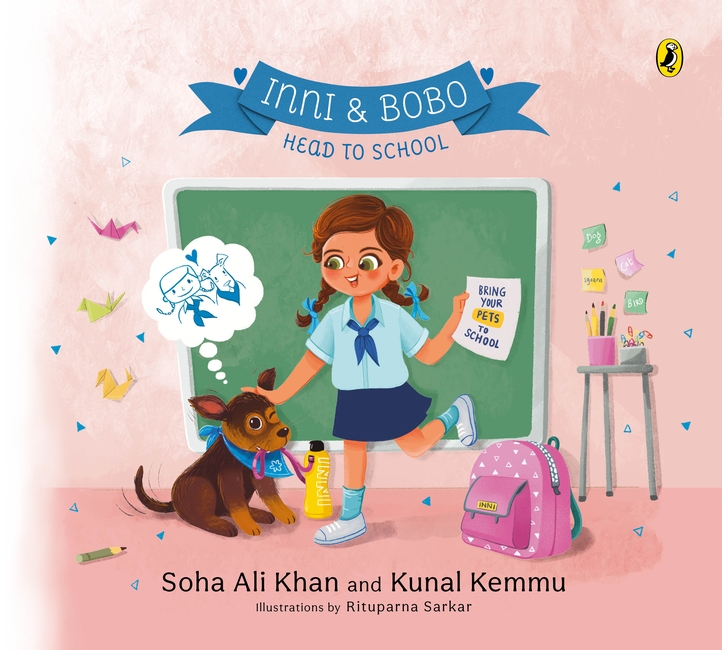
Bobo is a special puppy that little Inni has adopted. Bobo likes to help Inni get ready for school. He always checks if she has packed her lunch and water bottle.
And guess what? Bobo gets to go to school with Inni on a special day called ‘Bring Your Pet to School Day’! It’s the best Wednesday ever! Inni can’t wait to show her friends how wonderful Bobo is.
This endearing story, the third book in the Inni & Bobo series, delves into the everlasting bond between humans and pets. It will not only encourage children to show empathy and kindness towards animals but also teach them to open their hearts and homes to those in need.

In the fifteen masterful stories that make up this collection, Jai Chakrabarti crosses continents and cultures to explore what it means to cultivate a family today, across borders, religions, and race. In the title story, a closeted gay man in 1980s Kolkata seeks to have a child with his lover’s wife. An Indian widow, engaged to a Jewish man, struggles to balance her cultural identity with the rituals and traditions of her newfound family. An
American musician travels to see his guru for the final time-and makes a promise he cannot keep. A young woman from an Indian village arrives in Brooklyn to care for the toddler of a biracial couple. And a mystical agent is sent by a mother to solve her son’s domestic problems.
Throughout, the characters’ most vulnerable desires shape life-altering decisions as they seek to balance their needs against those of the people they hold closest. The stories in A Small Sacrifice for an Enormous Happiness capture men and women struggling with transformation and familial bonds; they traverse the intersections of countries and cultures to illuminate what it means to love in uncertain times; and they showcase the skill of a storyteller who dazzles with the breadth of his vision.

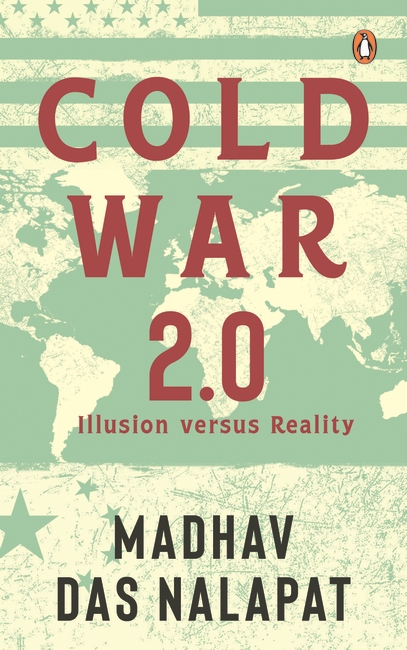
Cold War 1.0 was fought principally between the US and the Union of Soviet Socialist Republics. Soon after the collapse of the latter, Cold War 2.0 began. Just as with the earlier Cold War, this is also a battle of systems on an existential trajectory. This time around, the principal protagonists are the US and the People Republic of China (PRC). Those who deny the reality of the new Cold War, believe that Cold War 1.0 has reappeared, this time with the Russian Federation replacing the Soviet Union as the opponent. Such a view ignores the changes to the global order caused by the increasingly visible efforts of the PRC to replace the US as the prime mover influencing the trajectory of the twenty-first century.
Rather than a rearview mirror perspective on the current geopolitics, what is needed is a forward looking view of the overall relationship between not just the four Great Powers (China, the US, Russia and India) but also key players such as the European Union. From the 1980s, China has harnessed geopolitical currents to rise from a poverty-stricken behemoth to a superpower. India’s inability or unwillingness to adopt the same practical approach has thus far constrained its rise.
The book details the crosscurrents of Great Powers’ dynamics in the twenty-first century, and why it is important for a future-focused rather than a past-obsessed approach towards each other by the two biggest democracies on the planet, India and the US. Each needs to reinforce the other to jointly overcome the multi-dimensional challenge posed by the Communist Party of China to the global future. Just as in the case of Cold War 1.0, the democracies need to prevail in Cold War 2.0 as well.

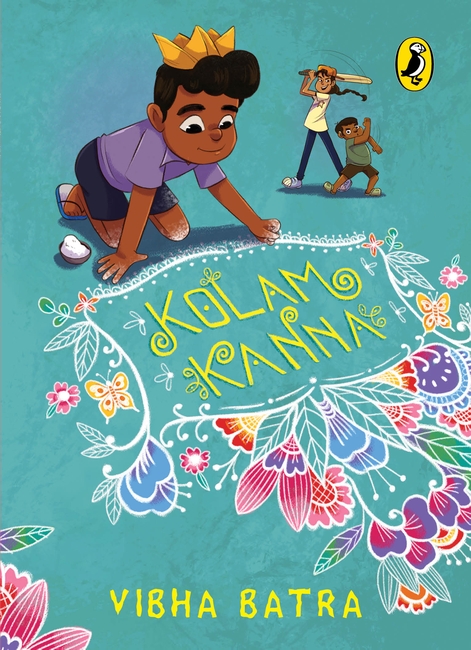
The exciting Kolam Kondattam Kontest is right around the corner. And Bharathi can’t wait to participate and show off, er, showcase his creative skills. Encouraged by his friends, Tabassum and Alagu, he registers for the contest (with a ‘k’).
Alas, the Residents’ Welfare Association, led by the fearsome Mrs Subramaniam, won’t hear of it. The contest is open only to the residents of Pravin’s Paradiso Apartments. And while Bharathi hangs out at the apartments all the time, he’s not exactly-technically-actually a resident.
Now it’s up to Bharathi to hatch an ingenious plan. Will he be able to get around the rules, get past the building bullies and get a shot at his dream?

SIDE A
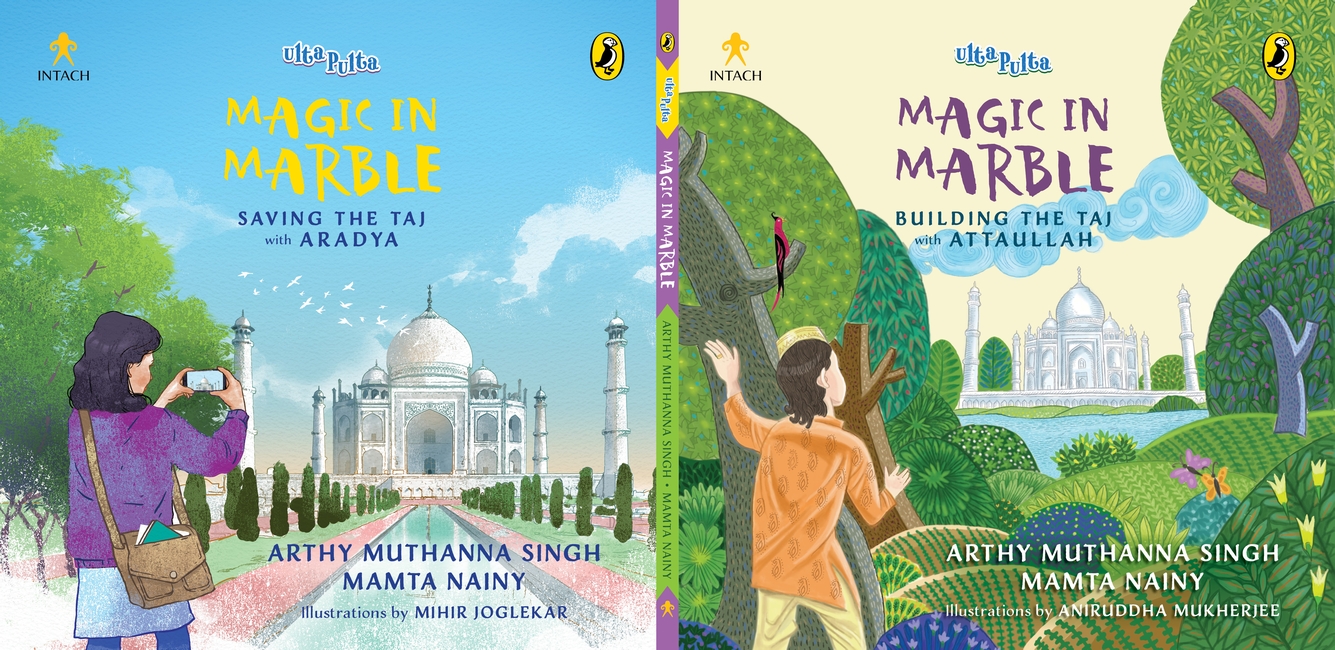
Magic in Marble: Building the Taj with Attaullah
Attaullah has to leave his playmates and the beautiful trees of Lahore behind as he makes the tiring journey to Akbarabad on a camel cart. His abbu, a master architect, has been summoned there to help build the most extraordinary monument ever-the Taj Mahal. The mausoleum will immortalize the memory of Jahan Panah Shah Jahan’s beloved wife, Mumtaz Mahal. And Attaullah wants to be a part of history as it’s being created. But how?
Travelling across two timelines in history, this is an ulta-pulta book about two children whose paths collide in a mysteriously magical way.
————————————————————————————————–
SIDE B
Magic in Marble: Saving the Taj with Aradya
Aradya has read everything she could find on the greatest monument ever built-the Taj Mahal. So, when her papa, a conservationist, invites her to join him on his quick work trip to Agra, she feels like she’s the luckiest girl in the whole, wide world. Her papa’s team is working on a project that will help preserve the Taj’s beauty and ensure its survival for future generations. And Aradya wants to help. But how?
Travelling across two timelines in history, this is an ulta-pulta book about two children whose paths collide in a mysteriously magical way.