Tanjore, 1942
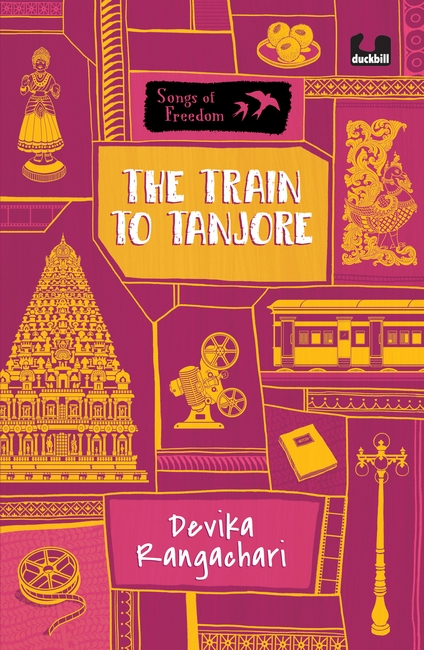
There are few excitements in Thambi’s quiet life. There is the new hotel, disapproved of by elders, which lures him with the aroma of sambar with onions. There are visits to the library to read the newspaper, and once in a while, a new movie at the Rajaram Electric Theatre. More disagreeably, there are fortnightly visits from his uncle to lay down the law.
When Gandhiji announces the Quit India movement, Tanjore is torn apart by protests. The train station-the lifeline of the town-is vandalized. Mysterious leaflets are circulated, containing news that newspapers do not publish. And inspired by the idea of a free India and his own dreams of being an engineer, Thambi must find the courage to do what he believes is right-even when it endangers all he holds dear.
The Songs of Freedom series explores the lives of children across India during the struggle for independence.
Calcutta, 1928
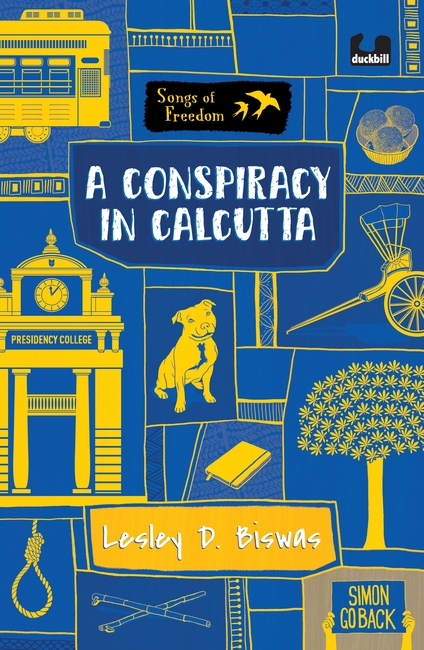
As the student protests gather momentum all across Calcutta, and police atrocities grow, ten-year-old Bithi wants to join in the struggle for freedom.
But living in a society where her best friend is to be married and just the fact that she is going to school is regarded with disapproval, how can Bithi play a substantial part? How can she fight those who are dearest to her? Discouraged but not daunted, Bithi schemes and plots and lies and is drawn into unexpected danger-all for the sake of fighting injustice in all its forms.
The Songs of Freedom series explores the lives of children across India during the struggle for independence.
The series complements school textbooks about the independence movement. As the stories are told from a child’s point of view, these stories bring the facts of the independence movement to vivid life in settings all over the country—and inspire each reader to engage with the idea of India.

Gauri Khan strikes the perfect balance between her sense of design and personality, and factors in the clients’ brief while transforming a space into something that the user can truly call their own. She uses her quiet, elegant style and charming-yet-sophisticated aesthetic to create a space the client can enjoy. A common thread that runs right through the process is the meticulous attention to detail, which juxtaposes the practical with the luxurious. Since its launch, design originality, intricate detailing and one-of-a-kind workmanship have been the foundations of Gauri Khan Designs.
In her coffee table book, My Life in Design, she charts out her journey as a designer with exclusive pictures of her and her family-Shah Rukh, Aryan, Suhana and AbRam. Unseen images of her Mumbai residence, Mannat, and the design thought-processes that went into it as well as other key projects are part of the book as well. She also imparts tips to those aspiring to get into her field of work and the laypeople who want to learn more about the fascinating and inspiring world of design.

Rajinder Singh Bedi: Selected Short Stories curates some of the best work by the Urdu writer, whose contribution to Urdu fiction makes him a pivotal force within modern Indian literature. Born in Sialkot, Punjab, Rajinder Singh Bedi (1915-1984) lived many lives-as a student and postmaster in Lahore, a venerated screenwriter for popular Hindi films and a winner of both the Sahitya Akademi as well as the Filmfare awards. Considered one of the prominent progressive writers of modern Urdu fiction, Bedi was an architect of contemporary Urdu writing along with leading lights such as Munshi Premchand and Saadat Hasan Manto.
Written between 1940 and 1975, the fifteen short stories included in this collection comprise favorites like ‘Garam Coat’ (Woollen Coat), ‘Lajwanti’, ‘Apne Dukh Mujhe De Do’ (Give Me Your Sorrows), ‘Rahman ke Joote’ (Rahman’s Shoes) and others. Bedi’s stories dissect human emotions with grim precision as he navigates the everyday lives of men and women, exposing social inequities and economic problems.
The Monkey’s Wound and Other Stories is a collection of sixteen short stories by Hajra Masroor that are illustrative of her uncompromising tone, her piercing portrayals of the bitter realities of life, and the wounds and traumas of the inner lives of women. The stories, translated from the original Urdu, are sourced from her well-known collection of stories, Sab Afsanay Meray and are stories that bring out Masroor at her best.

The Social Butterfly is back with her signature wingbeat. The world may have moved at a rattling pace since her last outing but the lifestyles of Lahore’s literati, Dubai’s glitterati and London’s desi flutterati have more than kept pace. Earth-shattering events like wars, climate change, and the pandemic have nothing on the treachery of the maalish waali, Meghan Markle’s tiara and the mechanics of ‘sad make-up’. Spanning eight rollicking years from 2014 to 2021, Butterfly’s frank, funny diaries tell us how it is in the private lives of the haves and the have-mores.
Scandalously colourful and uniquely desi, the latest installment of the Butterfly series is delish.

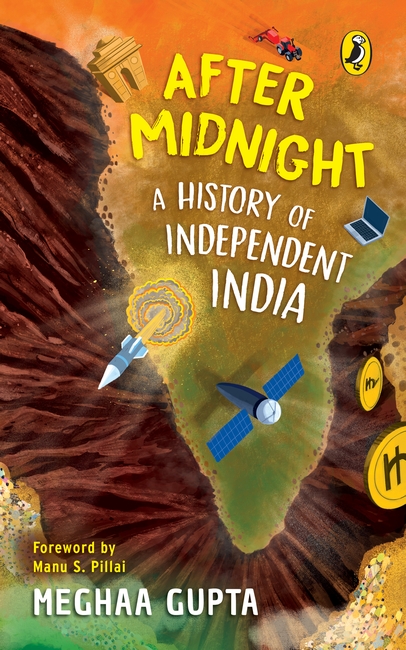
At the time of Independence, few believed that a country made up of British provinces and over 500 princely states could survive as a nation, even for a few years. That a land stripped of its riches, wracked by disease and famine, and divided along tense communal lines could thrive in its aspirations. Yet, in the 75 years since Independence, India has grown beyond anyone’s expectation.
How did India get this far? What were the sweeping social, political, scientific, technological, military, environmental and economic developments it witnessed along the way? Interspersed with personal anecdotes, illustrations, infographics, informative timelines and quotes, After Midnight revels in the diverse ideas that have come to shape India and offers a multifaceted context to the present. In many ways, this is one of the greatest underdog-beating-the-odds stories in world history, full of blood, sweat, tragedy and triumph.

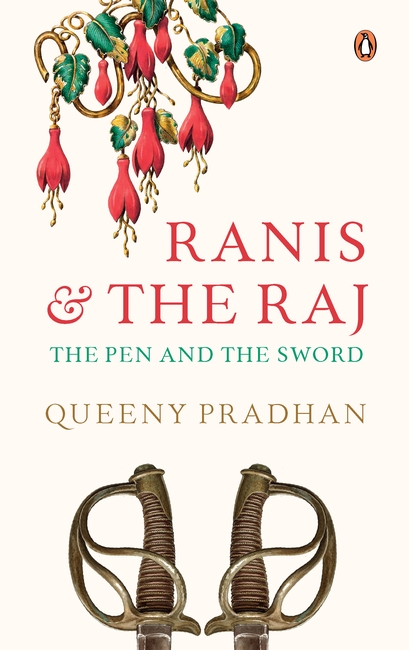
Traditionally, history has been telling us the stories of kings. In the long tradition of history writing, his-story has always dominated over her-story. Though queens evoke a sense of romance and their stories are told like fairy tales, it is common enough to find that these stories end in tragedy. In India’s history, not all queens are remembered today. Some are celebrated; while others have been almost ignored by historians.
In Ranis and the Raj, Queeny Pradhan has selected six queens. All the six queens are fromthe nineteenth century and have faced the British Raj, the East India Company and the Crown. From the Rani of Sirmur, who was the earliest to deal with theBritish authorities, to Rani Chennamma, Rani Jindan, Begum Zeenat Mahal, Rani Lakshmi Bai, to the Sikkim Queen from the 1860s to 1890s, Pradhan has attempted to carve an engrossing historical narrative for each of these important figures in Indian history. Unlike the biographical convention in traditional history writing, theresearch in this book can be placed in the realm of ‘microhistory’. The life stories of these queens are fragmented due to the ‘silences’ and ‘invisibilization’ in political history of the time, and this book aims to fill these gaps.

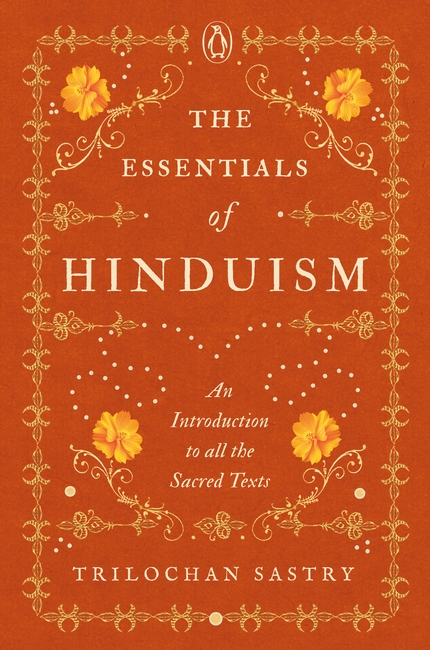
Hinduism is an ancient religion, philosophy and way of life. Unlike other great religions that are based on a small set of books, there are hundreds of texts in Hinduism, most of which are very voluminous. They span not merely centuries, but millennia. And most importantly, these ancient scriptures are all in Sanskrit which many do not know. Therefore for a beginner with an interest in Hinduism it is a daunting task as you don’t know where to start such a study.
In The Essentials of Hinduism, Trilochan Sastry unpacks all the ancient texts from the Vedas to the epics covering the entire range of scriptures and everything you need to know about them in an easy-to-read and accessible way making it of special interest to Hindus and those from other religions and nations, and even those who are agnostic or atheistic.

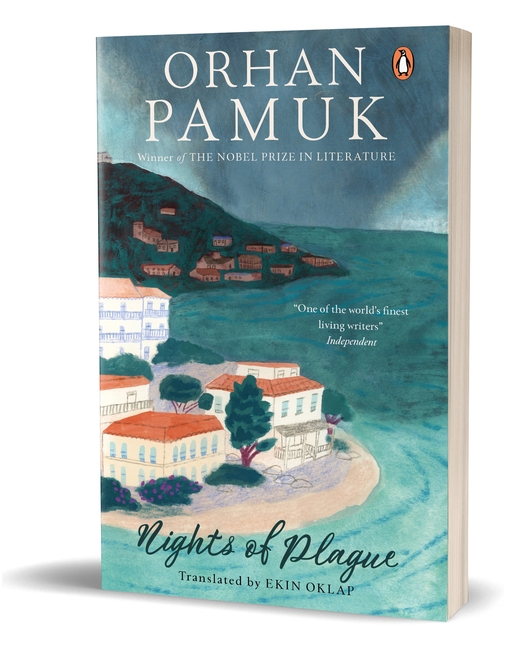
In April 1900, on the imaginary island of Mingheria—the twenty-ninth state of the Ottoman Empire—tensions rise between its Muslim and Orthodox Greek populations as a deadly plague, possibly brought by Muslim pilgrims or merchant vessels, sparks a rebellion. To curb the epidemic, Sultan Abdul Hamid II
dispatches a skilled Orthodox Christian quarantine expert, but resistance from some Muslims, a murder, and incompetence in local governance hinder containment efforts. As the death toll climbs, a Muslim doctor is also sent, yet the quarantine’s failure prompts international intervention through a naval blockade. Now
the people of Mingheria are on their own, and they must find a way to defeat the plague themselves. Steeped in history and rife with suspense, Nights of Plague is an epic story set more than one hundred
years ago, with themes that feel remarkably contemporary.