




This book examines the social and cultural infrastructure that sustains Sindhi business and its trade networks. It provides a rich historical context to the narrative by tracing the origin of Sindhi Trade to the annexation of Sindh in 1843, when it was incorporated into an expanding global economy. The book also locates Sindhi business within the dynamics of the contemporary Indian diaspora and features several success stories both from India and outside. The book emphasizes the commercial inventiveness, spatial mobility, and adaptability of Sindhis—-the qualities crucial to building successful cosmopolitan businesses.
Archives: Books
The Architect of the New BJP
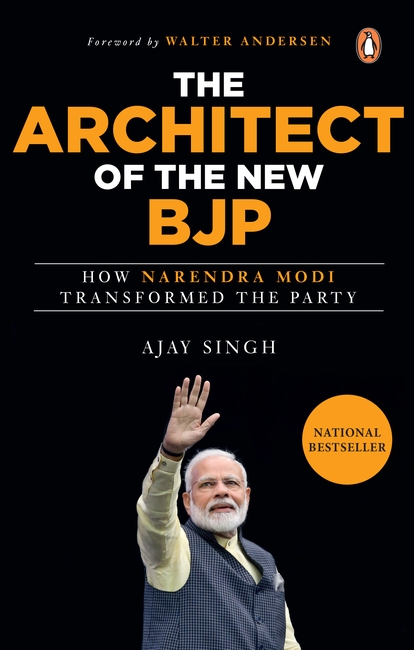
In less than forty years of its existence, the Bharatiya Janata Party has become the world’s largest political party and continues to go from strength to strength in Indian politics. Although its historic rise may seem organic to some, there is much internal deliberation and planning that has aided the growth of this 180-million-member organization.
The Architect of the New BJP uses in-depth research and concrete examples to explain how the BJP has transformed over the decades. It reveals lesser-known contributions, like Prime Minister Narendra Modi’s experiments with traditional methods of party-building, his keen eye for detail and the different innovative methodologies to expand the party. Ajay Singh not only examines the past of the party, including the vision of its founders, but also provides a glimpse into the future of the party. Based on extensive interviews with many party workers, leaders and observers, this is the story of how the veterans of this cadre-based party, appreciating its limitations, developed a unique Indian model that eventually transformed the BJP into the election-winning machine it is today.
The Power of Thoughts
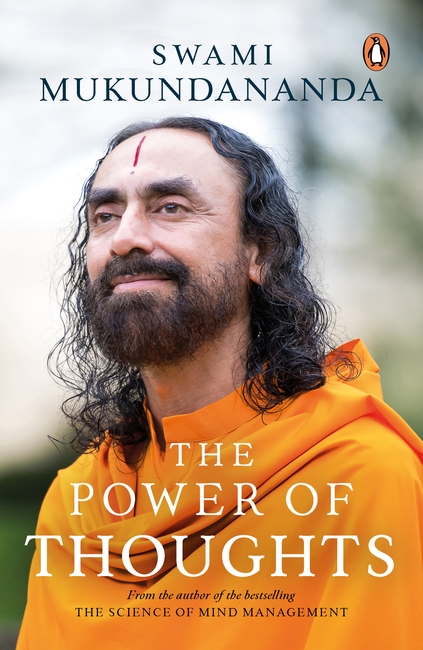
Incredibly, the ingredients of a hugely successful life cost nothing at all. In fact, we mass-produce 60,000 of them every day. These are the thoughts that our mind creates. They are responsible for the happiness and distress we experience. They are the precursors of all we do. We grapple with improving our actions, only to find our attempts undone by impure thinking.
If we focus on transforming our thoughts instead, incredible results will accrue from a fraction of the efforts. Since all aspects of our life are so strongly linked to our thoughts, we have much to gain by deepening our understanding of them.
In this book, Swami Mukundananda, a world-renowned spiritual teacher from India and an internationally acclaimed mind-management authority, will teach you about watching your thoughts, directing them, dismantling harmful thought structures, creative thinking, meditation and much more. When you focus on revolutionizing your thoughts-the most fundamental aspect of inner personality-you will discover yourself evolving to divine heights to fulfil the purpose of your life.
Visual Dictionary: Vehicles (Activity Books | Ages 3 and up | First Library | Early Learning Board Books)

This colourful board book introduces your child to different vehicles: rail, air and sea transport, as well as, special military and space equipment.
Filled with short stories for little ones, interesting facts and large vibrant pictures, this book is a fun learning experience!
So get ready to seek and find, identify vehicles and learn about them.
KEY FEATURES:
LARGE FORMAT
Big pages give little readers lots of room to explore their very first words
ACTIVE LEARNING
Sprinkled with hints and seek and find activities
PERFECTLY SIZED BOOKS
Easy and convenient for little readers to hold
BRIGHT AND BEAUTIFUL PICTURES
Full of eye-catching, colourful illustrations and drawings
CHILD-FRIENDLY FUN
Designed with the developmental needs of 3 and up to keep them interested and engaged
LEARNING OUTCOMES:
Each themed book features fun-filled pictures, things to name and inviting questions and activities.
Combines Seek and Find activities with new words providing hours of fun and learning.
Build vocabulary through picture-word association.
Curated for every preschooler’s holistic learning experience to help them develop their speaking, and observational skills as they learn to identify vehicles around them.
Visual Dictionary: Animals (Activity Books | Ages 3 and up | First Library | Early Learning Board Books)
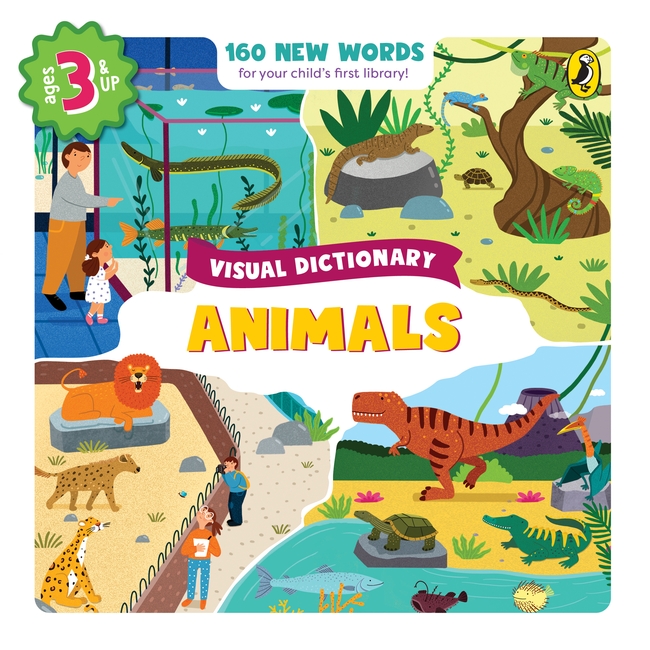
This colourful board book introduces your child to the world of animals: herbivores and predators, birds and fishes, bugs and spiders, reptiles and lots more.
Filled with short stories for little ones, interesting facts and large vibrant pictures, this book is a fun learning experience!
So get ready to seek and find, identify animals and learn about them.
KEY FEATURES:
LARGE FORMAT
Big pages give little readers lots of room to explore their very first words
ACTIVE LEARNING
Sprinkled with hints and seek and find activities
PERFECTLY SIZED BOOKS
Easy and convenient for little readers to hold
BRIGHT AND BEAUTIFUL PICTURES
Full of eye-catching, colourful illustrations and drawings
CHILD-FRIENDLY FUN
Designed with the developmental needs of 3 and up to keep them interested and engaged
LEARNING OUTCOMES:
Each themed book features fun-filled pictures, things to name and inviting questions and activities.
Combines Seek and Find activities with new words providing hours of fun and learning.
Build vocabulary through picture-word association.
Curated for every preschooler’s holistic learning experience as they identify animals and learn about them.
Visual Dictionary: Body (Activity Books | Ages 3 and up | First Library | Early Learning Board Books)
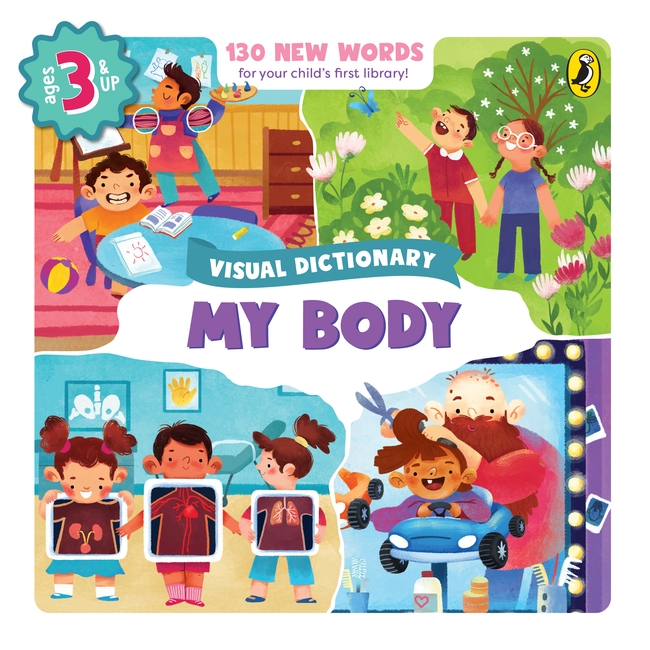
This colourful board book introduces your child to the human body: how muscles and bones work, what the brain and heart are responsible for, why different internal organs are needed and lots more.
Filled with short stories for little ones, interesting facts and large vibrant pictures, this book is a fun learning experience!
So get ready to seek and find, identify body parts and learn about them.
KEY FEATURES:
LARGE FORMAT
Big pages give little readers lots of room to explore their very first words
ACTIVE LEARNING
Sprinkled with hints and seek and find activities
PERFECTLY SIZED BOOKS
Easy and convenient for little readers to hold
BRIGHT AND BEAUTIFUL PICTURES
Full of eye-catching, colourful illustrations and drawings
CHILD-FRIENDLY FUN
Designed with the developmental needs of 3 and up to keep them interested and engaged
LEARNING OUTCOMES:
Each themed book features fun-filled pictures, things to name and inviting questions and activities.
Combines Seek and Find activities with new words providing hours of fun and learning.
Build vocabulary through picture-word association.
Curated for every preschooler’s holistic learning experience as they identify body parts and learn about them.
Listen to Your Heart: The London Adventure (Illustrated, boyhood memoir series from Ruskin Bond)
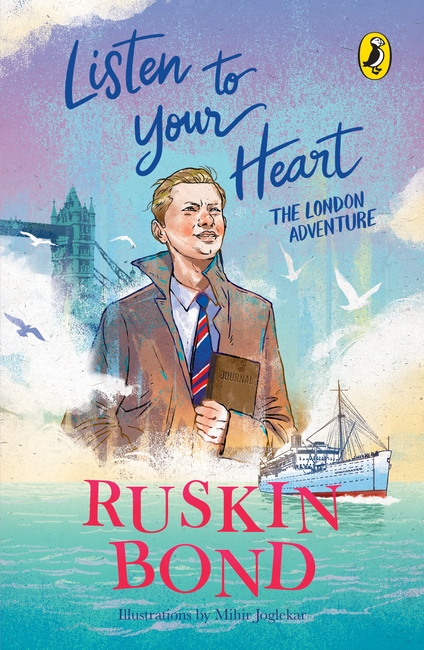
‘I followed my heart instead of my head. It is something I have done all my life.’
Shortly before his eighteenth birthday, Ruskin embarks on a literary journey and reaches England after charting unknown waters. Greeted by the uncertainties of a new city, he muses over his loneliness, switches jobs, falls in love, befriends the ocean and relentlessly chases a big dream!
What follows next is the metamorphosis of a journal entry into a novel as we time-travel to the fascinating events that led to the making of his iconic book, The Room on the Roof.
Capturing memorable experiences from young Ruskin’s life, Listen to Your Heart is an inspiration for aspiring young writers, a meditation on embracing fears, seizing every opportunity but most importantly living one’s dreams.
Photosynthesis for Smartypants
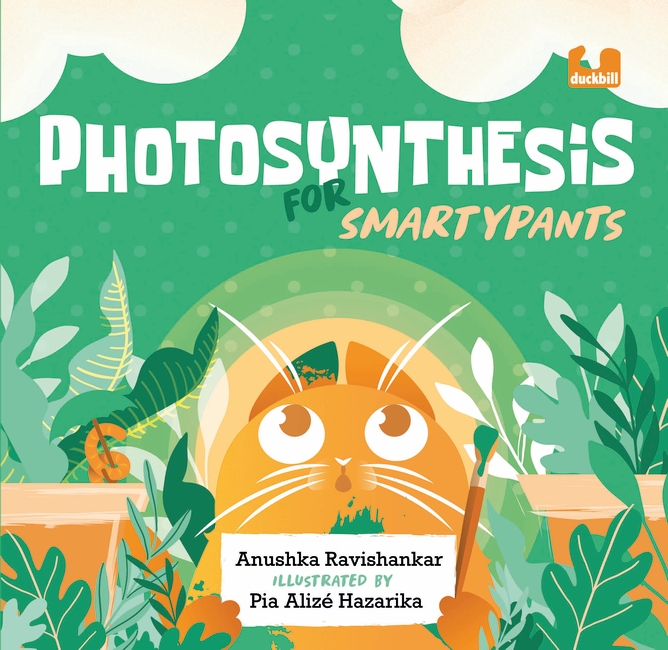
Are you a Smartypants?
Do you ask a lot of questions? Like-
Why are plants green?
How do plants make their own food?
Do plants have a kitchen?
If you do, then you just might find the answers in this book.
It has gorgeous pictures, simple explanations and a very curious cat!
Gravity for Smartypants
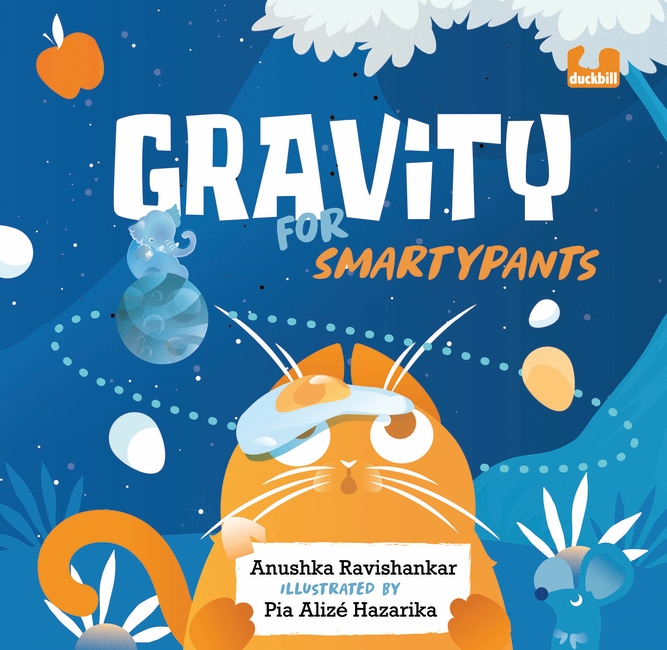
Are you a Smartypants?
Do you ask a lot of questions? Like-
Why do things drop down and not up?
Why do things stay on the ground?
Will the moon fall on us?
If you do, then you just might find the answers in this book.
It has gorgeous pictures, simple explanations and a very curious cat!
Evolution for Smartypants
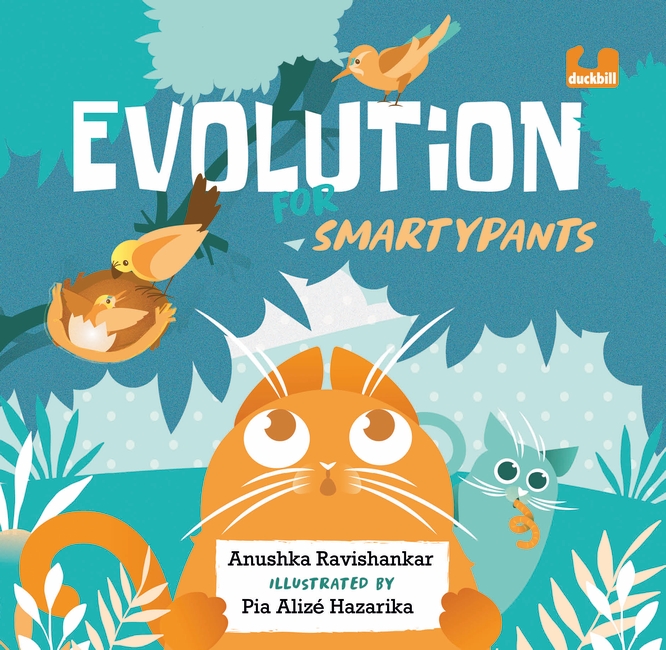
Are you a Smartypants?
Do you ask a lot of questions? Like-
Why do dogs only have dog babies?
Are all cats exactly alike?
Are humans actually monkeys?
If you do, then you just might find the answers in this book.
It has gorgeous pictures, simple explanations and a very curious cat!