Endings are inevitable. Whether it’s a romantic relationship that shatters, a close friendship that fades, or family ties that become toxic, sooner or later, we all face the painful truth of letting go. In the aftermath, we are left with one task: To heal. But here’s the truth—time alone doesn’t heal. Passive distance doesn’t heal. Looking away doesn’t heal. Only active, conscious healing does.
In a world of instant connections, silent ghosting, and fast goodbyes, this book offers what we were never taught: How to end relationships with grace and how to reclaim your peace after heartbreak. Blending deeply personal stories with timeless insights from Indian philosophy, mythology, and spiritual psychology, Goodbye, I Love(d) You gently guides you through emotional recovery.
Whether you’re grieving a break-up, mourning a friendship, or breaking free from toxic family patterns, this book is a steady, compassionate hand through the storm. With practical tools, soulful reflections, and powerful truths, it shows that every ending—no matter how painful—is an invitation to begin again. Because true healing isn’t about clinging. It’s about coming home to yourself.
NEW YORK TIMES BESTSELLER
Founder of Keto Kamp and health expert reveals the main reason why 93 percent of Americans are metabolically unhealthy, and provides a 30-day reset to restore their metabolism for good.
Metabolic Freedom is for those who are fed up with the failed diet dogma of fad diets, calorie counting and excessive exercise, and are looking to finally break free with a new paradigm on how to reset their metabolism to achieve metabolic freedom.
With Metabolic Freedom, readers will understand how their metabolism works, and the top contributors to why their metabolism has become inefficient, and then deep dive into all of the main factors that influence a free metabolism, including:
• the power of keto fasting
• improved sleep
• cutting edge bio-hacks
• mindset shifts
• smart exercise routines
• specific food swaps
• and more.
This book will also explore the way hormones impact these processes as they impact male and female bodies differently.
Most importantly, all of these tools are combined at the end of the book for the user to start implementing a clear road map to achieve Metabolic Freedom within 30 days by customising their own plan.
A biography of the late spiritual pioneer Dr. David R. Hawkins, or “Doc” as he was known to many of his devotees.
“This is more than a biography; it’s a heartfelt journey, an invitation to experience his life and witness the extraordinary legacy he left behind.”
Dr. David R. Hawkins, a man whose existence was a symphony of curiosity, discovery, and transformation, a man, who not only was a brilliant thinker, but a man of deep compassion and love, dedicated to the upliftment of all of humanity.
From his discoveries as a science-based psychiatrist to the confirmed reality of his own unique spiritual experiences, David R. Hawkins has gifted us with a treasure trove of insights into the human psyche and consciousness itself, that are as mind-blowing as they are soul-nourishing. He handed us a road map to Truth with his visionary Map of Consciousness®, an extremely useful guide in gaining profound insights into the nature or our existence and purpose on earth.
In this book, you will come face to face with the revelations that turned his world upside down and elevated the consciousness of anyone fortunate enough to encounter his work.
Let’s begin this journey of Dr. David R. Hawkins, an extraordinary yet ordinary life whose imprint on the world stands for Truth as the highest endeavor, embraces compassion for all sentient beings, and in complete surrender and devotion to God as the Ultimate Reality.
Tarot is the most effective tool available for strengthening your intuition, which is key for intentional manifestation. Here, author of Guided Tarot Stefanie Caponi shows you how to bring your desires to life.
Creativity shapes reality, and our words are our spells. Whether you’re a seasoned tarot enthusiast or a curious beginner, Tarot for Manifestation is a road map to a more vibrant and fulfilling existence, complete with practical tarot resources and insightful guidance. With a blend of practical advice and spiritual wisdom, Caponi demystifies manifestation and tarot, offering accessible techniques for readers of all levels.
This book provides step-by-step guidance on harnessing the energy of the universe to manifest dreams through tools like:
• custom tarot spreads
• creative exercises
• shadow work
• declutter magic
Through taking aligned action, readers are empowered to create a life filled with magic, abundance, and love.
A profound exploration of mediumship, spirituality, and the interconnectedness of all beings, with practical tools and personal stories to help readers connect with the spirit world and their own divine nature.
In Making the Afterlife Connection, gifted medium Suzanne Giesemann takes readers on a journey of spiritual awakening, to a life beyond physical existence.
As a former Navy Commander, Suzanne’s credibility and down-to-earth style make deep spiritual concepts accessible and engaging. She offers a grounded approach that blends her military background with her spiritual insights, and in doing so, she demystifies mediumship and provides a systematic method for others to explore their own gifts.
Making the Afterlife Connection is rich with compelling, true stories and practical exercises that help readers experience their own spiritual connections.
By sharing her personal journey and the irrefutable evidence she has gathered, Giesemann helps readers understand that they are part of a larger, interconnected web of existence and that divine love is a powerful, healing force available to everyone.
A quest to make peace with your past, release the burdens you carry for your ancestry and embrace the gifts of the present.
What if your inner child holds the key to the life you’ve always longed to live? What if your deepest wounds hold the seeds of your vitality? In this groundbreaking guide, Nina Mongendre offers a powerful approach to healing childhood wounds and ancestral patterns through a powerful fusion of Family Constellations Therapy, inner child work, and shadow integration.
Weaving together professional expertise and personal wisdom, she guides readers through 12 initiations to:
• Heal childhood wounds and transform limiting patterns
• Release inherited family trauma and access ancestral gifts
• Navigate parental relationships
• Transform shadows into strength
• Access the wisdom of the future self
• Foster a lasting sense of inner safety and belonging
Through practical exercises, guided journeys, and real-life stories, this book is a map for anyone ready to embark on their own Hero’s Journey. Whether you’re dealing with childhood trauma, seeking to break generational patterns, or simply yearning to live more authentically, these tools reveal the path to reclaim the life that is yours.
This isn’t just another self-help book—it’s an invitation to transform your relationship with yourself, your past, and your future. By embracing both the wounded and magical aspects of your inner child, you can finally write a new story—one of healing, wholeness, and joy.

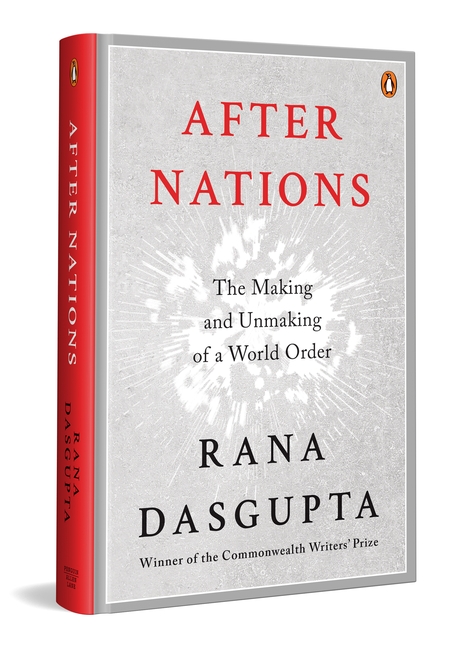
The system of nation-states is in convulsion. As American hegemony unwinds, anxious Western countries slide into xenophobia and debt. Liberal ideas and institutions are losing their prestige; autocracies like China, Russia, and the UAE, by contrast, are rising. For those most completely abandoned by nation-states, meanwhile, there is no future except through life-threatening migration. All in all, the global political order offers human beings ever fewer securities—and ever more threats.
Rana Dasgupta traces the formation and rise of this system in order to explain the cause of its multiple failures today. He takes us from the fall of ancient empires and the expansion of European concepts of money and law, right up to the emergence of twenty-first-century tech firms—which present formidable competition to nation-states—and the epochal restoration of Chinese power. He posits that the time has come to develop a new conception of citizenship, law, and economy—one that corresponds to our own globalized and ecologically fragile condition.
An urgent work of astute political and historical analysis, After Nations is an essential text for anyone looking to understand why we seem to be losing our political hold on the world, and how we might try to restore it.
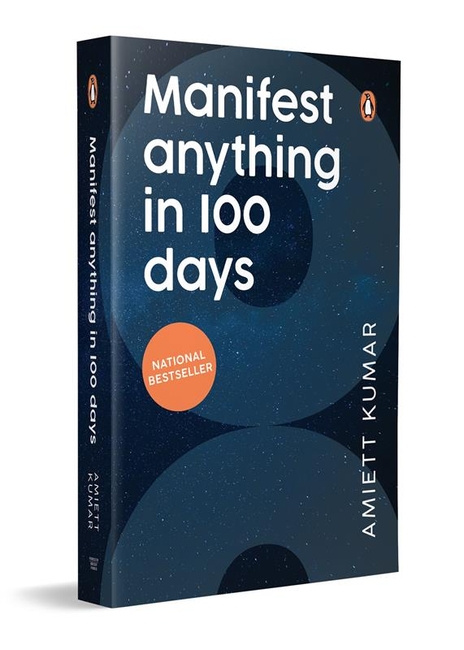
Don’t wait for miracles—manifest them, one day at a time.
Manifest Anything in 100 Days is not just a book—it’s your personal transformation blueprint. Backed by science, ancient wisdom and real-life success stories, this 100-day challenge will help you unlock the full power of your mind and manifest the life you’ve always dreamed of.
Unlike typical self-help books that stop at theory, Dr Amiett Kumar’s practical approach combines mindset training, manifestation techniques and disciplined daily action. Each of the 100 chapters offers one powerful idea—gratitude, visualization, affirmations, belief-building, and a simple task designed to rewire your thoughts and align your energy with your goals.
Through consistency and focus, you’ll learn how to attract abundance, strengthen self-belief and turn dreams into reality—one day at a time. Whether you want success, love, peace or purpose, this book gives you the tools to create it.
You don’t just read this book—you live it. So get ready to claim your manifestation space and begin the most powerful 100 days of your life.
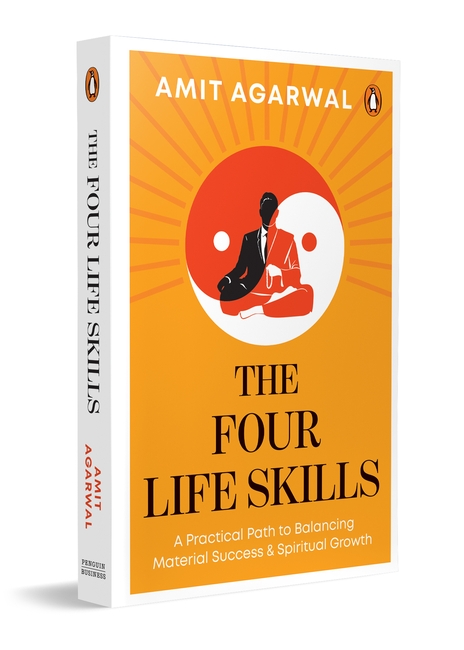
We learn how to make a living, but rarely how to live.
Our education system teaches us engineering, law, medicine and management—skills that help us earn. But it often overlooks life skills that help us live meaningfully every day. This book decodes four essential life skills that address four key aspects of our being: Communication, Mind, Money and Food.
Sales: Communicate effectively and efficiently in personal and professional contexts.
Mindfulness: Be aware and equanimous in both pleasant and unpleasant situations.
Personal Finance: Become financially free and experience the things that truly matter.
Nutrition: Decode what to eat, when to eat and how to eat.
Each of these skills is essential. Remove one, and you will feel incomplete. Through twenty-three practical habits, you will learn to master these four life skills—not through theory, but through doable actions.
Whether you are starting your career, seeking balance in a fast-paced life or looking for deeper meaning, this book offers a practical path to experience both material success and spiritual growth.
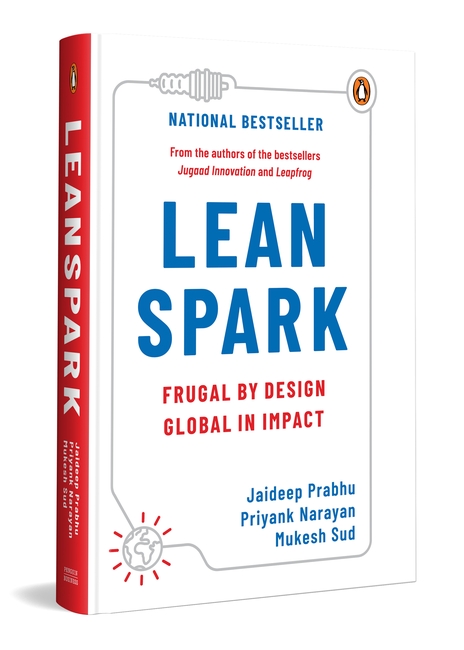
India is entering a decade where ingenuity under constraint will decide who leads and who falls behind. LeanSpark shows how India’s ‘high-tech jugaad’ is turning scarcity into an innovation superpower—across drones and EVs, fintech and AI, sports, space and public policy. It distils a decade of research and fieldwork into a practical playbook for doing more with less, and for doing it at scale.
This book will help you:
- Build frugal, high-tech ventures that start small but scale smart, using the LeanSpark attributes of lean execution, purposeful simplicity, adaptive scalability and systemic sustainability.
- Design products, services and policies that are affordable, resilient and environmentally conscious—without sacrificing ambition or quality.
- Apply the Frugal Innovation Canvas (FIC) to turn constraints into launchpads, whether you are in a start-up, large company, social enterprise or government.
- Learn from real stories: from drones transforming sports broadcasting and DPIs reshaping finance, to ISRO’s space missions and India’s frugal AI revolution.
- Translate India’s frugal ingenuity into frameworks you can use in any country facing limits of capital, infrastructure or climate.
Who is LeanSpark for?
- Entrepreneurs and founders who want to build capital-efficient, tech-enabled businesses in India and beyond.
- Leaders in corporates, government and non-profits who must deliver more impact with tighter budgets and higher scrutiny.
- Investors, policy thinkers and students looking for a grounded counterpoint to resource-heavy Silicon Valley models.
If you care about innovation that is affordable, scalable and humane, this book is written for you.
What’s inside LeanSpark?
- Section I – LeanSpark Ventures: stories of founders who built ‘bold ideas on bare-bones budgets’ in EVs, drones, retail, food and more.
- Section II – LeanSpark Culture: how festivals, foundations, educators and ecosystem builders create ‘resource-light, impact-heavy’ change.
- Section III – LeanSpark Nation: India’s LeanSpark moments—from ISRO and digital public infrastructure to frugal AI and sports—showing innovation at national scale.
- LeanSpark Toolkit: The Frugal Innovation Canvas and practical tools you can use to frugalise your own venture or initiative.
Each chapter blends narrative with a clear analytical lens, so readers get both inspiration and a reusable framework.