



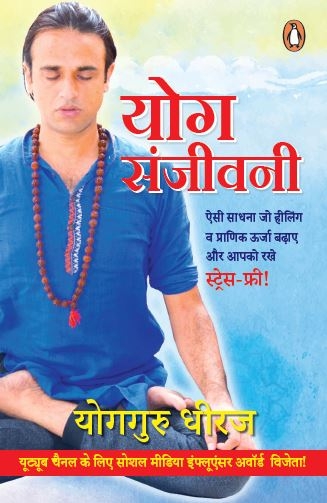
This book focuses on health questions of the present time and engages with the readers in easy way. The book discusses the Yogic treatment of stress, anxiety and other life style diseases. This is a collection of selected Yoga practices from the vast ocean of the Yoga. You can choose your own Yoga practice according to your needs.
This book is also helpful for existing and future Yoga teachers.
Archives: Books
Savarkar
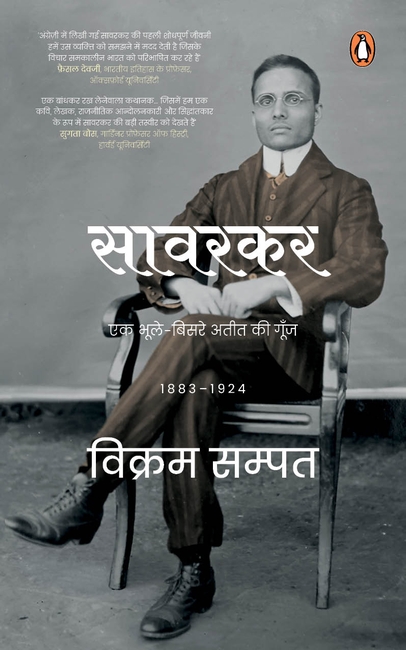
As the intellectual fountainhead of the ideology of Hindutva, which is in political
ascendancy in India today, Vinayak Damodar Savarkar is undoubtedly one of
the most contentious political thinkers and leaders of the twentieth century.
Accounts of his eventful and stormy life have oscillated from eulogizing
hagiographies to disparaging demonization. The truth, as always, lies
somewhere in between and has unfortunately never been brought to light.
Savarkar and his ideology stood as one of the strongest and most virulent
opponents of Gandhi, his pacifist philosophy and the Indian National Congress.
An alleged atheist and a staunch rationalist who opposed orthodox Hindu
beliefs, encouraged inter-caste marriage and dining, and dismissed cow worship
as mere superstition, Savarkar was, arguably, the most vocal political voice for
the Hindu community through the entire course of India’s freedom struggle. From
the heady days of revolution and generating international support for the cause
of India’s freedom as a law student in London, Savarkar found himself arrested,
unfairly tried for sedition, transported and incarcerated at the Cellular Jail, in the
Andamans, for over a decade, where he underwent unimaginable torture.
From being an optimistic advocate of Hindu-Muslim unity in his treatise on the
1857 War of Independence, what was it that transformed him in the Cellular Jail
to a proponent of ‘Hindutva’, which viewed Muslims with suspicion?
Drawing from a vast range of original archival documents across India and
abroad, this biography in two parts-the first focusing on the years leading up to
his incarceration and eventual release from the Kalapani-puts Savarkar, his life
and philosophy in a new perspective and looks at the man with all his
achievements and failings.
Smash It, Butterfingers!
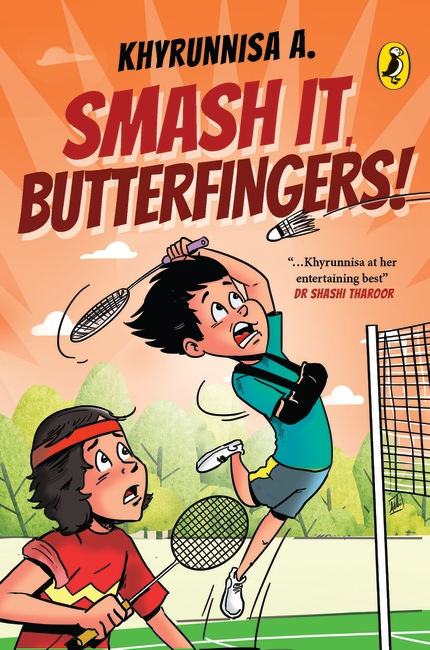
‘The latest edition in the wonderful Butterfingers series Smash It, Butterfingers! shows Khyrunnisa at her entertaining best. Having launched (and enjoyed) every one of his previous adventures, I was delighted to follow Amar’s latest exploits, this time in a tale about badminton. An amusing, charming, rollicking children’s story-and for adults too, for whom it should bring back glorious memories of the joy and trepidation of school sports tournaments. A marvellous, addictive writer at the height of her powers!’ Shashi Tharoor
Look out! It’s Butterfingers again, and in smashing form!
There’s a lot going on in Green Park School. Ozymandias, a black cat, walks into classrooms and there’s a buzz about a badminton tournament that is to be played on Friday the thirteenth.
Sponsored by Brijesh K. Singh, an eccentric multimillionaire who loves badminton and hates superstitions, this tournament is good news for sports-crazy Amar Kishen, aka Butterfingers, and his friends.
Badminton practice begins, but can it be smooth sailing with talk of scams, superstitions and suspicions? Butterfingers sure has a lot on his hands!
Join Amar on his hilarious adventures as he defies luck with his madcap schemes. Let the game begin!
Right Between the Ears

Right Between the Ears reveals the secrets that allow brands to open up hidden domains in our minds through powerful psychological triggers. The power of cognitive brands is not accidental; it is architected by applying recent scientific advances in fields as disparate as psychology, behavioural economics, social anthropology and cognitive neuroscience. These consilient techniques now allow us to peer into the soul of a brand as never before.
Marketers have created truly phenomenal brands in the past. However, until now, our understanding of brain science was not quite enough to explain why some brand campaigns become so iconic while others fizzle. This book provides a new lens with which we can deconstruct those successes and failures. It takes the reader on a rollicking ride through examples and stories of brands as timeless as De Beers, Mastercard, Allstate and Guinness, as well as modern-day wonders like Madison Reed, Allbirds and Warby Parker.
The book is called Right between the Ears because that is where the brain is. Psychologists sometimes say that everything about sex happens not where you think but right between your ears. Everything about brands, too, happens there. This book reveals all you need to know to build your own epic brands.
Wanwasi
The character of this novel is from our country, but no one can recognize them with their culture, language and dress that they are from our country. They are quiet different from use in social culture, there is something special, they love the soil of our country. With these character written an interesting story Wanwasi.
Bhool
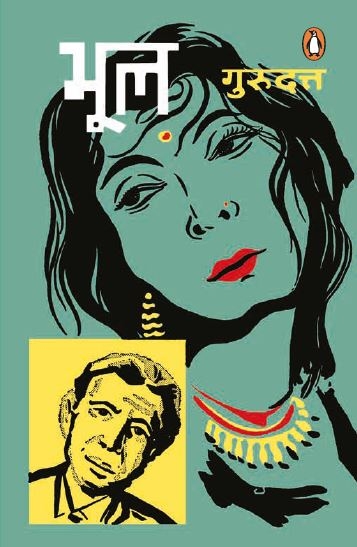
The story of Madanmohan and Nirmala is in this novel. They do love marriage. They are working, so they had to keep a maid. But Nirmala has a doubt on her character and from there his marriage life was corrupted. Nirmala doesn’t want to leave his job and Madanmohan advises to his wife to leave the job for save their marriage life.
Bhairavi Chakra
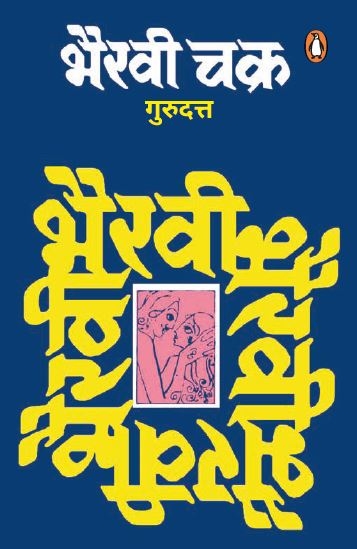
This novel discussed about famous Bhairav Community in ancient era, who consider sex act as legal. That time the unpleasantness was spreading between Bauddh & Other Community, so the writer found a new path. That time Kashmir was the independent state and the cultural relation with India, that was very important, which was indicating in this novel. That time Kashmir was an integral part of India besides of an independence state
Dhuppal

Dhuppal is a biographical novel. How a boy of backward area became Bhagawaticharan Verma, which he didn’t know himself. He only knows the struggle of life, which he calls Dhuppal. He didn’t written autobiography but written a novel.
Aakhiri Daanw
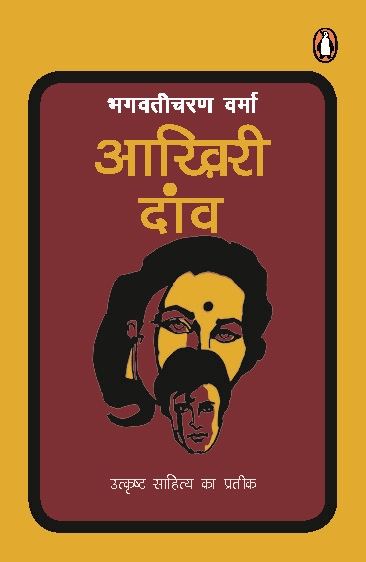
The writer of this novel has raised the problems of the society on his own point of view. The deceptive colorful illustration of filmi world are also be there along with social problems. The serial was broad cast on Door Darshan in 1990 with the name of Aakhiri Daanw, that time which established a new record of popularity
Aanand Math
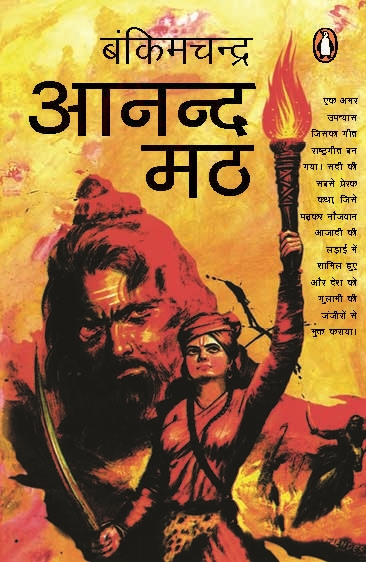
This is that novel, which one song was ‘Vande Matram’ became Rashtriya Geet and provide many amazing enthusiasms to the revolutionaries. Bankim Babu illustrated the courage of revolutionaries with challenging to the British in this novel & alert to every Indians about freedom is the primary right.