



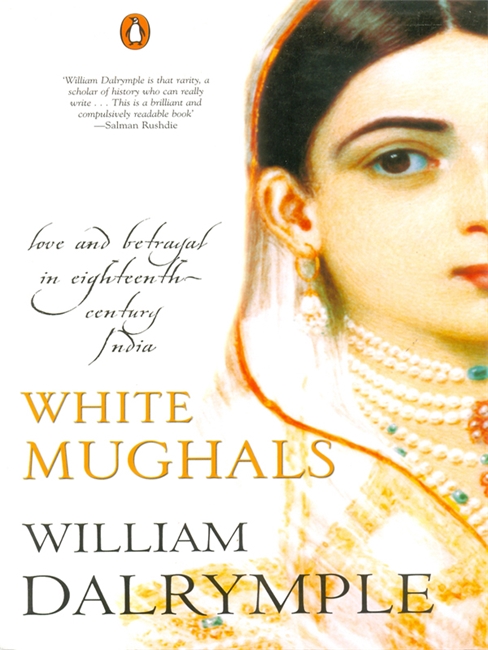
James Achilles Kirkpatrick landed on the shores of eighteenth-century India as an ambitious soldier of the East India Company. Although eager to make his name in the subjection of a nation, it was he who was conquered—not by an army but by a Muslim Indian princess. Kirkpatrick was the British Resident at the court of the Nizam of Hyderabad when in 1798 he glimpsed Khair un-Nissa—’Most Excellent among Women’—the great-niece of the Nizam’s Prime Minister. He fell in love with Khair, and overcame many obstacles to marry her—not least of which was the fact that she was locked away in purdah and engaged to a local nobleman. Eventually, while remaining Resident, Kirkpatrick converted to Islam, and according to Indian sources even became a double-agent working for the Hyderabadis against the East India Company. Possessing all the sweep of a great nineteenth-century novel, White Mughals is a remarkable tale of harem politics, secret assignations, court intrigue, religious disputes and espionage.
Archives: Books
The Age Of Kali

From the author of The Last Mughal and Nine Lives: the classic stories he gathered during the ten years he spent journeying across the Indian subcontinent, from Sri Lanka and southern India to the North West Frontier of Pakistan. As he searched for evidence of Kali Yug, the “age of darkness” predicted by an ancient Hindu cosmology in a final epoch of strife and corruption, Dalrymple encountered a region that thrilled and surprised him. Venturing to places rarely visited by foreigners, he presents compelling portraits of a diverse range of figures—from a Hindi rap megastar through the Tamil Tigers to the drug lords of Pakistan. Dalrymple’s love for the subcontinent comes across in every page, which makes its chronicles of political corruption, ethnic violence and social disintegration all the more poignant. The result is a dark yet vibrant travelogue, and a unique look at a region that continues to be marked by rapid change and unlimited possibilities as it struggles to reconcile the forces of modernity and tradition.
In Xanadu
In Xanadu is, without doubt, one of the best travel books produced in the last 20 years. It is witty and intelligent, brilliantly observed, deftly constructed and extremely entertaining. Dalrymple’s gift for transforming ordinary humdrum experience into something extraordinary and timeless suggests that he will go from strength to strength. The book leavens adventure story and scholarly history with farcical dialogue with high-spirited buffoonery. It is a fast, furious read, clearly the stuff bestsellers are made of.
From The Holy Mountain
A Journey in the Shadow of Byzantium
‘In his third book William Dalrymple has dug deep to present the case of the Middle East’s downtrodden Christians. More hard-hitting than either of his previous books, From the Holy Mountain is driven by indignation. While leavened with his characteristic jauntiness and humour, it is also profoundly shocking. Time and time again in the details of Dalrymple’s discoveries I found myself asking: why do we not know this?
The sense of unsung tragedy accumulates throughout the chapters of this book…From the Holy Mountain is the most rewarding sort of travel book, combining flashes of lightly-worn scholarship with a powerful sense of place and the immediacy of the best journalism. But more than that it is a passionate cri de coeur for a forgotten people which few readers will be able to resist’—Philip Marsden, Spectator.
Collected Stories
Story-writing is, to me, a way of exploring the world,’ says best-selling novelist and short-story writer Shashi Deshpande. In this, the second volume of her collected short fiction, we travel with her into a world of characters and situations that are identifiable, and experience emotions that are at once complex and cathartic. Intensely felt and beautifully rendered, these are stories that will stay with you a long, long time.
Distorted Mirror

R.K. Laxman, cartoonist par excellence, is also one of the country’s most entertaining writers. The Distorted Mirror brings together some of his best short stories, essays and travelogues. The collection begins with ‘An Accident’, a most unusual mystery story where the murder weapon is a newspaper. In other stories, we are introduced to Gopal, a schoolboy in an ordinary small town that is transformed one day when the Viceroy visits; Shantha, a little girl who makes an interesting discovery in the midst of a wedding; and Bhasker, a writer who is suddenly confronted by his past. Each story is marked by Laxman’s ability to delineate a character or a moment with a few deft strokes and imbued with his trademark wit. No less fascinating are the travelogues-about the United States, Australia, the Andamans, Darjeeling, Mauritius and Kathmandu-which are brought to life by Laxman’s vivid descriptions and his inimitable way of looking at the world around him. The collection is rounded off with a few rare and delightful anecdotes about Laxman’s cartooning career, a subject on which he is usually reticent. Accompanied by Laxman’s illustrations, the pieces in The Distorted Mirror will amuse and entertain every fan of R.K. Laxman’s.
Sari Shop
A gem of a novel about the stuff life’s made of It is another working day in Amritsar, and Ramchand is late again. He runs through the narrow streets to Sevak Sari House, buried in the heart of one of the city’s main bazaars. There, amongst the Bangladesh cottons and Benaras silks, Ramchand and his fellow shop assistants sit all day, patiently rolling and unrolling yards of coloured fabric. Then, one afternoon, Ramchand is sent to a new part of the city with a bundle of saris carefully selected for a trousseau. His trip to Kapoor House jolts him out of the rhythm of his daily routine and his glimpse into this different world charges him with an urgent sense of possibility. And so, armed with a second-hand English grammar book and a battered Oxford Dictionary, a fresh pair of socks and a bar of Lifebuoy soap, Ramchand attempts to realize the dream that his childhood had promised. But soon these efforts turn his life upside down, bringing him face to face with the cruel reality of his very existence. The Sari Shop heralds the arrival of a writer who combines a profound sensitivity with humour and unflinching honesty. Rupa Bajwa’s story is both heartbreaking and very real, and depicts a modern world in which hope and violence are permanently entwined.
Corridor
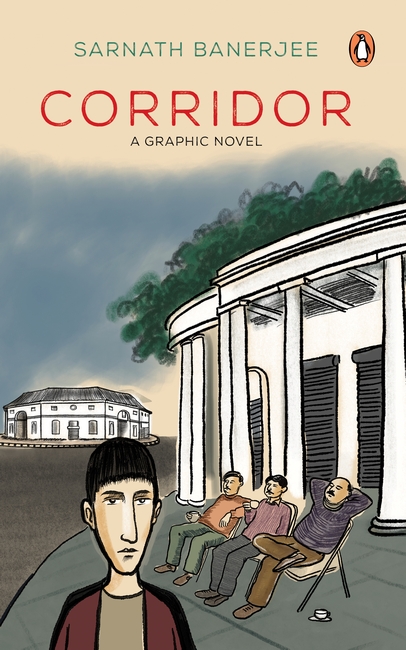
The story of Corridor revolves around an enlightened dispenser of tea, Jehangir Rangoonwalla, who has a shop in the heart of Lutyens’ Delhi, Connaught Place. He also sells second-hand books and dispenses wisdom to his customers. All of the main characters of the novel have this shop as their common local haunt and Mr Rangoonwalla interacts with these residents of Delhi when they visit his shop and at times gives them his words of wisdom. They come to him for tea, books, conversation and advice.
The story is about a plethora of characters, each from a different strata of society and different background. These customers are Brighu, passionate for obscure collectibles and a real love life, Shintu, the newly married on a quest of the ultimate aphrodisiac, and Digital Dutta, a person mostly torn between an H-1B visa and Karl Marx. Dutta is portrayed as a man who lives in his head.
Each of these characters has a story of his own and the author ties them together in a brilliant manner for his book. While narrating their stories, Banerjee subtly touches the greyer shades of their lives and presents them vividly to the reader. The entire novel has been captured in the corridors of contemporary Connaught Place in Delhi and Calcutta. Various pictures and objects have been shown in the background frame and the author ensures to refer them, thereby touching upon the different cultural references.
Sarnath Banerjee presents a different flavour to the art of storytelling by mixing various other art forms such as sketches, illustrations, and photographs. These heighten the impact on the reader in a beautiful way. The author uses an imaginative alchemy of words and images, of a script and artwork, to present the alienation and fragmented reality of the Indian urban life. Thus, the novel presents a delightful tale with interesting twists and turns.
The Caterpillar Who Went On A Diet And Other Stories
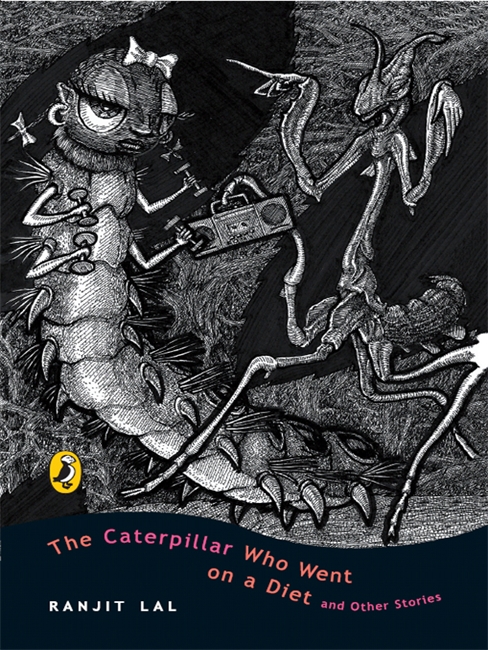
A hilarious glimpse of the complex lives of insects These fourteen scintillating stories are marked by Ranjit Lal’s usual combination of meticulous research, rollicking storytelling and fascinating characters. Nimbu, the caterpillar, resolves to go on a diet inspired by the stick insect. Cheeni Chor, the ant, discovers a refrigerator stuffed with goodies and is driven to rebellion. Ladoo Gulabjamun, one of the resident cockroaches of the famous Golden Thali Restaurant, decides to take on the management to impress his ladylove. You will also meet the body-building cricket, the dung beetles who like to party and a host of other insects who reveal their inner lives as never before and are true to both the insect and human world. Lal’s mastery of the world of birds and beasts, as captured in Crow Chronicles and The Life and Times of Altu Faltu, also extends to the world of insects, and this is perhaps his most enchanting and comical book to date. Rahul Dutta’s unusual and striking illustrations capture the magic of worlds Lal reveals.
Department Of Denials
The best selling author of The Inscrutable Americans and Making the Minister Smile returns with another entertaining story in The Department of Denials. In this latest venture, Babar Thakur” Babs to his friends” a youth fresh out of college in search of an identity and direction in life, sets off on a trip to fulfil his dream of becoming the prime minister of India one day.In the best traditions of all heroic odysseys, he starts out on his quest alone. Soon, he is on a roller coaster ride through the corridors of power, witness to the shenanigans of netas and babus. Chief among them is the minister Balak Kumar, who, repeatedly at the receiving end of various allegations from the Opposition, finally decides to centralize all denials under one authority, namely, the Department of Denials. And he asks Babs’s father, Bahadur Prasad Thakur, to head the newly created department. The stage is thus set for an unending run of situations, alternately bizarre and funny.