



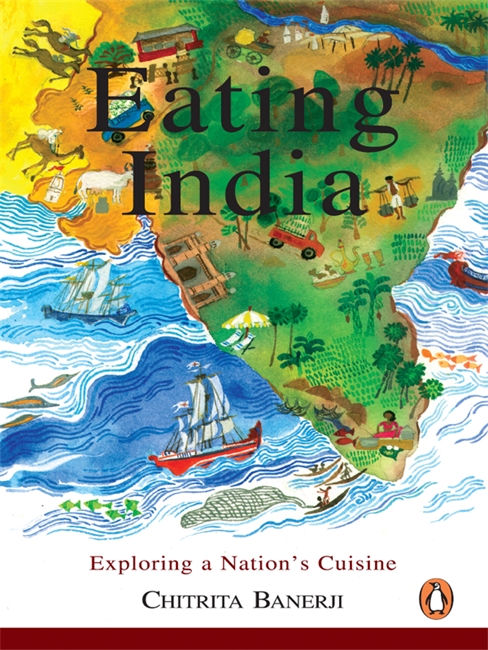
In Eating India, award-winning food writer Chitrita Banerji takes us on an extraordinary journey through a national cuisine formed by generations of arrivals, assimilations and conquests. Traveling across the length and breadth of the country-from Bengal to Goa and Karnataka, via the Grand Trunk Road, then northwards to Amritsar, Lucknow and Varanasi, on to Bombay and Kerala-Banerji discovers a civilization with an insatiable curiosity, one that consumes the old and the new with eager voracity. Weaving together myths and folklore associated with food, the people and their culture, the author narrates captivating accounts of life in the subcontinent: the legend behind the week-long harvest festival of Onam; the strictly observed rules of kosher in the Jewish households of Cochin; the best Benarasi thandai that has a dollop of bhang in it; and the food and culture of the indigenous people who hover on the edges of mainstream consciousness, among others. Eating India is also peppered with fascinating tidbits from India’s history: the use of ‘shali’ rice to make pilafs during the Mughal period; the advent of chillies with the arrival of the Portuguese; British, apart from Goan, influence on Parsi society that prompted the Parsis to open the first girls’ school in India in 1849; and the medieval movable feast that unfolded on the travellers’ platter as they moved from east to west on Sher Shah Suri’s Sarak-i-Azam. At different points in her journey, Banerji shows us how restructuring old customs and making innovations is what India is all about: food in India has always been and still is fusion-one that is forever evolving. Certain to enchant anyone enamoured of Indian food and culture, Eating India is a heady blend of travelogue and food writing.
Archives: Books
The Shattered Thigh & Other Plays
The Girl
The Blind Pilgrim
Meet Pooch, the mongoose along with scorpions, crabs, centipedes and other insects and reptiles in the pages of this charming little book as they talk about their habits and eccentricities – in verse! Did you know that the cobra cannot hear, and ‘dances’ because it is following the movements of the snake charmer’s flute? That the hermit crab does not have a shell of its own and has to go about looking for one that fits? And what, exactly, does the cockroach feel when you flee screaming from it? Crackling with wit, and full of fun facts, these poems by the author of the widely acclaimed “Cobra in My Kitchen”, are a must read for poetry and nature lovers alike.
The Boastful Centipede And Other Creatures in Verse

Meet Pooch, the mongoose along with scorpions, crabs, centipedes and other insects and reptiles in the pages of this charming little book as they talk about their habits and eccentricities – in verse! Did you know that the cobra cannot hear, and ‘dances’ because it is following the movements of the snake charmer’s flute? That the hermit crab does not have a shell of its own and has to go about looking for one that fits? And what, exactly, does the cockroach feel when you flee screaming from it? Crackling with wit, and full of fun facts, these poems by the author of the widely acclaimed “Cobra in My Kitchen”, are a must read for poetry and nature lovers alike.
Show More
Show Less
The Co-wife & Other Stories
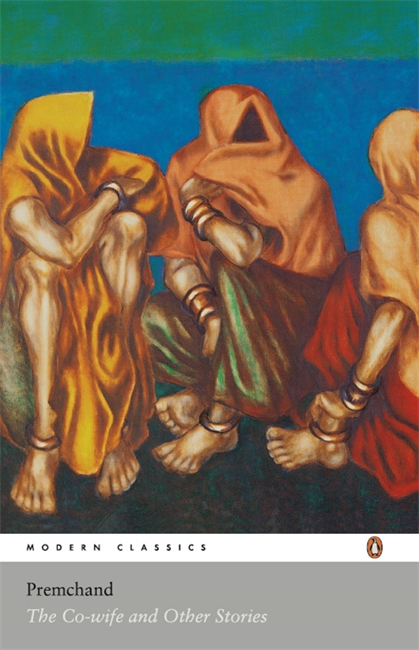
Premchand is India . . . If you haven’t read Premchand, you have missed out on a lot’ -The Hindu
Considered one of the greatest fiction writers in Hindi, Munshi Premchand (1880-1936) wrote over three hundred short stories, a dozen novels and two plays over a prolific career spanning three decades. Though best known for his stories exposing the horrors of poverty and social injustice, he wrote on a variety of themes with equal facility-romance, satire, social dramas, nationalist tales, and yarns steeped in folklore.
The Co-wife and Other Stories brings together twenty classic tales of Premchand which provide a glimpse of the author’s extraordinary range and diversity. While some cast a harrowing look at poverty, reflecting Premchand’s sympathy with the underdog, others expose human foibles without being judgmental and tackle gender politics in a humorous and ironic manner. This collection also includes an imaginative foray into historical fiction, a nostalgic look at childhood, a comic exploration of the theme of women’s autonomy, and stories that reveal the writer’s profound empathy with animals.
Ruth Vanita’s sensitive translation captures the power and beauty of Premchand’s language, conveying the nuances of the original and bringing to life the author’s inherent humanism.C
Ethnography Of Goa, Daman And Diu
The intellectual and cultural efflorescence in Goa reached its apogee in the late nineteenth and early twentieth centuries. Antonio Bernardo de Bragana Pereira was a product of this time, and Ethnography of Goa, Daman and Diu is an expression of the author passionate interest in scholarship and research into various dimensions of Goan life. His intellectual curiosity and critical spirit led him to delve deep to understand the lan vital of the society of his ancestors and to catalogue the many dimensions of Goan life. In the book he describes the rituals, customs and manners of various castes and religions, their habitat, their artisanship, their environment and all aspects of Goa and Goan society. Ethnography of Goa, Daman and Diu was published as a two-volume edition in 1940 in Portuguese. In making the second volume available to a larger readership, the publishers perform a dual role of bringing this scholarly work to a new generation of readers and in a language that will be accessible. Its publication is a tribute to A.B. de Bragan.a Pereiras passionate attachment to Goa and his pride in being a Goan.
Sacred Games
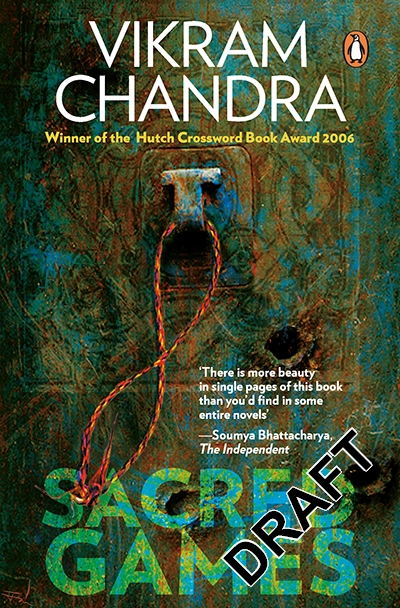
WINNER OF THE HUTCH CROSSWORD BOOK AWARD 2006 FOR BEST WORK IN ENGLISH FICTION Seven years in the making, Sacred Games is an epic of exceptional richness and power. Vikram Chandra’s novel draws the reader deep into the life of Inspector Sartaj Singh, and into the criminal underworld of Ganesh Gaitonde, the most wanted gangster in India. This is a sprawling, magnificent story of friendship and betrayal, of terrible violence, of an astonishing modern city and its dark side. Drawing on the best of Victorian fiction, mystery novels, Bollywood movies and Chandra’s years of first-hand research on the streets of Mumbai, Sacred Games reads like a potboiling page-turner but resonates with the intelligence and emotional depth of the best of literature.
The Untold Charminar

A dazzling collection that captures the essence of Hyderabad, offering glimpses of the various strands that go into its making, fact and legend, old-world quaintness and the highest hi-tech, eccentricity and intrigue, the calm of genteelness and the fury of rebellion.
Hyderabad is a city once ruled by the worlds richest man who invested most lavishly in his state, most shabbily in his wardrobe; it holds stories of a courtesan who fought wars, counselled prime ministers, sang her own verse and enthralled luminaries who mattered; of a chief minister who transformed it into a hi-tech hub; and of a sports star who brought the young glamour of India to every tennis court in the world.
Home as much to the Golconda as to Jacob, the 187-carat diamond used as a paperweight by the Nizam, and to rock landscapes two and a half million years old, Hyderabad is a city that forever mixes cultures, cuisines, religions and languages. Here, Persian turned alloy with Telugu, Marathi and Arabic to yield a special version of Urdu, Dakhini. And here, as Andhra mingled with Telangana, a smiling mildness has survived, disarming at every turn, just as grace under pressure, regardless of gender, is unfailing.
In The Untold Charminar readers will discover a city they will want to explore, as Sarojini Naidu, Sir Mark Tully and William Dalrymple rub shoulders with Ian Austin, Meenakshi Mukherjee and Anees Jung, regaling you with their feast of hard facts and hearsay; as each foreign visitor shares his story through Narendra Luther; as the film-makers Shyam Benegal and Nagesh Kukunoor paint their vivid memories of home; as poets, not just the maverick Makhdoom and Gaddar, raise their voices in song; as statesmen, academics and aficionados hold forth on the completely different Hyderabad each experienced.
And when Tejaswini Niranjana profiles the vigilante Vijayasanthi and Dharmender Prasad picks out place names and explains their sometimes almost mystic origins, as Bachi Karkaria, Omkar Goswami and Harsha Bhogle share their typically offbeat views of a favourite city, readers will be persuaded to believe they have encountered not a city but the inner workings of a very complex character.
Tamas
‘Tamas drove the point home that ordinary people want to live in peace’ -The GuardianSet in a small-town frontier province in 1947, just before Partition, Tamas tells the story of a sweeper named Nathu who is bribed and deceived by a local Muslim politician to kill a pig, ostensibly for a veterinarian. The following morning, the carcass is discovered on the steps of the mosque and the town, already tension-ridden, erupts. Enraged Muslims massacre scores of Hindus and Sikhs, who, in turn, kill every Muslim they can find. Finally, the area’s British administrators call out the army to prevent further violence. The killings stop but nothing can erase the awful memories from the minds of the survivors, nor will the various communities ever trust one another again. The events described in Tamas are based on true accounts of the riots of 1947 that Sahni was a witness to in RawalpPBI – Indi, and this new and sensitive translation by the author himself resurrects chilling memories of the consequences of communalism which are of immense relevance even today.