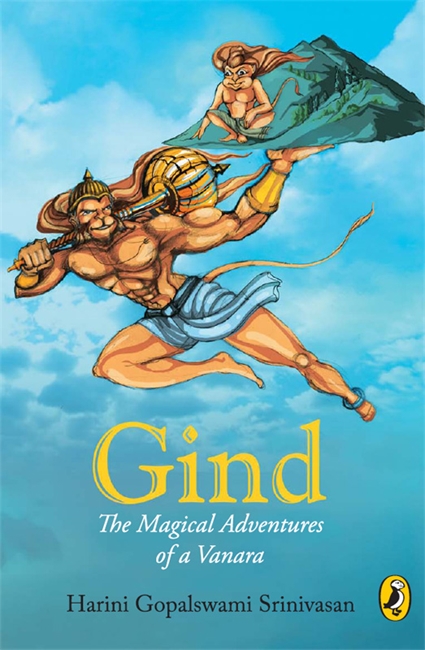
When Ongchu, a young vanara princess, is kidnapped by a rakshasan, Rishi Agastya entrusts Gind, a bold young vanara, with the dangerous mission of restoring her to Baulpur, her home beyond the Himalayas. As Gind, his father Karuppan, and Ongchu set out on their long, arduous journey from the island of Poompuhar, they are stalked by wild animals and magical beings, waylaid and terrorized by rakshasas, and thwarted by a wrathful Indra, the god of thunder. They meet an army of vanaras on a mission to rescue a human princess from the clutches of the wicked rakshasa king; help a giant vanara in his search for the magical herb sanjeevini; and winter with a band of yetis in the high Himalayas. Mysterious and momentous things are happening around the vanaras, but they are clueless about their own part in these events. What is Agastya’s secret purpose? Will the three vanaras make it to Baulpur? What are the shadowy forces at work?
Gind’s exciting adventures will have you rollicking from one escapade to another in this action-packed fantasy. Meet delightful, strange and magical characters, and follow the trail of the vanaras as their light-hearted adventure turns into an odyssey…
A sudden violent storm takes Kolkata by surprise. It also leaves Narendra Nath Biswas injured, hit by a falling tree in the Park Street Cemetry . . . or was it the work of some unknown assailant? Feluda starts his own investigations and soon encounters enough questions to puzzle his matchless intellect.
Who was Thomas Godwin and why is someone digging up his grave? What is a Perigal Repeater? Who is this mysterious N.M. Biswas?
In his search for answers, Feluda digs up the fascinating history of the Godwin family going back to nineteenth-century Lucknow, and learns about Thomas Godwin’s precious heirloom. Ghostly happenings in a graveyard, a ruthless criminal with a gang of thugs, a master chef and a happy quitar player come together in an adventure full in danger and excitement.

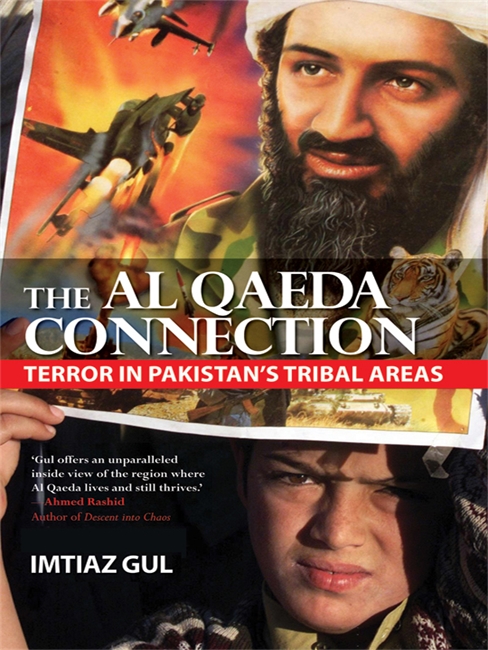
The face of Terror has changed dramatically. Today major terrorist attacks are marked by their meticulous preparation and deadly execution—as the Mumbai attacks of 26/11 have clearly established. The most important planning centre for these operations is the tribal region located on the border between Pakistan and Afghanistan. Following the U.S. action in Afghanistan in December 2001 many Al Qaeda and Taliban fighters escaped and settled down in these regions where, historically, the writ of the state has always been weak. Taking advantage of the inhospitable terrain and the porous border, Al Qaeda militants of multiple ethnic origins regrouped.
In 2008 alone they launched over fifty suicide missions which have inflicted more than six thousand casualties in attacks across the PBI – World. In these remote valleys the fatal mix of ultra-conservatism, economic under-development, religious obscurantism and the absence of law and justice has resulted in a cauldron of militancy which is being fed and fuelled by the shadowy presence of the Al Qaeda and the Taliban. Ever-younger fighters are being recruited for suicide missions while music, shaving and the education of girls are proscribed by increasingly powerful clerics.
In this book Imtiaz Gul follows the trail of militancy and the way it has evolved under Al Qaeda’s influence in tribal areas.
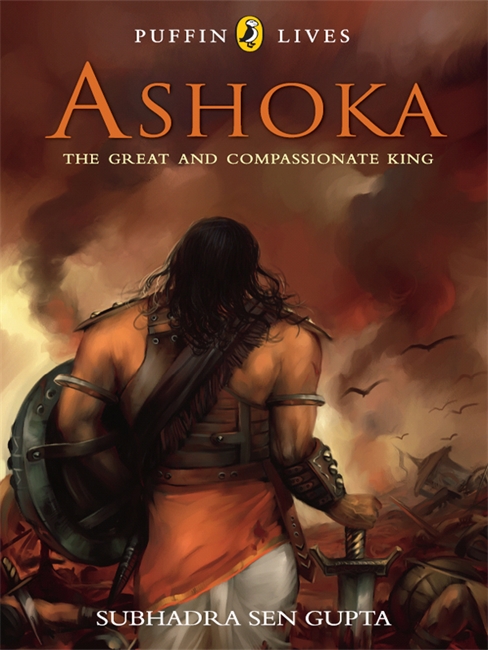
Ashoka the Great, the ruler of ancient India’s largest kingdom, took the path of peace, tolerance, non-violence and compassion after a fierce battle in Kalinga. He now addressed his subjects as a father would his children, and erected pillars that spread his thoughts throughout the land in the people’s own language. He put their welfare above all else and worked towards that for the rest of his life. One of the most well-known symbols from India’s history, the Ashoka chakra, now adorns India’s national flag, and the lion capital from his pillars is our national emblem. In this lively, engrossing account of Ashoka’s life and the times, Subhadra Sen Gupta deftly brings him alive again from behind the swirling mists of time.
It is 1953 in colonial Kenya, and eightyearold Vikram Lall witnesses the celebration of Queen Elizabeth’s coronation, even as the Mau Mau guerilla war challenges British rule. Vic and his sister Deepa, whose grandfather came to Kenya from Punjab to build the railways, must find their place in this uncertain world of violent upheaval, confusing loyalties and conflicting ideologies. And among their newly acquired playmates, the brother and sister, neither Black nor White, find themselves in between British Bill and Annie, and the African Njoroge. These friendships will haunt them the rest of their lives. We follow Vic from the changing Africa of the fifties, to the sixties— a time that holds immense promise. But when that hope is betrayed by the corruption, fear and repression of the seventies and eighties, Vic finds himself drawn into the official orbit of graft and powerbrokering. Njoroge, on the other hand, can abandon neither the idealism of his youth nor his love for Deepa. Neither the cynicism of the one nor the idealism of the other can avert the tragedies that await. Acute and bittersweet, vividly portrayed and finely nuanced, The InBetween World of Vikram Lall is told in the voice of the exiled Vic from the shores of Lake Ontario, as he contemplates the historical events that have shaped him— `one of Africa’s most corrupt men’— and the choices he has made.
FROM THE AUTHOR OF OPEN SECRETS, THE UNTOLD STORY OF THE HUMAN TRAGEDY IN BENGAL BEFORE, DURING AND AFTER PARTITION.
Maloy and his mother board the Dacca- Sylhet Express from Bhairab in 1950. The young boy notices a tick mark in white chalk on the side of the carriage, a sign that worries him. The train enters the Anderson Bridge, and a blob, of fresh bloos hits Maloy’s face. Bodies roll down to the river…
As a young boy, Maloy Krishna Dhar, made the perilous journey to India from the East Pakistan. Politics had taken a communal colour in this region-age-old bonds between Hindi and Muslim Bengalis had deteriorated. The situation was made worse by near famine conditions and the brutal suppression of unrest. Villages were torched, marauding attackers had a free hand, and trains became charnel houses on wheels.
The partion in Bengal had its share of tragedy, of lives unmade and lost, but it is relatively less chronicled than events in Punjab. Maloy Krishna Dhar’s Train to India is a graphic and moving account of that turbulent and unforgotten era of Bengal History.
Economists talk of prices rising or falling in response to excess of demand or supply in the market, but are at a loss to explain who sets the price in a market of many players where no one has the power to dictate price. They then have to invent the ‘invisible hand’ of a mythical god called ‘price mechanism’ to create the image of the market operating as a self-regulating system. While unregulated free trade amounts to groping in the dark, the situation is far worse when the prices and other rules of the market are set by the state on behalf of large corporations-as has happened in globalizing India in the name of economic development.
Large corporations, aided and abetted by the land acquisition policies of the central and state governments, are indulging in massive land-grabbing. We witness the perversity of development in the destruction of livelihoods and displacement of the poor in the name of industrialization, in the construction of big dams for power generation and irrigation, in the corporatization of agriculture despite farmers’ suicides, and in the modernization and beautification of our cities by the demolition of slums.
One of India’s foremost theoretical economists, Amit Bhaduri contends that we have abjectly surrendered to the conventional wisdom of our time-that there is no alternative to corporations and the type of globalization that they lead. The result, he warns, will not be a freer market and more freedom, but a disastrous and deepening chasm between the India of privilege and the India of crushing poverty.
The Face You Were Afraid to See is a collection of compellingly argued essays that draws attention to the other India that we turn away from. Fiercely critical of financial liberalization, corporate-led globalization and neoliberalism that celebrates unregulated free trade, the essays together make for a forceful critique of India’s economic policies.
Every May something extraordinary happens in the new cemetery of the sleepy little town – a laburnum tree, with buttery yellow blossoms, flowers over the spot where Lentina is buried. A brave hunter, Imchanok, totters when the ghost of his prey haunts him, till he offers it is a tuft of his hair as a prayer for forgiveness. Pokenmong, the servant boy, by dint of his wit, sells an airfield to unsuspecting villagers. A letter found on a dead insurgent blurs the boundaries between him and an innocent villager, both struggling to make ends meet. A woman’s terrible secret comes full circle, changing her daughter’s and granddaughter’s lives as well as her own. An illiterate village woman’s simple question rattles an army officer and forces him to set her husband free. A young girl loses her lover in his fight for the motherland, leaving her a frightful legacy. And a caterpillar finds wings.
From the mythical to the modern, Laburnum for My Head is a collection of short stories that embrace a gamut of emotions. Heart-rending, witty and riddled with irony, the stories depict a deep understanding of the human condition.