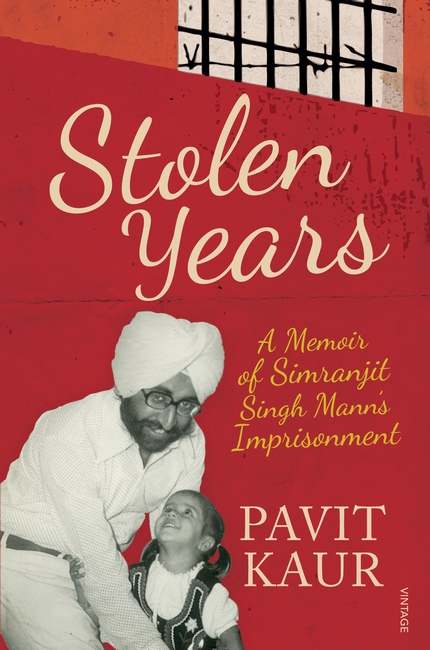
In 1984, Simranjit Singh Mann resigned from the Indian Police Service in protest of Operation Blue Star, the Indian Army operation ordered by Indira Gandhi, then prime minister, that cleared the Golden Temple complex of Sikh militants. Mann was subsequently charged, among other things, with conspiracy to assassinate Prime Minister Indira Gandhi. A passionate Sikh whose radical beliefs were honed by his family, Mann went underground and was apprehended while trying to flee the country. He spent five years in prison, after which all charges were dropped.
Three decades after Blue Star, his daughter Pavit Kaur looks back on the years her father spent in prison. In this disarmingly honest and emotionally charged account, Pavit Kaur documents her father’s hellish journey through the Indian prison system. This is also a personal story and the story of a family during one of the most fraught times in India’s history.
This fabulous volume, containing compositions of mystic poets across India, fromKabir, Annamacharya and Chandidas to Tukaram, Meera, Akkamahadevi and manymore, reminds us of the rich palette of Bhakti. Featuring classic translations as well asnew, unpublished ones by acclaimed poets, it will delight seekers and poetry lovers alike.

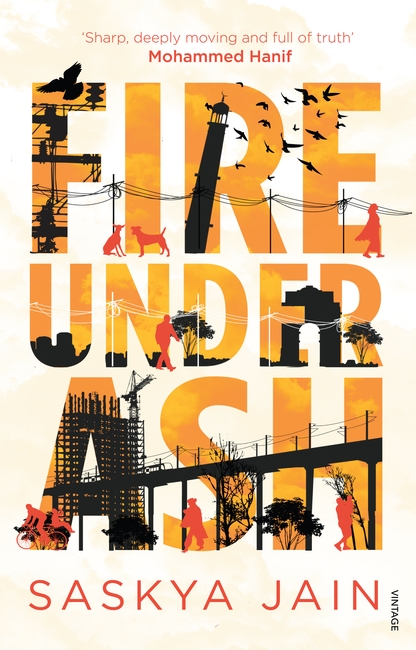
When Ashwin, a wealthy Delhi boy, meets Lallan, a struggling student from Patna looking to make his fortune, their friendship, with their mutual love for the almond-eyed Mallika, seems to transcend the fault lines of class and privilege.
But one night at a party, a fateful incident leads their worlds to unravel with consequences that change both their lives forever, and expose the deep turmoil inherent in the frenetic energy of the new, aspiring India.
An audacious debut, Fire Under Ash marks the arrival of Indian fiction’s latest star, who takes a coruscating look at Delhi’s beauty and brutality, writing the city as we’ve never read it before.

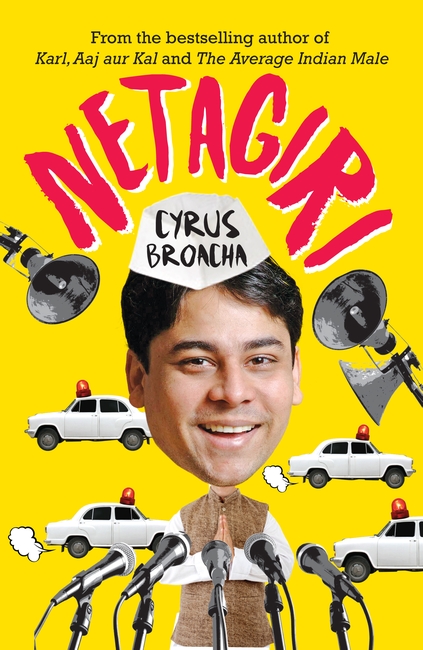
When Jay Huskee—the grand patriarch of the Huskee clan—falls out of a window and goes missing, he sets off a sequence of events that results in one of the biggest political showdowns in the history of the country of Gyaandostaan.
In his absence, his grandson Paul must now stake claim to what is rightfully his. Backed by an ebullient ‘crack’ team, Paul must now confront his greatest fears—including talking to girls—to rescue his people from an oppressive regime.
Riotous and riveting, Netagiri takes a satirical look at a power-obsessed society by India’s original funnyman.
An inspired observer of the Indian psyche, Sudhir Kakar trained as a psychoanalyst at the Sigmund Freud Institute, Frankfurt. He set up a clinic in Delhi in 1975, thus embarking on a lifelong search for the wellsprings of Indian identity. He went on to establish the new discipline of cultural psychology.
A Book of Memory records not only the crises of identity and intellect, but also the highs and lows of love and pleasure. It is fearless and revelatory with regard to the self and its motivations, a rare candour illuminating the urbane prose.
Angie Kulkarni is totally NUTS about fashion
and loves putting together zany outlandish
outfits! But life isn’t easy when your mother,
Bollywood superstar Kajol Kulkarni, constantly
doubts your style and thinks you’re a complete
fashion disaster!
You didn’t think it was going to be easy, did you?
To move on
To break up
To find someone else . . .
Molested in a nightclub, Aastha is left shaken and reeling. Thankfully, her best friend, Sameer, is a source of constant support, but he’s already in a rocky long-distance relationship with Karuna. Their friends Padmini and Rahul love each other, yet forever seem to be on the verge of breaking up. And as life takes its own course, each of them begins to grapple with their own issues.
Where and with whom will they end up? And where will their relationships finally take them?
Simply Complicated is a glimpse of life as it is-with a few good laughs and dozens of knotty problems.
In Mumbai, driven to its knees by a merciless blizzard, Saam the watchmender is cornered into an intolerable position. As Shiva’s only earthly demigod child, it falls upon him to stop his indomitable father.
Bred to war, son of destruction, Saam rides with six extraordinary companions into the horror of a crumbling world to face Shiva. He is forced to join hands with Ara, his half-brother he can never fully trust, and take with him his own mortal beloved, Maya, on this desperate attempt to stop the End of Days. But his path is littered with death, danger and betrayal.
Interweaving mythology, epic adventure and vintage heroism, this enthralling novel will change the way you see gods, heroes and demons.

Gathering the work of a lifetime, spanning four books of poetry, and including thirty-four new poems, Collected Poems is the first comprehensive collection of the work of one of India’s most influential English language poets. Arvind Krishna Mehrotra’s poetry has long been known for its mixing of the commonplace and the strange, the autobiographical and the fabulous, in which the insignificant details of everyday life-whether contemporary or historical-bring larger patterns into focus.
Mehrotra’s celebrated translations from Indian languages (Prakrit, Hindi, Gujarati, Bengali) take up a third of Collected Poems. Selections from The Absent Traveller and Songs of Kabir are followed by those of Nirala, Vinod Kumar Shukla, Mangalesh Dabral, Pavankumar Jain and Shakti Chattopadhyay. Together they tell the story of Indian poetry over two millennia.
In October 1947, two months after he became independent India’s first prime minister, Jawaharlal Nehru wrote the first of his fortnightly letters to the heads of the country’s provincial governments-a tradition that he kept until his last letter in December 1963, only a few months before his death.
Carefully selected from among nearly 400 such letters, this collection covers a range of themes and subjects, including citizenship, war and peace, law and order, national planning and development, governance and corruption, and India’s place in the world. The letters also cover momentous world events and the many crises and conflicts the country faced during the first sixteen years after Independence.
Visionary, wise and reflective, these letters are not just a testimony to Nehru’s statesmanship and his deep engagement with every aspect of India’s democratic journey, but are also of great contemporary relevance for the guidance they provide for our current problems and predicaments.