



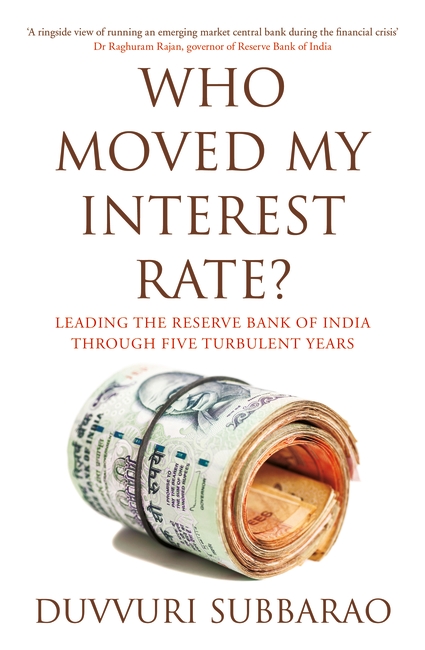
Duvvuri Subbarao’s term as the governor of the Reserve Bank of India from 2008 to 2013 was by all accounts an unusually turbulent period for the world and for India. The global financial crisis erupted within a week of his assuming office. Then, just as the impact of the crisis on India ebbed, the action shifted to combating a decade-high, stubborn inflation during 2009¬¬¬¬-11, which segued into a battle against a sharp depreciation of the rupee starting mid-2012. Who Moved My Interest Rate is an insider’s account of the dilemmas and quandaries Subbarao confronted while leading the Reserve Bank through these extraordinary economic and political challenges.
Subbarao’s five years at the Reserve Bank also marked an intellectually vigorous period for central banking around the world. Not only did the global financial crisis test the policy force of central banks, but it also raised several questions about the breadth of their mandates and the limitations of their autonomy and accountability. While much of the existing debate is set in the advanced economy context, Who Moved My Interest Rate places these issues squarely in an Indian and emerging market perspective.
This is also a compelling chronicle of Subbarao’s attempts to demystify the Reserve Bank and explain to the public its impact on their everyday lives. Honest, authoritative and deeply insightful, this book enhances our understanding of what is, arguably, one of India’s most trusted institutions.
Archives: Books
Laid in India
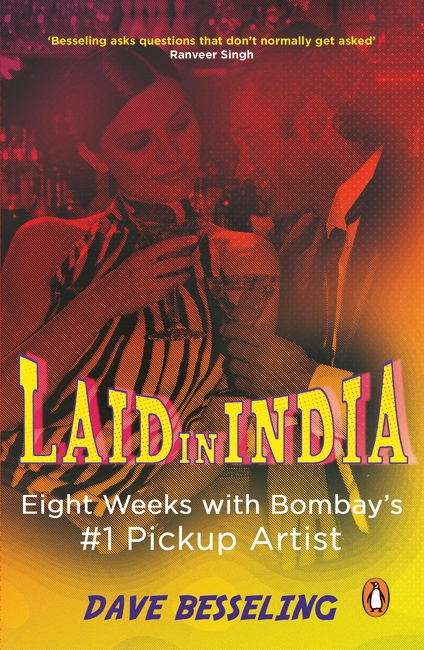
‘For a guy, attraction is simple,’ says Sid. ‘It’s like a switch. You see a hot girl, you want to have sex with her . . . For a girl, things are more complicated,’-fingertips glued together for a few seconds of emphasis-‘looks are just one switch of six, maybe seven. If you can flick all those switches, she will feel a compelling attraction to you. It’s evolutionarily hardwired.’
Meet Siddharth Malhotra, self-appointed Number One Pickup Artist in India, once a dork in a Tier-2 town in Andhra Pradesh who has never known the touch of a woman. Like many before him, he can now get just about any woman, as he boasts. The trick? A secret move only he knows, and an urban encyclopedia of psychological know-how targeted at the fair citizens of India’s metropolises.
Trailing him disbelievingly is a Canadian journalist, drawn to this curious character, six feet plus, wearing geeky glasses and a tailored suit-‘no Ranveer Singh, but no Shakti Kapoor either’. As he watches Sid prove his game bar after bar in Bandra, we discover a frightening yet compelling substrata of Indian pick-up artists. What makes young Indian men like Sid tick, and how do they thrive within a society which is the ultimate ‘cock-blocker’?
The story that follows is that of young urban India today, guided by Tinder and TrulyMadlyDeeply as well as the all-seeing Indian mother and equally ubiquitous societal pressure. Hilarious, acute and full of uncanny insight on modern-day dating, Laid in India reads as real as a pub brawl-and punches just as hard.
The Girl Who Chose
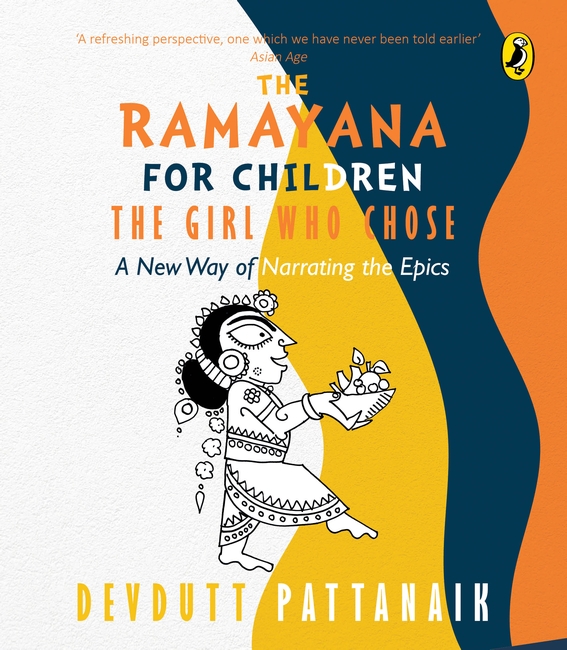
A book about consent and choosing responsibly
‘You are bound by rules,
but not I. I am free to choose.’
Long ago, the poet-sage Valmiki composed the Ramayana. It is the tale of Ram, the sun-prince of Ayodhya, who is obliged to follow family rules and so makes no choices. And of Ravana, king of Lanka, who does not respect anybody’s rules or other people’s choices.
Over the centuries, hundreds have retold the tale in different languages, adding new twists and turns. But few have noticed that the tale always depends on the five choices made by Sita. What were Sita’s five choices?
India’s favourite mythologist brings to you this charmingly illustrated retelling of the Ramayana that is sure to empower and entertain a new generation of readers.
Applied Minds
Growing up in a remote village in Bengal, Rekha Kalindi was always made to believe that being born a girl was a burden. A feisty, intelligent child, she was aware of the horrific consequences of forced marriages on the young girls in her village. Having observed how her friends were married off and sent to live with their mothers-in-law, where they were often treated like slaves, she was determined not to suffer the same miserable fate.
At the age of eleven, Rekha caused a sensation when she refused to be a child bride. Furious, her mother locked her up and even starved her, but the young girl’s spirit could not be broken. It took an incredible amount of bold determination for Rekha to persuade her family not to marry her off against her will. Ever since, she has actively campaigned for the rights of young girls, and has emerged as a crusader for justice. She also went on to become a recipient of India’s National Bravery Award in 2010.
The Strength to Say No is a powerful portrait of one girl’s monumental struggle against oppression as well as a heartrending and inspiring story about the triumph of the human spirit.
The Devil Take Love
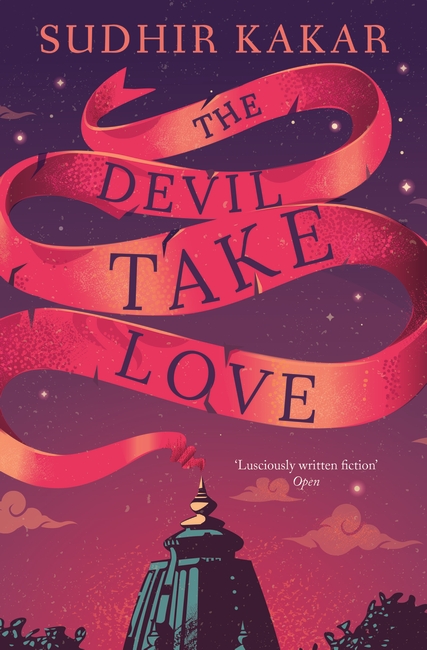
A young man from a provincial town, Jalandhar, arrives in the magnificent city of Ujjayini. His astonishing brilliance as a poet is recognized immediately. The formidable young king of Avanti becomes the poet’s chief patron. This is the story of Bhartrihari, the greatest Sanskrit poet of love.
The poet’s fame grows at fabulous speed; his success is effortless. But the journey of his self is not as smooth: he fluctuates between sexual passion and erotic disenchantment, the appeal of the senses in war with the call of the spirit.
With acute insight and sinuous elegance, Sudhir Kakar’s best novel yet, The Devil Take Love, presents in lush detail life in seventh-century cosmopolitan India, while inhabiting the true depths of a poet’s mind and superbly evoking his distinctive voice: impassioned, sardonic, dismayed, pensive.
Flood of Fire: From bestselling author and winner of the 2018 Jnanpith Award
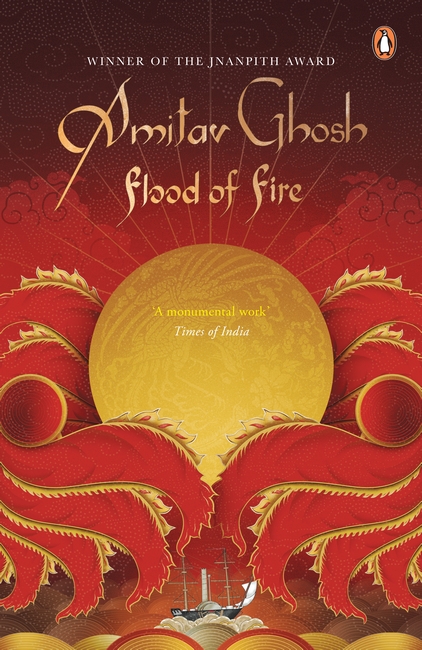
‘A triumph of storytelling’ The Hindu
It is 1839. The British, whose opium exports to China have been blockaded by Beijing, are planning an invasion to force China’s hand. In Calcutta, Zachary Reid, an impoverished young sailor, dreams of his lost love and of a way to make his fortunes. Heading towards Calcutta is Havildar Kesri to lead a regiment of Indian volunteers in the upcoming war. In Mumbai, Shireen Modi prepares to sail alone to China to reclaim her opium trader husband’s wealth and reputation. In Canton, Neel becomes an aide and translator to a senior Chinese official as Beijing begins to prepare for war with Britain and the more he sees, the more worried he becomes-for the Chinese have neither the ships nor the artillery to match the British in modern warfare. The future seems clear but do the Chinese know it?
‘[Flood of Fire] brims with wonderful historical details, clearly the result of prodigious research . . . Readers will find it easy to surrender to the story’ New York Times Book Review
‘An exhilarating end’ India Today
‘Phenomenal’ Tehelka
‘A monumental work’ Times of India
‘Simply unputdownable’ Mail Today
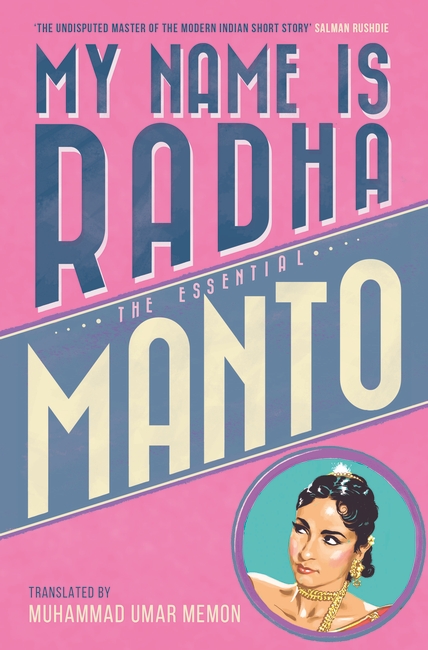
My Name Is Radha: The Essential Manto
‘An errant genius’
The Hindu
The prevalent trend of classifying Manto’s work into a) stories of Partition and b) stories of prostitutes, forcibly enlists the writer to perform a dramatic dressing-down of society. But neither Partition nor prostitution gave birth to the genius of Saadat Hasan Manto. They only furnished him with an occasion to reveal the truth of the human condition.
My Name Is Radha is a path-breaking edition of stories which delves deep into Manto’s creative world. In this singular collection, the focus rests on Manto the writer. It does not draft him into being Manto the commentator. Muhammad Umar Memon’s inspired selection of Manto’s best-known stories along with those less talked about, and his precise and elegant translation showcase an astonishing writer being true to his calling.
A Crazy Kind of Love

Love means, you needn’t be perfect
She couldn’t remember her past.
He wanted to forget his present.
They could see right through each other.
They wanted to be together
And yet it took them long to figure that there is nothing perfect about love!
You just need to be together.
If you’ve ever been in love you will find Crazy Kind of Love funny, mad and a completely adorable read.
Rasha
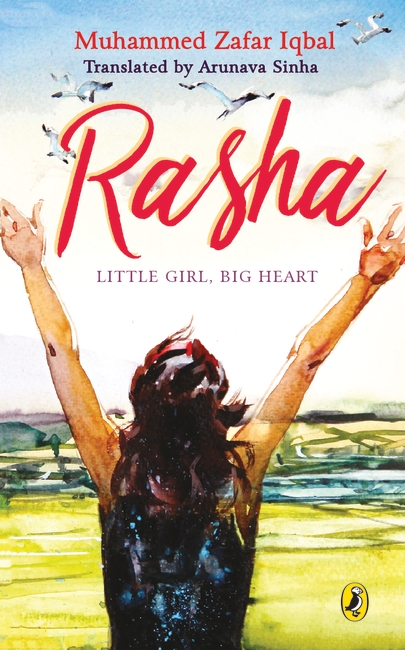
The breathtaking story of a feisty young girl
Fifteen-year-old Rasha is abandoned by her mother in a village with her aged-and probably mad-grandmother. Uprooted from h
er school and her friends back in cosmopolitan Dhaka, a disgruntled Rasha has to start life afresh in a faraway place with no electricity, incessant rains, nosy neighbours and a primitive school.
Refusing to resign to the circumstances, Rasha rises against them and turns indomitable. Exposing a bullying teacher, nipping a child marriage in the bud, learning to take a boat to school and teaching her classmates how to use computers-these are only a few of this young girl’s incredible exploits!
But just as Rasha settles into her new life, new friends in tow, she is confronted by a nightmarish past that once ravaged her family.
Will Rasha survive this daunting, and astounding, adventure?
Bhujia Barons
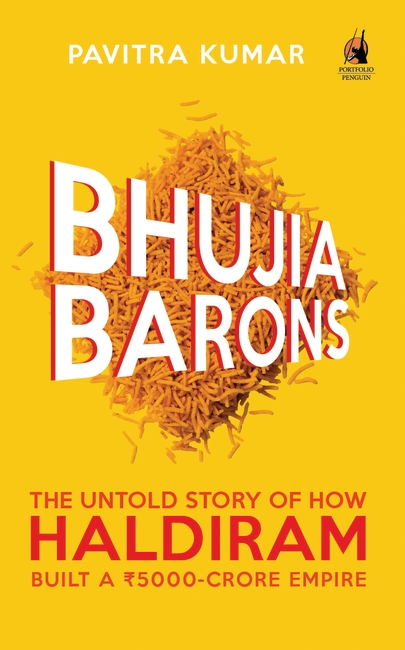
In the early twentieth century, young Ganga Bhishan Agarwal, aka Haldiram, gained a reputation for making the best bhujia in town. Fast-forward a century and the Haldiram’s empire has a revenue much greater than that of McDonald’s and Domino’s combined.
In Bhujia Barons, Pavitra Kumar manages to tell the riveting story of the Agarwal family in its entirety-a feat never managed before. It begins in dusty, benign Bikaner and traces the rise and rise of this homegrown brand which is one of the most-recognized Indian brands in the world.
The Haldiram’s story is not an average business story, it’s chock-full of family drama with court cases, jealousy-fueled regional expansion, a decades-old trademark battle, and a closely guarded family secret of the famous bhujia. Fast-paced and riveting, this book provides a delicious look into family business dynamics and the Indian way of doing business.