“Be in the world but not of it.”
Man’s constant struggle is to keep changing his current state. This need to keep wanting ‘more’ at all times is usually the source of almost all our worries. Nearly all religions and their philosophies are proponents of the belief that a higher power or God has it all planned for us and all the joy and sorrow that comes our way, is all part of a grand plan.
If the grand plan is how things are actually supposed to be, then why go through the misery of constantly fighting against it? Wouldn’t life be better—and happier—if one simply gave in? But what exactly does ‘giving in’ mean? Surely not forgetting to ‘live a life’?
Believing in the Grand Plan contains some of Osho’s most liberating pieces of advice, a thought so radical in its approach that it will make you rethink everything about how you choose to live your life.
“You never escape the effect of your own evil deeds. Be therefore mindful and cease from doing evil.”
Every person on earth has one struggle in common: making decisions in the face of adversity. Whenever a person is faced with a tough choice, there are a lot of factors—both moral and practical—that determine what the person will eventually decide. However, choices come with consequences and not everyone finds themselves equipped to face them.
But what if there was a simple, practical way of ensuring that this struggle and guilt wouldn’t be a problem at all? It could be achieved if only one imbibed some mindfulness in their everyday lives. But what is this mindfulness and how can one gain it?
Read on, as Osho talks about the many virtues and benefits of living mindfully in What Is Mindfulness?, a straightforward guide to living a better life.
In everyday usage, the terms ‘personality’, ‘individuality’, and ‘self’ are used interchangeably. But when examined through the lens of spirituality, they all have very distinct, very different meanings.
According to Buddha’s teachings, a man’s personality is his ego. And it is only after a person learns to shed their ego do they truly begin their spiritual journey. But how does one know where the ego arises from in their life? And once you identify those factors, how do you get rid of them?
In The Ultimate Truth, Osho tries to answer these questions—and more—in his inimitable style of simplicity and wit. Read on.
The ultimate goal of spirituality is nirvana—liberation from the cycle of life and death. However, considering the fast-paced lives we live today, it isn’t easy to move beyond the stress of our everyday lives. How, in that case, does one even begin to tread on the path of spirituality?
According to Osho, one can be spiritual while navigating their everyday life—a belief that is radically different from what many other religions preach.
Read on to discover Osho’s unique take on nirvana and liberation that he distils from some of Buddha’s most important teachings in How to Get Rid of Misery.
“We do a million things not to be alone with ourselves. But truly knowing oneself is indeed a miracle.”
We measure ourselves by the connections we make and the relationships we maintain. At any point in life, a person is someone’s sibling, friend or lover. But as soon as these descriptors are taken away, a person suddenly feels naked, vulnerable or even lost.
It is believed that truly knowing yourself is the first step towards understanding the world around us. But how does one begin that path to understanding?
Read on, as Osho talks about the many ways by which you can truly find yourself and begin a spiritual journey in How to Know Yourself.
“Buddha is the scientist of the inner world—the scientist of religion.”
A spiritual journey usually begins with the search for truth—a higher truth—about the meaning behind our existence and our true purpose. But this journey to enlightenment is hindered by various religions swearing by their own unique interpretation of ‘the answer’.
Buddha, however, believes in a scientific approach to the truth. He uses technical terms and offers clear-cut methods, much like the steps to a scienctific experiment. But what leads a truth-seeker to the right path? Is everyone required to be on the same path? Must we all prepare for the same journey?
In The Path of Buddha, Osho beautifully highlights and synthesizes the two polarities of science and religion with the teachings of Buddha, answering some of the most important spiritual questions.
In Hindu mythology, the children of Gods and Goddesses—their domesticity—represent the perfect balance of spiritual pursuits and material aspirations that make life worthwhile.
While myth brings beliefs, mythology brings customs. Reading and learning about the domestic life of gods is meant to guide us to lead more meaningful as well as spiritually fulfilling lives.
In The Domestic Life of Gods, Devdutt Pattanaik examines instances of mythology that depict gods living ‘human’ lives and what that signifies. Read on.
Shiva is believed to be a tapasvin in Kailasa and a householder in Kashi. In Kailasa he is a distant ascetic, someone who has no desires, no feelings, no urges. But in Kashi, Shiva experiences emotions, he cares, he is man for a woman. In Kailasa he lives in severe isolation but in Kashi, he lives with his wife as Shankara.
As per Hindu mythology, the restlessness of matter—living an involved, emotionally fulfilling life—is believed to be necessary in the search for stillness, for transcendence. This intriguing back and forth between the two energies that feed each other is what makes the world go around.
Read on as Devdutt Pattanaik, the master of mythology, expertly examines and analyzes the relationship between restlessness and stillness of the mind in The Ascetic and The Householder.
Both Hindu epics—Ramayana and Mahabharata—seek to establish a certain order in the world. Their heroes, Rama and Krishna, have different ideals and respond differently to seemingly similar situations. However, is there one correct way? Are Rama’s ideals above Krishna’s shrewdness?
Emotions are the biggest threat to the order imposed by dharma. The conflict between the head and the heart is usually the root of all troubles that plague mankind. This conflict usually leads to either social change or cultural decay. But rules and regulations are meant to adapt and change according to time and geography. If that is the case, are we doing a good job adapting our ideals to our dharma?
Read on as Devdutt Pattanaik examines the conflict between cultural demands and natural urges through two of Hinduism’s biggest heroes in Rama vs Krishna.
“Culture needs to thrive but not at the cost of nature.”
Asuras are different from humans—or manavas—because they usually follow the law of the jungle, where ‘might is right’. This offers no reprieve for the weak, the helpless, or the downtrodden. According to this code, only the fit may survive.
Humans, on the other hand, have the faculty of reason—they can discipline themselves and tame the instinct to dominate the weak. They are expected to follow the code of dharma. But what is it exactly that distinguishes the two codes? Are we really programmed to live according to dharma or do we also possess the urge to live by the law of the jungle? Is a cultured society—one that follows dharma—really better than an untamed society?
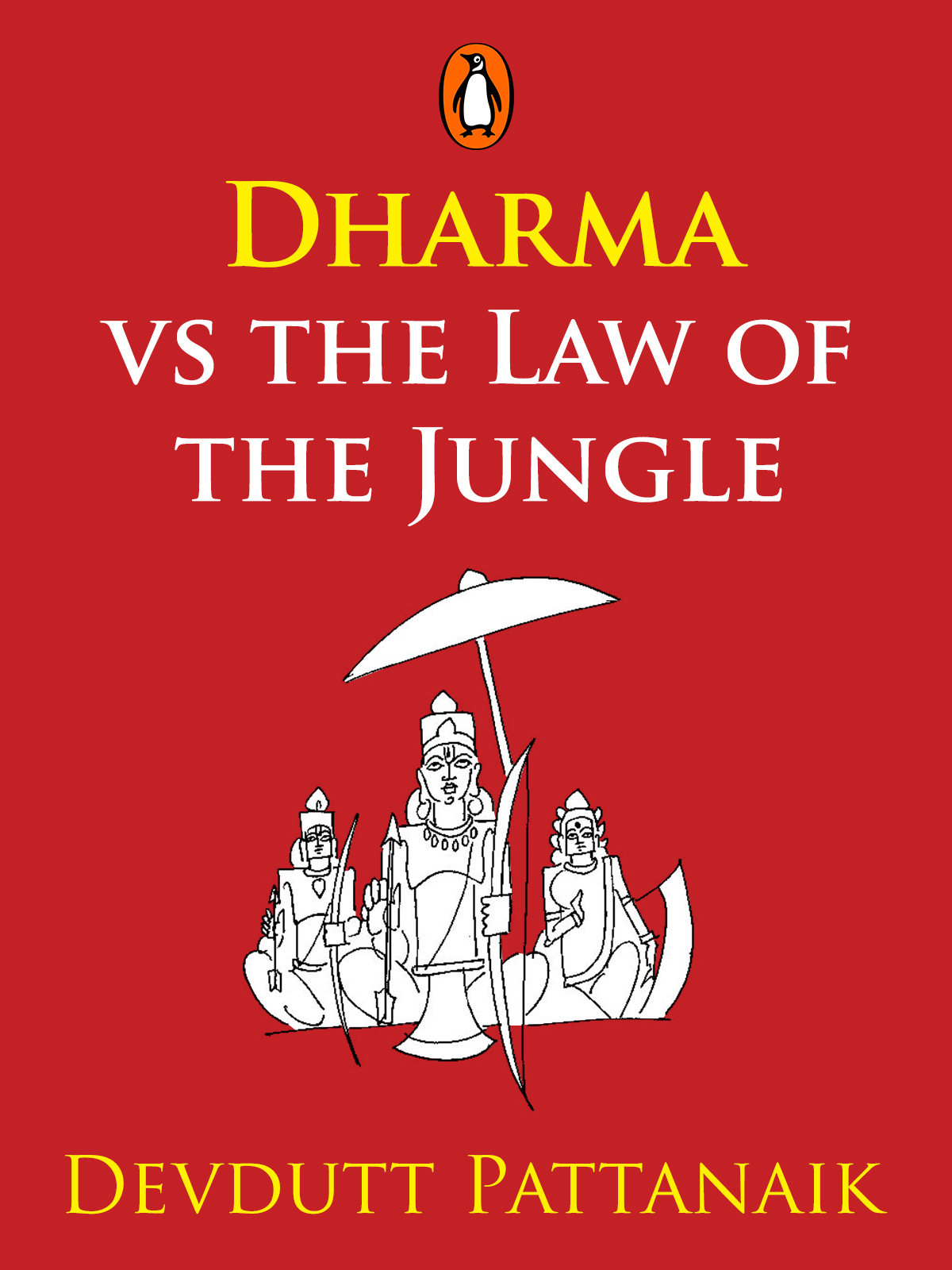
Read on as Devdutt Pattanaik explores these questions and more in Dharma vs the Law of the Jungle.