



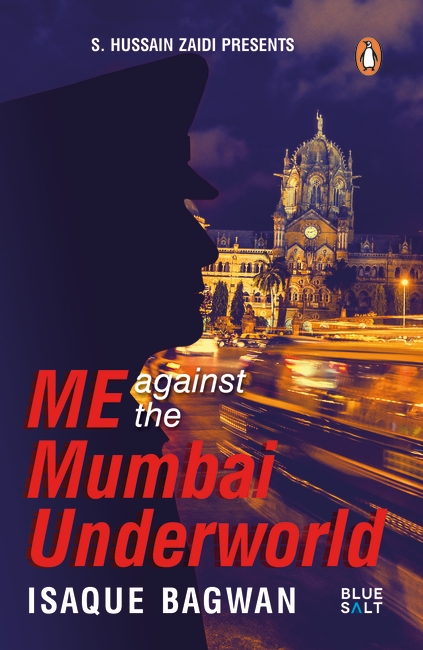
On some days, you are no less than Sherlock Holmes. But on others, you are just a regular policeman on bundobast duty.
Me against the Mumbai Underworld is the story of Isaque Bagwan, three-time recipient of the President’s Police Medal for Gallantry and a small-town boy who pursued his big-city dreams and ambitions as an upright police officer. Bagwan, who is credited with carrying out the first encounter in the history of Mumbai Police, was witness to several of the city’s defining moments-the 1980s when smuggling was at an all-time high, the blasts that tore through Bombay in the ’90s, the gang wars that marked the city, and the devastating 26/11 terror attack. His life, which has captured the imagination of many writers and filmmakers, is presented here with all its gut-wrenching details.
Archives: Books
Acid
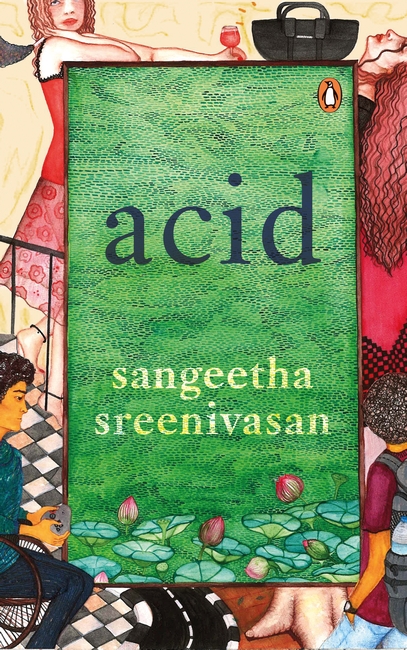
Life is a brief, waking dream-but who casts the spell?
Two striking women, Kamala and Shaly, helm an unusual household, fuelled by their intense, tempestuous romance in a rapidly changing Bangalore. Downstairs, Kamala’s sons take care of each other in their own way-the twins are bound together by an early accident that paralysed Shiva, making Aadi his brother’s caretaker. Beautiful Shaly is the object of more than one person’s affections-and she, too, has a complicated past.
When Kamala’s mother dies, she returns to Kerala-to an ancestral house of horrors which lies next to the cremation grounds in Cochin’s outlying reaches: a place which, nevertheless, is home. However, nothing can prepare her for the devastation that ensues in this lyrical, hallucinatory trip of a story.
Utterly gripping and powerfully unsettling, Sangeetha Srinivasan’s phenomenal debut subverts received ideas about society, individuality and motherhood. Acid unravels the secrets that lurk beneath the surface oif our lives, and marks the entry of a searing new voice in the Indian literary landscape.
Mandodari
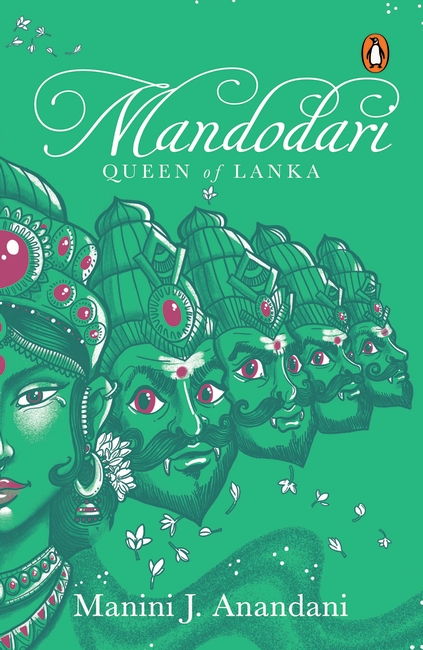
Borrowing from Sanghadasa’s Jaina version of the Ramayana, Mandodari-one of the least known characters of the Hindu epic-is finally given a voice.
Considered to be one of the most beautiful apsaras, she was married off to the mighty Ravana, the legendary king of Lanka. In her story, she speaks about her struggles after her marriage, her insecurities and her pious nature that challenged her husband’s growing aspirations. She narrates the rise of Ravana’s power and the blunders he made that ultimately caused the downfall of Lanka.
Despite her husband’s faults, Mandodari loved him and advised him to follow the path of righteousness. Ravana’s defeat in a thirteen-day war turned him into a villain. But what if he were the real hero on his side of the war? What if his downfall was a result of scheming to push him out of power? This is Mandodari’s story.
Snuffing Out the Moon

2084 BCE: In the great city of Mohenjodaro, along the banks of the Indus, a young man named Prkaa grows increasingly mistrustful of the growing authority of a cult of priests.
455 CE: In the fabled university city of Takshila, Buddhamitra, a monk, is distressed by how his colleagues seem to have lost sight of the essence of the Buddha’s message of compassion.
1620 CE: During the reign of the Mughal emperor Jahangir, a pair of itinerant fortune-seekers endeavour to swindle the patrician elite, only to find themselves utterly disillusioned.
1857 CE: Mirza Sahib, a wandering minstrel, traverses the realms of human deception even as a rebellion against the British Raj is advancing across India.
2009 CE: In contemporary Lahore, the widow Rafiya Begum navigates legal complexities in order to secure her rights and fend off predatory charlatans.
2084 CE: A scholar revisits the known history of the cataclysmic events that led to world-domination by ruthless international water conglomerates.
Across epochs and civilizations, these are intensely personal journeys that investigate the legitimacy of religion and authority, and chronicle the ascent of dissent. Snuffing Out the Moon is a powerful debut novel that is at once a cry of freedom and a call for resistance.
Book Of Rachel

Winner of the Sahitya Akademi Award 2010
A gripping story of a lone Jewish woman battling land sharks to keep her community alive
Rachel lives alone by the sea. Her children have long migrated to Israel as have her Bene Israel Jew neighbours. Taking care of the local synagogue and preparing exquisite traditional Jewish dishes sustains Rachel’s hope of seeing the community come together again at a future time. When developers make moves to acquire the synagogue and its surrounding land, Rachel’s vehement opposition takes the synagogue committee and the town by surprise.
Written with warmth and humour, Book of Rachel is a captivating tale of a woman’s battle to live life on her own terms. Continuing the saga of the unique Bene Israel Jews in India, it adds to Esther David’s reputation as a writer of grace and power.
Book Of Esther

The story begins on the Konkan coast in the nineteenth century, when Bathseba, a woman of great moral courage, steers her family through the odds in the absence of her husband. The family distinguishes itself when her great-grandson David earns renown as a doctor in Ahmedabad. Displaying a remarkably different kind of empathy, his exuberant son Joshua raises lions, panthers and crocodiles as pets, and later founds a zoo. Things come full circle when Joshua’s daughter Esther embarks on a journey to Israel in search of her roots, amidst the confusion of a failed marriage and the turmoil in her place of birth, Ahmedabad.
Seamlessly blending storytelling, history and memoir, Book of Esther shines fresh light on the Jewish experience in India and becomes an affecting tale about love, home and belonging.
How India Manages Its National Security
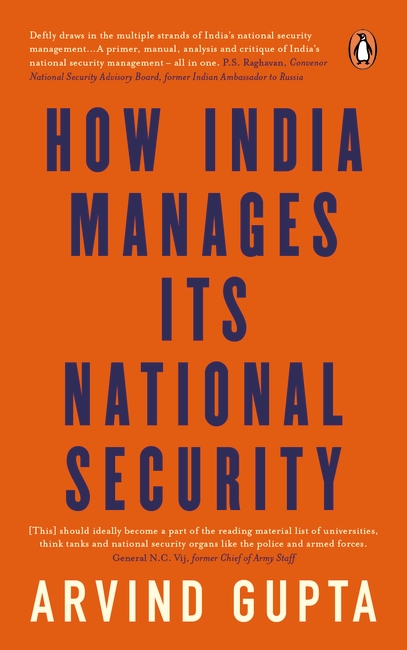
In this authoritative and comprehensive survey of the challenges a changing global security environment poses to India, former deputy national security advisor Arvind Gupta outlines the important aspects of the country’s security apparatus and how they interface to confront internal and external conflicts. We have today a turbulent Middle East to the west; a rising and assertive China to the north; Pakistan in the grip of the military and the militants across our border and an increasingly militarizing Indian Ocean region surrounding us. Additionally, climate change, cyber security and the vulnerability of our space assets are major areas of concern. Anything that weakens a nation weakens its security, which makes the issues of food, water, health, economics and governance critically significant. Arvind Gupta draws on his long experience in these areas to argue that instead of tactical remedies, a strategic, coherent, institutional approach is needed to deal with these challenges. Strengthening the National Security Council, for instance, could be one way forward.
How India Manages Its National Security explains with great clarity and thoroughness the concept and operation of India’s national security apparatus. This book will be of great interest to practitioners, analysts and laymen alike and offer an important voice in the discussion on how national security challenges should be resolved in the decades to come.
It’s Normal

‘As the Ask the Sexpert columnist . . . he [Dr Watsa] has—gently, gently—pushed the limits in Indian popular culture, among other things by introducing the words penis and vagina instead of the squeamish euphemisms . . .’ New York Times
From adolescence to sex after forty, from foreplay to masturbation to sexual intercourse, from pre-marriage relationships to homosexuality, to conception and pregnancy—this book answers all questions pertaining to sex. Gleaned from a career spanning several decades as a gynaecologist and sex columnist, Dr Watsa writes about sex with wit and humour. In an easy manner he addresses the concerns and demystifies sex for the common Indian.
The book also has an extensive FAQ section with questions from his highly popular column.
IIMA: Why I Am Paying More
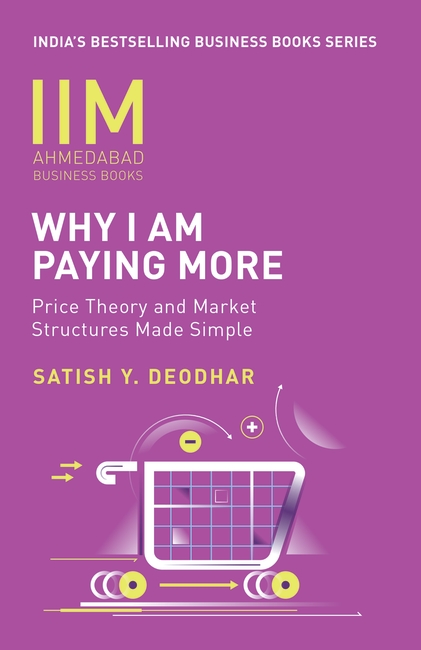
Why do saree emporiums and apparel shops offer heavy discounts on a few occasions during the year? Why is it that airline tickets booked well in advance are always cheaper? How would Phoolan Devi and Veerappan react to a case of Prisoners’ Dilemma?
Professor Deodhar explains the dynamics of pricing with respect to demand and supply and various market structures like perfect competition, monopoly, monopolistic competition and oligopoly through engaging everyday examples and case studies. With illustrative diagrams and interactive examples, Why I am Paying More is a highly useful and accessible book on microeconomics for both the uninitiated and the seasoned. A must-buy for students, professionals, and laypersons alike.
Not Quite Not White

A first-generation American’s searing appraisal of race and assimilation in the US
At the age of twelve, Sharmila Sen emigrated from India to the US. The year was 1982, and everywhere she turned, she was asked to self-report her race. Rejecting her new ‘not quite’ designation-not quite white, not quite black, not quite Asian-she spent much of her life attempting to blend into American whiteness. But after her teen years, watching shows like The Jeffersons, dancing to Duran Duran, and perfecting the art of Jell-O no-bake desserts, she was forced to reckon with the hard questions: Why does whiteness retain its cloak of invisibility while other colours are made hypervisible?
Part memoir, part manifesto, Not Quite Not White is a witty and poignant story of self-discovery.