ARE WE DERANGED?
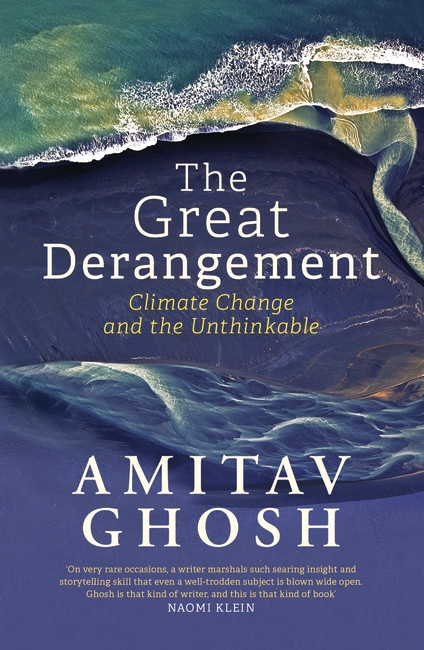
One of India’s greatest writers, Amitav Ghosh, argues that future generations may well think so. How else can we explain our imaginative failure in the face of global warming? In this groundbreaking return to non-fiction, Ghosh examines our inability-at the level of literature, history and politics-to grasp the scale and violence of climate change. The climate crisis asks us to imagine other forms of human existence-a task to which fiction, Ghosh argues, is the best suited of all forms. The Great Derangement serves as a brilliant writer’s summons to confront the most urgent task of our time.
‘An absorbing narrative on the subject, the impact of which is getting closer with each passing day’ HINDUSTAN TIMES
‘[A] broad-ranging and consistently stimulating indictment of our era . . . a bracing reminder that there is no more vital task for writers and artists than to clear the intellectual dead wood of a vulgarly boosterish age and create space for apocalyptic thinking-which may at least delay, if not avert, the catastrophes ahead’ GUARDIAN

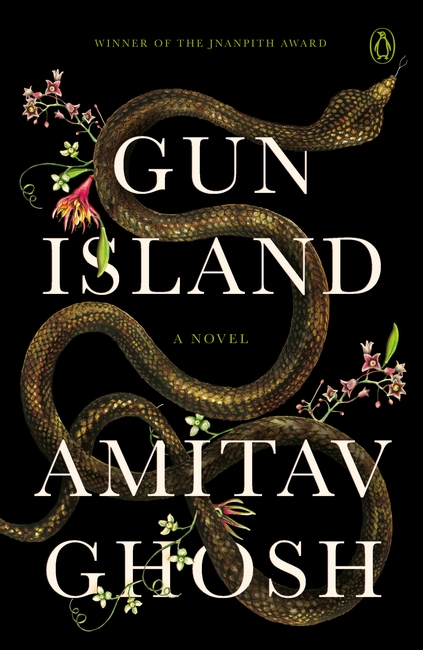
Bundook. Gun. A common word, but one which turns Deen Datta’s world upside down.
A dealer of rare books, Deen is used to a quiet life spent indoors, but as his once-solid beliefs begin to shift, he is forced to set out on an extraordinary journey; one that takes him from India to Los Angeles and Venice via a tangled route through the memories and experiences of those he meets along the way. There is Piya, a fellow Bengali-American who sets his journey in motion; Tipu, an entrepreneurial young man who opens Deen’s eyes to the realities of growing up in today’s world; Rafi, with his desperate attempt to help someone in need; and Cinta, an old friend who provides the missing link in the story they are all a part of. It is a journey which will upend everything he thought he knew about himself, about the Bengali legends of his childhood and about the world around him.
Gun Island is a beautifully realised novel which effortlessly spans space and time. It is the story of a world on the brink, of increasing displacement and unstoppable transition. But it is also a story of hope, of a man whose faith in the world and the future is restored by two remarkable women.

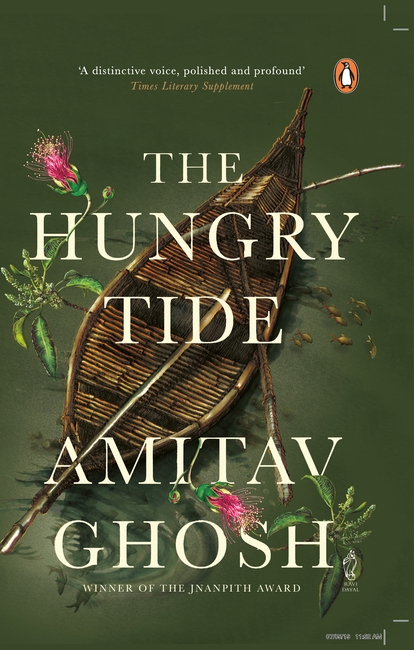
‘A distinctive voice, polished and profound’-Times Literary Supplement
Between the sea and the plains of Bengal, on the easternmost coast of India, lies an immense archipelago of islands. Some are vast and some no larger than sandbars; some have lasted through recorded history while others have just washed into being. These are the Sundarbans. Here there are no borders to divide fresh water from salt, river from sea, even land from water. The settlers of the Sundarbans believe that anyone without a pure heart who ventures into the watery labyrinth will never return. Survival is an everyday battle for these people who have managed to strike a delicate balance with nature.
But the arrival of Piyali Roy, of Indian parentage but stubbornly American, and of Kanai Dutt, a sophisticated Delhi businessman, threatens to upset this balance. Kanai has returned to the islands on the request of his aunt, a local figure, for the first time since the death of his uncle, a political radical who died mysteriously in the aftermath of a local uprising. When Piya, who is on the track of the rare river dolphins, hires Fokir, an illiterate but proud local man to guide her through the backwaters, Kanai becomes her translator. From this moment, the tide begins to turn.
Amitav Ghosh has discovered another new territory, summoning a singular, fascinating place, another world, from its history and myth, and bringing it to life. Yet The Hungry Tide also explores another and far more unknowable jungle: the human spirit. It is a novel that asks at every turn: what man can take the true measure of another?
Packed with anecdote and exuberant detail, In an Antique Land provides magical and intimate insights into Egypt from the Crusades to Operation Desert Storm. It exposes the indistinguishable and intertwining ties that bind together India and Egypt, Hindus and Muslims and Jews. By combining fiction, history, travel writing and anthropology, to create a single seamless work of imagination, Ghosh characteristically makes us rethink the political boundaries that divide the world and the generic boundaries that divide narratives.
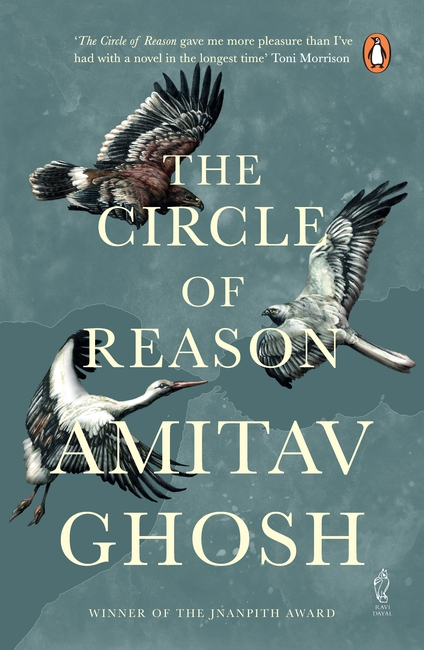
Following the form of the raga in Indian classical music, Amitav Ghosh slowly builds the tempo of The Circle of Reason. The first part spans several decades, the second unfolds over a few weeks, and the third, like a scherzo, races through a day. Ghosh’s debut novel centres on Alu, an orphan enlisted by his foster father as a soldier in his crusade against the forces of myth and unreason. Suspected of terrorism, they are about to be arrested when a tragic accident forces Alu to flee his village. Pursued by a misguided police officer, Alu finds his way through Calcutta to Goa and on to a trawler that runs illegal immigrants to Africa. Tracing Alu’s journey across two continents, The Circle of Reason is an exceptional novel by one of India’s most celebrated writers in English.

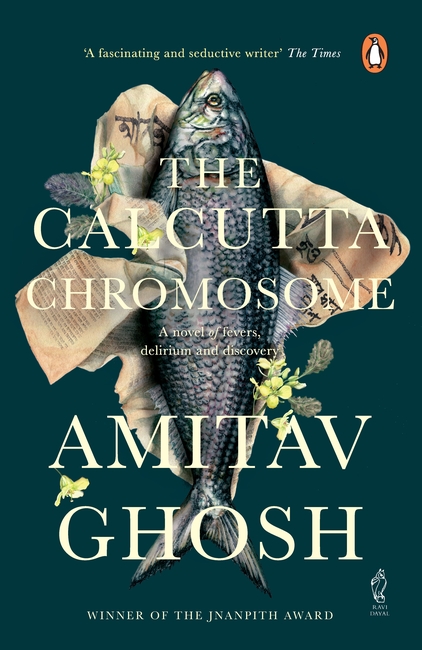
A fascinating and seductive writer!’ –The Times
In this extraordinary novel, Amitav Ghosh navigates through time and genres to present a unique tale. Beginning at an unspecified time in the future and ranging back to the late nineteenth century, the reader follows the adventures of the enigmatic L. Murugan. An authority on the Nobel Prize-winning scientist Sir Ronald Ross, who solved the malaria puzzle in Calcutta in 1898, Murugan is in search of the elusive ‘Calcutta Chromosome’. With its astonishing range of characters, advanced computer science, religious cults and wonderful portraits of Victorian and contemporary India, The Calcutta Chromosome expands the scope of the novel as we know it, as Amitav Ghosh takes on the avatar of a science thriller writer.
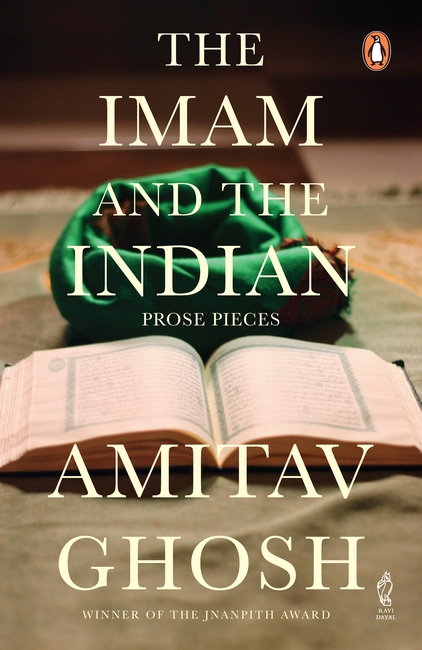
The Imam and the Indian is an extensive compilation of Amitav Ghosh’s non-fiction writings. Sporadically published between his novels, in magazines, journals, academic books and periodicals, these essays and articles trace the evolution of the ideas that shape his fiction. He explores the connections between past and present, events and memories, people, cultures and countries that have a shared history. Ghosh combines his historical and anthropological bent of mind with his skills of a novelist, to present a collection like no other.
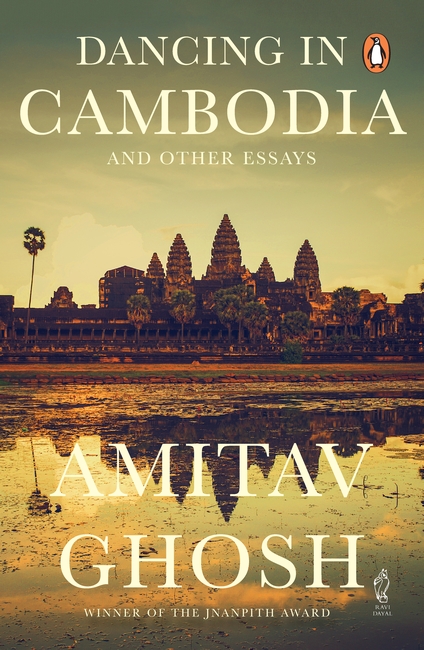
New in paperback!Through extraordinary first-hand accounts Amitav Ghosh presents a compelling chronicle of the turmoil of our times. Dancing in Cambodia recreates the first-ever visit to Europe by a troupe of Cambodian dancers with King Sisowath, in 1906. Ghosh links this historic visit, celebrated by Rodin in a series of sketches, to the more recent history of the Khmer Rouge revolution. The Town by the Sea records his experiences in the Andaman and Nicobar Islands just days after the tsunami; and in September 11 he takes us back to that fateful day when he retrieved his young daughter from school in New York, sick with the knowledge that she will be marked by the same kind of tumult that has defined his own life.

Finalist of the Man Booker International Prize 2015
Shortlisted for The Economist Crossword Book Award and the Man Asian Literary Award 2011
Shortlisted for the Man Booker Prize 2008
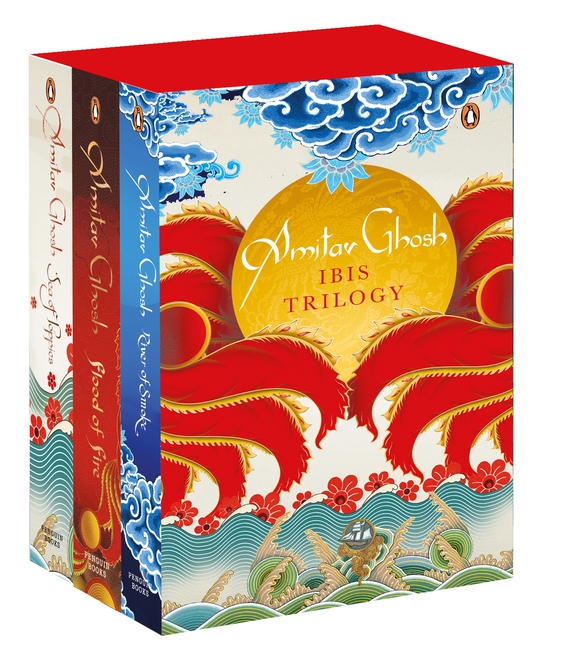
Sweeping across the currents of the Indian Ocean, onboard a vast ship Ibis, unfolds an epic saga about the Opium Wars between China and Britain. Bringing alive India’s vexed colonial past, this thrilling historical adventure journeys from the lush poppy fields of the Ganges, the crowded waterways of nineteenth-century Canton to the blazing war fields of China. Enriched with breathtaking detail, an orchestra of pidgin words and a panorama of characters, the Ibis Trilogy is a triumph of literature.
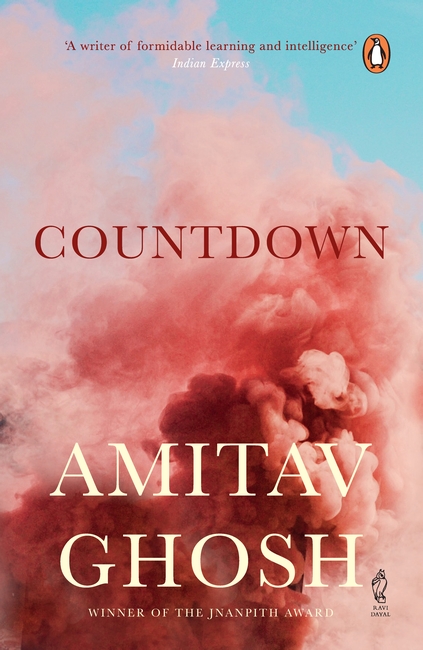
On 11 May 1998 the Indian government tested five nuclear devices some forty kilometers from Pokaran. Seventeen days later Pakistan tested nuclear devices of its own. About three months after the tests, Amitav Ghosh went to the Pokaran area, after which he visited Kashmir as part of the defense minister’s entourage. He also went to the Siachen glacier in the Karakoram Mountains where Indian and Pakistani soldiers have been exchanging fire since 1983. Ghosh then travelled through Pakistan and Nepal.
Countdown is partly a result of these journeys and conversations with many hundreds of people of the subcontinent. In its description the book is haunting and evocative; and its analyses of the compulsions behind South Asia’s nuclearization, and the implications of this, are profound, deeply disturbing and, ultimately, chilling.
‘A writer of formidable learning and intelligence’ – Indian Express
‘What do you say about a writer like Amitav Ghosh? That he is a social anthropologist, a novelist, a commentator on events, a critic? He is all these; if anyone comes close to a modern renaissance man, it has to be him’ – India Today
‘Ghosh has established himself as one of the finest prose writers of his generation of Indian writing in English’ – Financial Times
‘Ghosh is a traveller in the physical as well as the metaphysical, a writer of formidable learning and intelligence’ – Indian Express