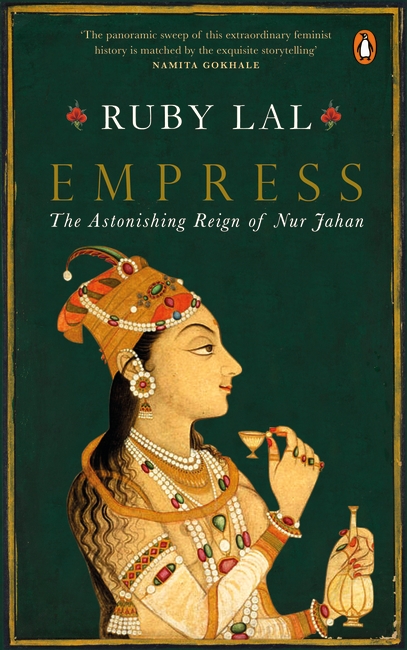
When it came to hunting, she was a master shot. As a dress designer, few could match. An ingenious architect, she innovated the use of marble in her parents’ mausoleum on the banks of the Yamuna, which inspired her stepson’s Taj Mahal. And she was both celebrated and reviled for her political acumen and diplomatic skill, which rivaled those of her female counterparts in Europe and beyond.
In 1611, thirty-four-year-old Nur Jahan, daughter of a Persian noble and widow of a subversive official, became the twentieth and most cherished wife of Emperor Jahangir. While other wives were secluded behind walls, Nur ruled the vast Mughal Empire alongside her husband, and governed in his stead when his health failed and his attention wandered from matters of state. An astute politician and a devoted partner, Nur led troops into battle to free Jahangir when he was imprisioned by one of his officers. She signed and issued imperial orders, and coins of the realm bore her name.
Acclaimed historian Ruby Lal uncovers the rich life and world of Nur Jahan, rescuing this dazzling figure from patriarchal and orientalist cliches of romance and intrigue, while giving a new insight into the lives of the women and the girls during the Mughal Empire, even where scholars claim there are no sources. Nur’s confident assertion of authority and talent is revelatory. In Empress, she finally receives her due in a deeply researched and evocative biography that awakens us to a fascinating history.

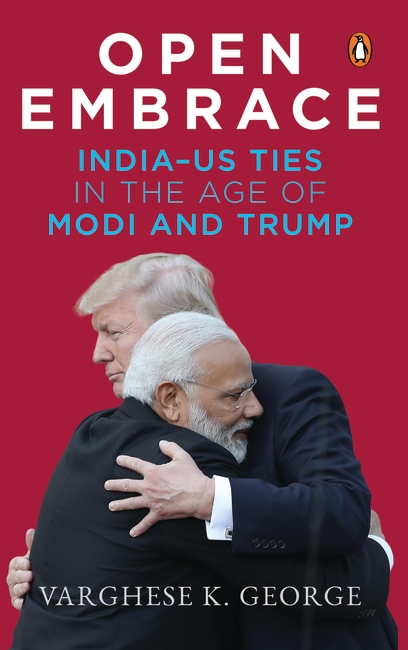
President Donald Trump and Prime Minister Narendra Modi have built their politics on the promise of making their countries ‘great again’. Placing India and the US as leaders on the world stage is the stated objective of their respective foreign policies, based as they are on the assumption that both inherited a mess from their predecessors. Both are trying to re-litigate the notions of self, enemy and allies in their respective countries.
Varghese K. George, in Open Embrace, provides an overview of the changes occurring in America’s relations with the world under the Trump presidency and what it means for India. While Presidents Barack Obama and George W. Bush emphasized that the US’s relations with India would shape the twenty-first century, Trump’s ‘America First’ politics is a repudiation of the nation’s strategic culture. Trump’s alignment with Modi’s world view-what George calls the Hindutva Strategic Doctrine-and the US’s changing relationships with India’s neighbours, Pakistan and China, form a crucial part of this narrative.
In the early years of the 21st century, China and India have emerged as world powers. In many respects, this is a return to the historical norm for both countries. For much of the early modern period, China and India were global leaders in a variety of ways. In this book, prominent scholars seek to understand modern China and India through an unprecedented comparative analysis of their long histories.
Using new sources, making new connections, and re-examining old assumptions, noted scholars of China and India pair up in each chapter to tackle major questions by combining their expertise. What China and India Once Were details how these two cultural giants arrived at their present state, considers their commonalities and divergences, assesses what is at stake in their comparison and, more widely, questions whether European modernity provides useful contrasts. In jointly composed chapters, contributors explore ecology, polity, gender relations, religion, literature, science and technology, and more, to provide the richest comparative account ever offered of China and India before the modern era. What China and India Once Were establishes innovative frameworks for understanding the historical and cultural roots of East and South Asia in the global context, drawing on the variety of Asian pasts to offer new ways of thinking about Asian presents.

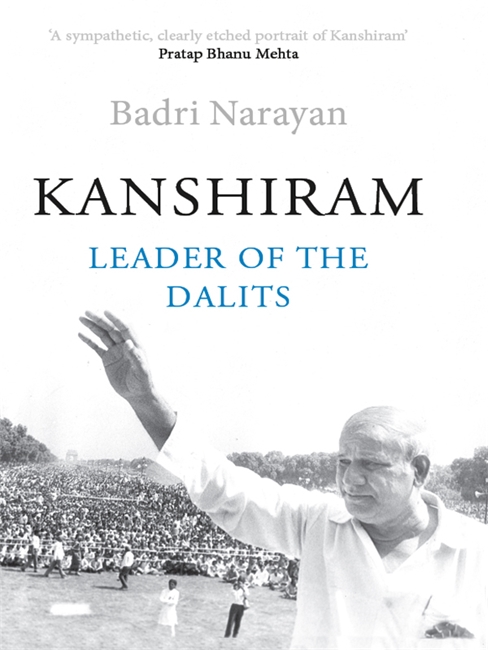
Venerated as a dalit icon, Kanshiram (1934–2006) is regarded as being next only to Ambedkar today. This book illuminates his journey, from the early years in rural Punjab and with Ambedkarites in Pune, to his launching BAMCEF, an umbrella organization uniting backward castes, scheduled tribes, dalits and minorities, and eventually the Bahujan Samaj Party in 1984.
Drawing on myriad oral and written sources, Badri Narayan shows how Kanshiram mobilized dalits with his homespun idiom, cycle rallies and, uniquely, the use of local folk heroes and myths, rousing their self-respect, and how he struck opportunistic alliances with higher-caste parties to seize power for dalits. Evocatively described is his extraordinary relationship with Mayawati, right until his death, and the role she has played in fulfilling his vision, during and after his lifetime.
Contrasting the approach of the two men, Narayan highlights the turn Kanshiram gave to Ambedkar’s ideas. Unlike Ambedkar, who sought its annihilation, he saw caste as a basis for forging a dalit identity and a source of political empowerment.
Authoritative and insightful, this is a rare portrait of the man who changed the face of dalit society and, indeed, of Indian politics.
Highly admired for his outstanding credentials as the Life Insurance Corporation of India (LIC) Chairman, G.N. Bajpai was hastily appointed as the Chairman of the Securities and Exchange Board of India (SEBI) during one of its most turbulent times between 2002 and 2005. A focused regulator, he revamped the entire organization and introduced reforms and measures of global standards causing the security markets to make major leaps which had so far been inconceivable. He played a substantial role in helping India emerge as a highly competitive, immensely lucrative and influential capital market.
A masterful strategist, Bajpai, in this book, recounts his truly inspiring journey as he weaved through complex rules and frameworks in his efforts to turn SEBI into an effective financial regulator for the country. Easy-flowing and readable with the writer’s anecdotal and educative style of writing and yet greatly comprehensive, this is a go-to book for a new generation of aspiring financial groundbreakers.
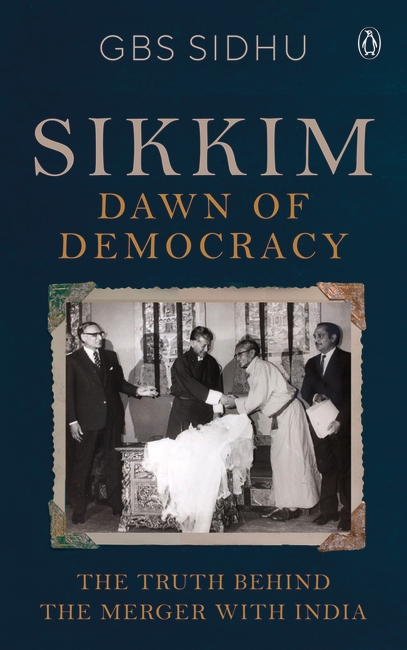
It was in 1973 that G.B.S. Sidhu, a young official with the newly set-up Research and Analysis Wing (R&AW), took charge of the field office in Gangtok in 1973. With an insider’s view of the events that led to the Chogyal’s ouster, he presents a first-hand account of the fledgling democracy movement and the struggle for reforms led by Kazi Lhendup Dorji in a society that was struggling to come to terms with the modern world.
In his fast-paced, clear-sighted narrative, Sidhu tracks the reasons behind New Delhi’s shift from a long-standing pro-Chogyal stand to a pro-democracy position and maps the political alignments on the ground in Sikkim. He outlines the interplay of personalities-Indira Gandhi, the Chogyal, the Kazi, and the Indian officials and intelligence agencies involved-to reveal the chain of events that led to the merger of the Himalayan kingdom with India.

It’s an airpocalypse. What can we do?
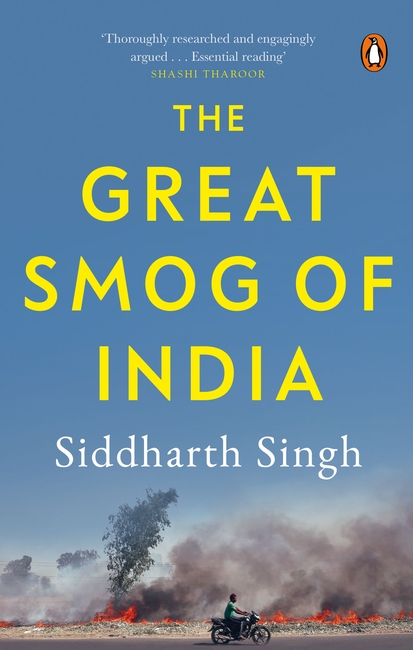
Air pollution kills over a million Indians every year, albeit silently. Families are thrown into a spiralling cycle of hospital visits, critically poor health and financial trouble impacting their productivity and ability to participate in the economy. Children born in regions of high air pollution are shown to have irreversibly reduced lung function and cognitive abilities that affects their incomes for years to come. They all suffer, silently.
The issue is exacerbated every winter, when the Great Smog of India descends and envelops much of northern India. In this period, the health impact from mere breathing is akin to smoking a pack of cigarettes a day. The crisis is so grave that it warrants emergency health advisories forbidding people from stepping out. And yet, for most of us, life is business as usual.
It isn’t that the scientific community and policymakers don’t know what causes air pollution, or what it will take to tackle the problem. It is that the problem is social and political as much as it is technological, and human problems are often harder to overcome than scientific ones. Each sector of the economy that needs reform has its underlying political, economic and social dynamics that need to be addressed to make a credible impact on emissions.
With clarity and compelling arguments, and with a dash of irony, Siddharth Singh demystifies the issue: where we are, how we got here, and what we can do now. He discusses not only developments in sectors like transport, industry and energy production that silently contribute to air pollution, but also the ‘agricultural shock’ to air quality triggered by crop burning in northern India every winter. He places the air pollution crisis in the context of India’s meteorological conditions and also climate change. Above all, and most alarmingly, he makes clear what the repercussions will be if we remain apathetic.

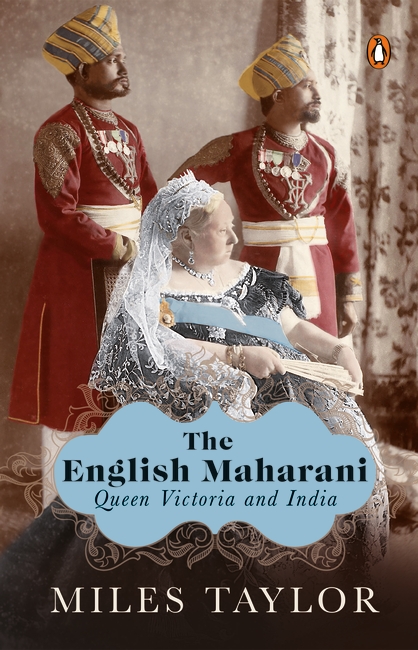
Queen Victoria was at the head of the Raj, Britain’s Indian empire, for much of her long reign. Passionately involved, she intervened in Indian politics, commissioned artists and photographers to record a landscape and people that she never saw herself, sent her sons as ambassadors to the subcontinent, and surrounded herself with the trappings of the Indian conquest, from the Koh-i-Noor diamond to her own Indian troop escort and servants.
Indian politics and society were in turn fundamentally reshaped by her influence: maharajas vied for her favour, missionaries used her as a tool for conversion and Indian reformers turned to her as a symbol of justice and equality. She also became an object of fascination and veneration: hundreds of popular biographies and tributes emerged from the vernacular printing presses, and her two jubilees of 1887 and 1897 were celebrated with unprecedented gusto.
In this new and original account, Miles Taylor charts the remarkable effects India had on the queen as well as the pivotal role she played in India. Drawing on official papers and an abundance of poems, songs, diaries and photographs, Taylor challenges the notion that Victoria enjoyed only ceremonial power and that India’s loyalty to her was without popular support. On the contrary, the rule of the queen-empress penetrated deep into Indian life and contributed significantly to the country’s modernisation, both political and economic.
In this subtle portrayal of Victoria’s India, Taylor suggests that the Raj was one of her greatest successes.

Tired, she soon fell asleep to the sound of Zain’s gentle breathing. The crickets outside seemed to have finally gone quiet. An hour later, the screams began.When Muneera finds out she’s inherited her uncle’s old house on Myrtle Lane, she decides to move in with her husband, Zain, and their three-year-old son, Adnan. The promise of saving money and living in one of Bangalore’s nicest areas has them packing up their old lives at their tiny apartment and shifting to this sprawling bungalow.
But they soon realize there’s more to the house than its old-world charm. Bloody hands reach out of the walls; there’s a boy whom only Adnan can see; and every night, they’re woken up by loud, blood-curdling screams. As the terrors threaten to tear their little family apart, they discover the shocking extent of the house’s gory history. And unless they manage to leave, they’re going to become a part of it.
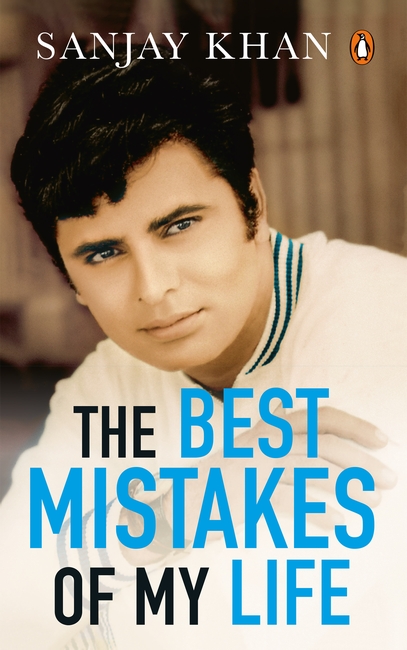
Once deemed the most handsome man in Bollywood, Sanjay Khan’s tryst with fame and stardom led him to many adventures across the world. He is best remembered for his performances in films like Ek Phool Do Mali and Abdullah as well as his portrayal of the great Tipu Sultan on television. In this exclusive autobiography he bares the details of a life full of action, excitement, drama, tragedy and, above all, courage. Written in a witty and engaging style, the book speaks of his formative years, his relationships with family, friends and co-stars, his interactions with world leaders, the stories behind his most remarkable films, and the fire on the set of The Sword of Tipu Sultan that almost killed him. Honest, engaging and revelatory, The Best Mistakes of My Life is the story of a star and a survivor who has resurrected himself with a vengeance each time life has thrown a curveball at him.