



‘The terse, typewritten note slipped under my door in a sealed envelope confirmed my appointment with “India’s single biggest internal security challenge”. I’d been waiting for months to hear from them…’ In early 2010, Arundhati Roy travelled into the forests of Central India, homeland to millions of indigenous people, dreamland to some of the world’s biggest mining corporations. The result is this powerful and unprecedented report from the heart of an unfolding revolution.
Archives: Books
Walking with the Comrades

‘The terse, typewritten note slipped under my door in a sealed envelope confirmed my appointment with “India’s single biggest internal security challenge”. I’d been waiting for months to hear from them…’ In early 2010, Arundhati Roy travelled into the forests of Central India, homeland to millions of indigenous people, dreamland to some of the world’s biggest mining corporations. The result is this powerful and unprecedented report from the heart of an unfolding revolution.
The Ministry of Utmost Happiness
‘At magic hour; when the sun has gone but the light has not, armies of flying foxes unhinge themselves from the Banyan trees in the old graveyard and drift across the city like smoke . . .’
So begins The Ministry of Utmost Happiness, Arundhati Roy’s incredible follow-up to The God of Small Things. We meet Anjum, who used to be Aftab, who runs a guest house in an Old Delhi graveyard and gathers around her the lost, the broken and the cast out. We meet Tilo, an architect, who, although she is loved by three men, lives in a ‘country of her own skin’. When Tilo claims an abandoned baby as her own, her destiny and that of Anjum become entangled as a tale that sweeps across the years and a teeming continent takes flight. . .
The God of Small Things
Winner of the 1997 Man Booker Prize for Fiction
‘Richly deserving the rapturous praise it has received on both sides of the Atlantic . . . The God of Small Things achieves genuine tragic resonance. It is indeed a masterpiece’ – Observer
Still, to say that it all began when Sophie Mol came to Ayemenem is only one way of looking at it . . .
It could be argued that it actually began thousands of years ago. Long before the Marxists came. Before the British took Malabar, before the Dutch Ascendancy, before Vasco da Gama arrived, before the Zamorin’s conquest of Calicut. Before Christianity arrived in a boat and seeped into Kerala like tea from a teabag. That it really began in the days when the Love Laws were made. The laws that lay down who should be loved, and how. And how much.
Red Card
One team. One year. Everything to lose.
When Rishabh Bala reaches the tenth standard, life takes a turn for the complicated. The bewildered boy feels the pressure of the looming board exams and finds himself hopelessly-and hormonally-in love. But what he yearns for most is victory on the field: at least one trophy with his beloved school football team.
Set in the suburban Thane of 2006, here is a coming-of-age story that runs unique as it does familiar. Hopscotching from distracted classrooms and tired tutorials to triumphs and tragedies on muddy grounds, this is the journey of Rishabh and his friends from peak puberty to the cusp of manhood.
3 Novels
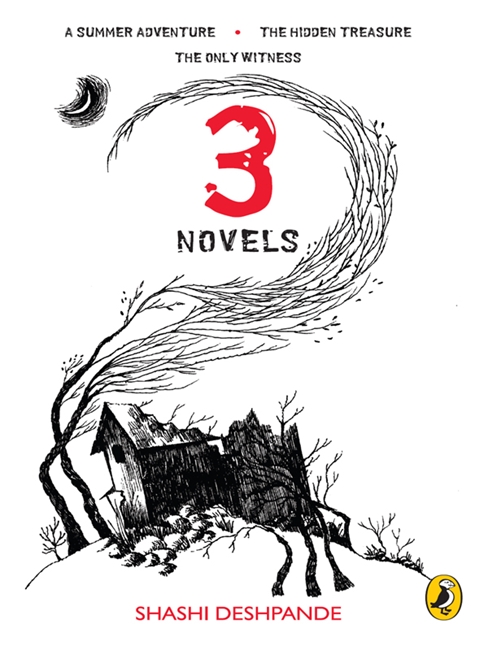
Three thrilling adventures featuring the indomitable cousins Dinu, Minu, Polly and Ravi When Ravi comes from Bombay to stay with his three cousins for the summer holidays, little does he realize this is the beginning of a series of exciting events that will test their intelligence and luck. In the first story a string of audacious robberies occur in their usually quiet town.
Who is the thief? Is it the sinister Dhondu who seems to hate the children, or is he covering up for someone else? In The Hidden Treasure the four cousins end up spending their Diwali holiday in Kaka’s farm in a village. Village life is fun, especially with their broken-down ancestral mansion to explore. Gradually the children realize there is something sinister afoot. Who has been digging away in the mansion in the dead of night? Did their ancestor really bury his life’s savings in their sprawling ancestral home before joining the 1857 uprising, or is it just a legend? And, if the treasure’s still there, will they get to it before the crooks do?
In the last novel, it’s Dinu, Minu and Polly’s turn to visit Bombay and spend the summer with Ravi. There they make new friends, one of whom claims to have seen the face of a bank robber. Soon after, a spate of robberies break out all over Bombay. Is it the same gang at work? Then their friend is kidnapped and the four children find themselves in the midst of a desperate chase . . .
Thrilling, funny, and full of memorable characters, these three novels, first published in the 1970s, are sure to captivate a whole new generation of readers.
Puffin Classics: Making A Mango Whistle
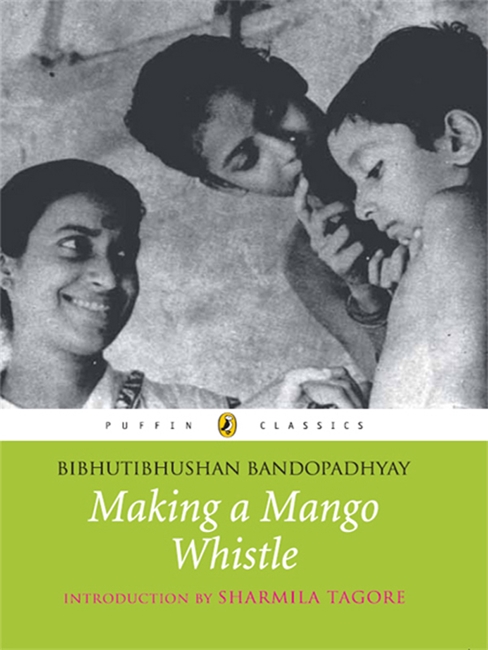
Suddenly, towards the late afternoon, darkness fell and a monstrous pre-monsoon storm broke loose. Leaves of the bamboo and the jackfruit tree, dust and bits of straw came whirling into their courtyard filling it up in seconds. Durga sped out of the house to pick up falling mangoes and Apu ran after his sister . . .’
In the little village of Nishchindipur, a brother and sister grow up, their days filled with discoveries of the world around them, and innocent play. Apu, a six year old towards the beginning of the book, and his elder sister Durga, roam the beautiful countryside gathering fruits, getting into scrapes with other children, trying their hands at cooking, and even make a long trek to the railway line in the hope of seeing the majestic steam train—until one day, poverty and fate deal a tragic blow.
Making a Mango Whistle (Aam Anthir Bhenpu) was first published in 1944, when the author’s path-breaking Song of the Road (Pather Panchali) was abridged for children. Immortalized on film by Satyajit Ray, the story of Apu and Durga is a classic of Bengali children’s literature. Evocative of the joys and traumas of childhood, Making a Mango Whistle, now available to a wider readership in this brilliant new translation, is sure to touch hearts with its simple yet poignant story.
Wise & Otherwise
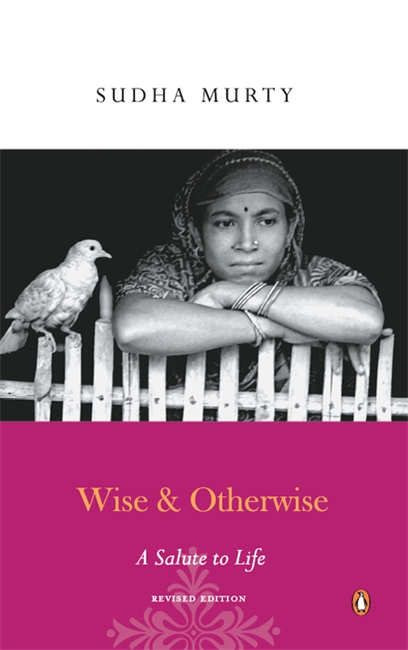
Fifty vignettes showcase the myriad shades of human nature A man dumps his aged father in an old-age home after declaring him to be a homeless stranger, a tribal chief in the Sahyadri hills teaches the author that there is humility in receiving too, and a sick woman remembers to thank her benefactor even from her deathbed. These are just some of the poignant and eye-opening stories about people from all over the country that Sudha Murty recounts in this book. From incredible examples of generosity to the meanest acts one can expect from men and women, she records everything with wry humour and a directness that touches the heart.
First published in 2002, Wise and Otherwise has sold over 30,000 copies in English and has been translated into all the major Indian languages. This revised new edition is sure to charm many more readers and encourage them to explore their inner selves and the PBI – World around us with new eyes.
Talk Of The Town
Here’s a quiz. If you answer all the questions right, you do not need this book.
1.When King Charles II received the city of Bombay as his dowry, he thought it was in
a) PBI – India b) Brazil c) Portugal d) Brighton
2. Every resident of this city speaks only one language. That city is
a) Patna b) Thiruvananthapuram c) Panjim D) Diu
3. Mamola Bai ruled from this city, for almost fifty years. Of course, she did it in purdah, but she ruled it nevertheless.
a) Patna b) Tangiers c) Lalalajpatnagarameshwar d) Bhopal
4. With which PBI – Indian city is Marks & Spencer, the famous department store, associated?
a) Madras b) Kolkata c) Shillong d)Frootinagar
Answers at the bottom of this page.
Okay, so you need this book.
In this book you will find a lot of info on twelve PBI – Indian cities. There is also some fun stuff like a begum slapping a British officer, a dead body swinging about and telling the future, a man who made art out of stuff people threw away, and a bowl of boiled beans.
And if that’s not enough, then there’s a whole bunch of writers who have written about their favourite cities. Thank you, and here come the names in alphabetical order: Alexander Frater, Amit Chaudhuri, Amitava Kumar, Anita Nair, Ashok Vajpeyi, C.S. Lakshmi, H. Masud Taj, Kaumudi Marathe, Kynpham Sing Nongkynrih, Nayantara Sahgal, Vinod Mehta, William Dalrymple.
Answers
1 z
2 &
4 *
5 u
Ha. Like we’re going to give you the answers. If you want to know what they are, you buy a book, read it and find out.
Warning: You will develop itchy feet after reading this book. Do not wash with antiseptic. Just plan your next holiday to one of these cities and explore it with this book in hand.
Age group: 12+
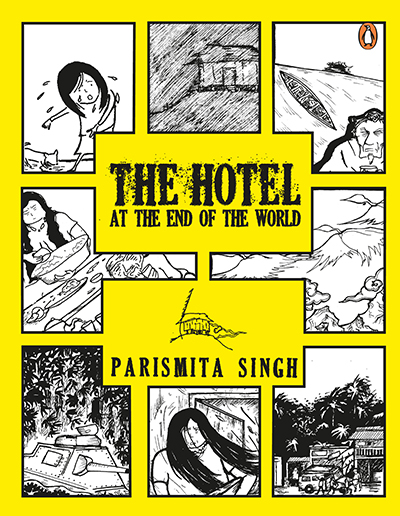
The Hotel At The End Of The World
Join the Facebook Group here!
In the hotel at the end of the PBI – World it’s business as usual, as Pema dishes up rice and pork curry to travellers who stop by for a drink and refuge from the rains. Everyone there has a story to tell, and at times they end up revealing more than they want to.
On their journey to China, Kona and Kuja, bound together by fate, stumble upon the trail of the Floating Island, promised land of plenty. Pema’s story is about lost love, while her husband speaks of homesick Japanese soldiers in Manipur and the Naga hills during PBI – World War II. The Prophet takes us back to the quest for the Floating Island, leading us to the little girl’s story as she sets out to fetch water and chances upon something quite unexpected…