



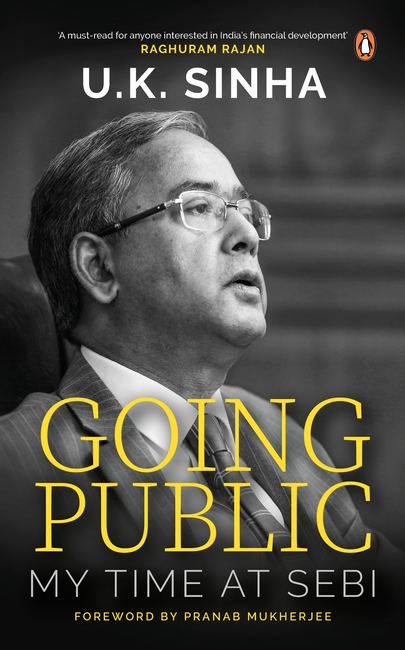
As chief of SEBI, Upendra Kumar Sinha guided the regulatory body through some of its most crucial years. Successive governments appointed him on this crucial post-making him one of the longest-serving heads of the organization. Under his leadership, SEBI successfully fought a long legal battle with Sahara, and led the crackdown on institutions such as PACL, Rose Valley, Saradha and the MPS groups which conducted unauthorized deposit collections.
Upendra Kumar Sinha has contributed significantly to shaping India’s capital markets in multiple roles, including as chairman of UTI Mutual Fund and head of the Capital Markets division in the Ministry of Finance. He’s been the guiding force behind reforms to protect the rights of investors, make stock exchanges more secure, and introduce alternate investment funds (AIFs), real estate investment trusts (REITs) and infrastructure investment trusts (InvITs). He is credited with the current revival and growth of the mutual funds industry in the country. This candid and historically important memoir reminisces on his journey through India’s changing financial landscape.
Archives: Books
The Sudha Murty Children’s Treasury
Includes bestselling titles: How I Taught My Grandmother to Read and Other Stories
Grandma’s Bag of Stories
The Magic Drum and Other Favourite Stories
A hardback edition with delicate motifs and foiling
A perfect gift edition
From inspiring real-life encounters as a teacher to timeless stories woven from the memories of her own grandparents’ bedtime tales, Sudha Murty has delighted generations of readers with her words and wisdom. The Sudha Murty Children’s Treasury, in a dazzling hardback edition, is a compilation of the immensely adored short stories of India’s favourite storyteller. It’s just waiting for its rightful place on every bookshelf.
Cow and Company

A brave and hilarious debut set in colonial India, Cow and Company begins with the British Chewing Gum Company setting up shop in Bombay with the mission of introducing chewing gum in the colonies. They declare paan, which is in all mouths at all times, as their enemy. A cow is chosen as the mascot. It is up on all the posters.
Religious sentiments are hurt. What begins as a search for a cow ends up in a catastrophe. With laugh-out-loud moments, ingenious use of language, and a spellbinding interplay of fantasy and myth, Cow and Company uses satire to take stock of the state of the nation, religion and capital, then and now.
I Am Life
‘You are from India-the land of three hundred and thirty million Gods-and you say you don’t believe in even one of them? I think it’s time to go home, Sid.’
Andrea’s words echoed in Siddharth’s mind as he poured himself another peg of Scotch. A Google search for the word ‘God’ directed him to India-a place where he had buried his childhood dream eleven years ago, before moving to New York. Now India and spirituality were vague memories. Siddharth had dismissed the idea of God when he had come to New York.
Until now . . .
Life was always demanding but this time it had gone too far. Now Siddharth was desperate and determined to find God one way or the other, to get his money and company back. As he boarded the flight to India, Siddharth shut his eyes and prepared himself for the ride back to where it had all started . . .
Sridevi
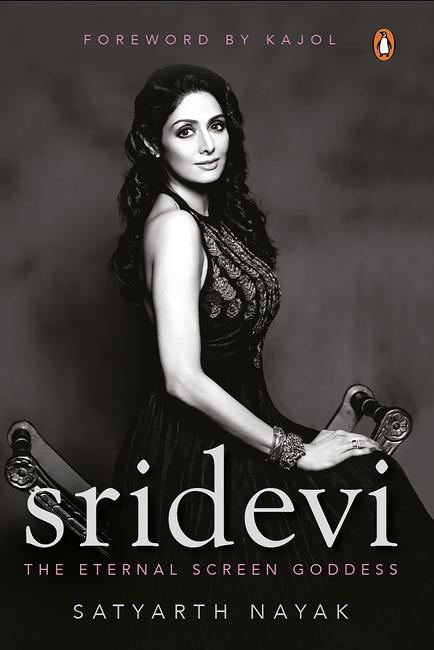
Hailed as the first pan-Indian female superstar in an era which literally offered actresses crumbs, Sridevi tamed Hindi cinema like no other. Beginning her affair with the camera when she was four, this doe-eyed beauty conquered Tamil, Telugu, Malayalam and Kannada industries with performances etched in gold. Taking Hindi cinema by storm with Himmatwala in 1983, Sridevi emerged as one of the most iconic screen goddesses of India, playing characters that went on to become cultural touchstones.
A supreme artiste who had mastered all the nine rasas, her comedy was peerless, her dances legendary, her histrionics awe-inspiring and her life a study in contrast, electric on screen, strangely reticent off it. Besides reigning as queen bee for the longest spell among Hindi heroines, she also remains the only actress who was No.1 in Tamil and Telugu cinema as well.
Such was Sridevi’s megastardom that she emerged as the ‘hero’ at the box office, towering above her male co-actors. Challenging patriarchy in Bollywood like no other, she not only exalted the status of the Hindi film heroine but also empowered a whole generation of audiences. After a hiatus of fifteen years, she shattered the rules again by becoming the only Bollywood diva to make a triumphant comeback in 2012 with the globally acclaimed English Vinglish.
If her life played out forever in the limelight, so did her sudden demise in 2018. Charting five decades of her larger-than-life magic, this book celebrates both the phenomenon and the person Sridevi was. This is her journey from child star to one of our greatest movie luminaries who forever changed the narrative of Indian cinema.
Re-forming India
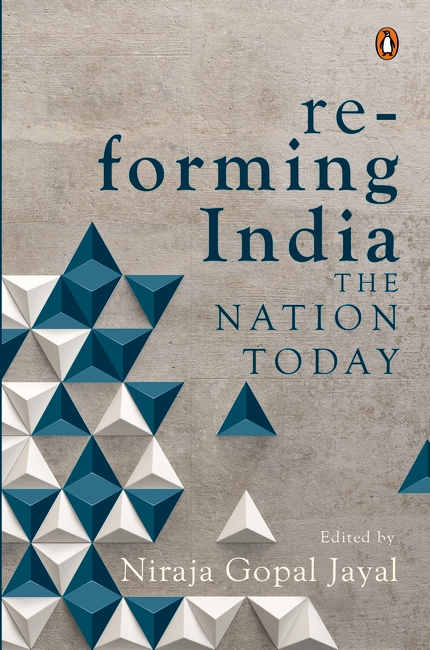
India’s social and political landscape has, in recent times, witnessed many significant transformations. This book offers a wide-ranging review of how India has, over the last few years, fared on the most critical dimensions of our collective life-politics, economy, governance, development, culture and society.
The project of change entailed processes of both reform and re-formation: if reform was about correcting or improving what was considered unsatisfactory, re-formation was a bolder project that aimed to construct anew, anchored in a fundamental re-visioning of India in social, cultural and even moral terms. In many ways, the programme of re-forming India may have outpaced that of reforming India and even exceeded its own expectations.
This volume provides an overview of the prevailing political imaginary of nationalism and of the current trends of public discourse in Indian democracy; it seeks to identify and interpret the transformations in state institutions and the public sphere and evaluate their implications for the future.
Re-Forming India brings together reflections, from leading commentators in their fields, on some of these transformations-from the promise of economic revival and demonetization to the impact on gender relations, higher education and the media. Has the country been transformed in ways that were promised? Or indeed in other ways that had not been anticipated?
With essays from Smita Gupta, Ashok K. Lahiri, C. Rammanohar Reddy, Indira Rajaraman, Radhicka Kapoor, Prem Shankar Jha, Harish Damodaran, A. K. Bhattacharya, Paranjoy Guha Thakurta, Yamini Aiyar, Yogendra Yadav, Diane Coffey, Anirudh Krishna, Navroz K. Dubash, Shibani Ghosh, Madhav Khosla, Ramachandra Guha, Srinath Raghavan, Ashutosh Varshney, Suhas Palshikar, Anand Teltumbde, Pratiksha Baxi, Amitabh Behar, Sanjay Srivastava, Surinder S. Jodhka, Ravindra Karnena, Niraja Gopal Jayal, Gautam Bhatia (lawyer), Ravish Kumar, Taberez Ahmed Neyazi, Neera Chandhoke, Apoorvanand, Gautam Bhatia (architect), Siddhartha Chatterjee and Chandrika Grover Ralleigh.
Adultery
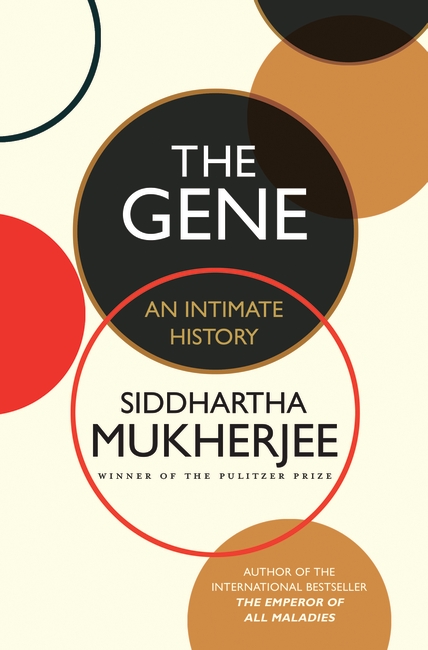
Linda, in her thirties, begins to question the routine and predictability of her days. In everybody’s eyes, she has a perfect life: happy marriage, children, and a career. Yet what she feels is an enormous sense of dissatisfaction. All that changes when she encounters a successful politician who had, years earlier, been her high-school boyfriend. As she rediscovers the passion missing from her life, she will face a life-altering choice.
The Spy
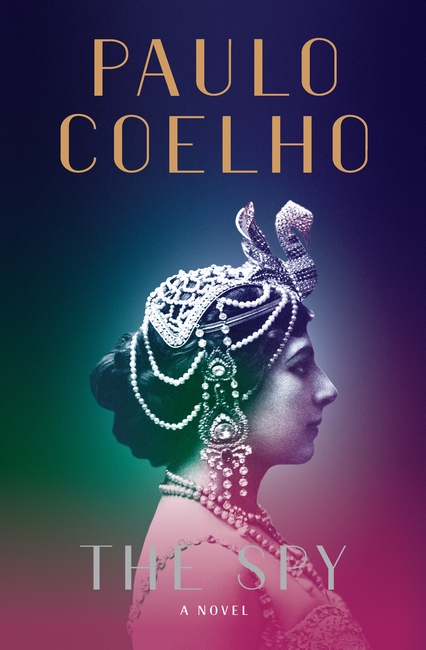
When Mata Hari arrived in Paris she was penniless. Within months she was the most celebrated woman in the city.
As a dancer, she shocked and delighted audiences; as a courtesan, she bewitched the era’s richest and most powerful men.
But as paranoia consumed a country at war, Mata Hari’s lifestyle brought her under suspicion. In 1917, she was arrested in her hotel room on the Champs Elysees, and accused of espionage.
Told in Mata Hari’s voice through her final letter, The Spy is the unforgettable story of a woman who dared to defy convention and paid the ultimate price.
Breath of Gold

Fights, action, music, romance, secret trysts-renowned classical musician Pandit Hariprasad Chaurasia’s life reads almost like a film script. Wrestler in the morning, student during the daytime and flute player in secret, he lived more than a double life through his early years, till he broke away from his wrestler father’s watchful eye to join All India Radio as a flautist.
His marriage, relocation to Bombay and his foray into films were events rich in drama. As were his meetings with other musical greats, including Pandit Shiv Kumar Sharma, his dearest friend and music partner, with whom he composed the music for films like Silsila, Lamhe and Chandni. His reminiscences about his journey as a student of the reclusive Annapurna Devi, daughter of the famed Allauddin Khan of Maihar, give deep insights into his nature as well as that of his guruma.
Hariprasad Chaurasia has also been a guru to innumerable students in his Mumbai and Bhubaneswar gurukuls, and at the World Music Department, Rotterdam Music Conservatory, the Netherlands, where he is artistic director. His mesmerizing flute can be heard in some of Hindi cinema’s most popular songs, in a composition by the former Beatle George Harrison, as well as in recordings with renowned musicians from across the world.
A plethora of awards, including the Padma Vibhushan, sits lightly on the man, who has taken the humble flute to international renown as an instrument that can hold its own. Hariprasad Chaurasia and his Breath of Gold will inspire and amaze everyone who reads the life story of this much-loved flautist.
A Chequered Brilliance
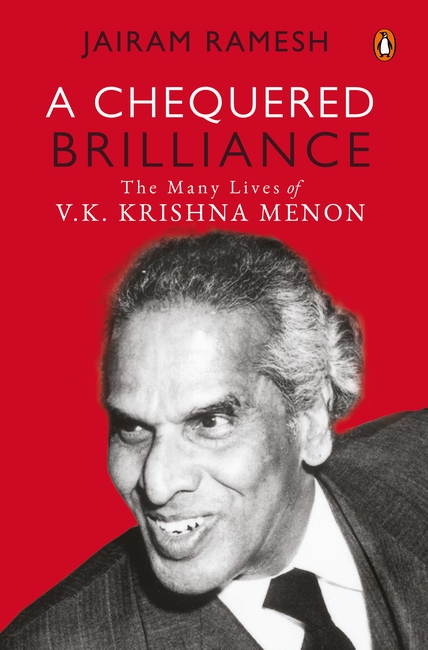
This is a compelling biography of one of India’s most controversial and consequential public figures. V.K. Krishna Menon continues to command our attention not just because he was Jawaharlal Nehru’s confidant and soulmate but also for many of his own political and literary accomplishments. A relentless crusader for Indian independence in the UK in the 1930s and 1940s, he was a global star at the United Nations in the 1950s before he was forced to resign as defence minister in the wake of the India-China war of 1962.
Meticulously researched and based entirely on new archival material, this book reveals Krishna Menon in all his capabilities and contradictions. It is also a rich history of the tumultuous times in which he lived and which he did so much to shape.