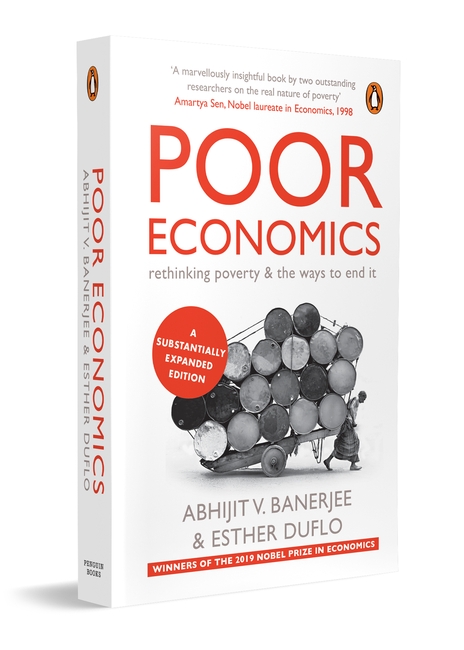
Imagine you have a few million dollars. You want to spend it on the poor. How do you go about it? Billions of government dollars, and thousands of charitable organizations and NGOs, are dedicated to helping the world’s poor. But much of their work is based on assumptions about the poor and the world that are untested generalizations at best, harmful misperceptions at worst.
Abhijit V. Banerjee and Esther Duflo have pioneered the use of randomized control trials in development economics through their award-winning Poverty Action Lab. They argue that by using randomized control trials, and more generally, by paying careful attention to the evidence, it is possible to make accurate—and often startling assessments—on what really impacts the poor and what doesn’t.
Why would a man in Morocco who doesn’t have enough to eat buy a television? Why is it so hard for children in poor areas to learn even when they attend school? Why do the poorest people in Maharashtra spend 5 percent of their total budget on sugar? Does having lots of children actually make you poorer? Drawing on their research at the Poverty Action Lab and their fifteen years of fieldwork in India and across the world, the two economists ask many such questions and show why the poor, despite having the same desires and abilities as anyone else, end up with entirely different lives.
Revelatory and impassioned, Poor Economics is a pathbreaking book that will help you to understand the real causes of poverty and how to end it.


Imprint: Vintage Books
Published: Jan/2026
ISBN: 9788184002805
Length : 464 Pages
MRP : ₹499.00
The authors of the highly acclaimed 2011 book, Poor Economics: A Radical Rethinking of the Way to Fight Global Poverty, now have another reason to celebrate! On 14th October 2019, authors Abhijit Banerjee and Esther Duflo were named as two of the three groundbreaking recipients for the 2019 Nobel Prize in Economics! Of course, that is as strong […]