© 2020 Penguin India
Taslima Nasrin (Author) was born in the city of Mymensingh, Bangladesh. After graduating from Mymensingh Medical College, she worked as a government doctor in public hospitals until 1993. When ordered by the government to
choose between her job and writing, she chose to resign from public service to continue her literary pursuits.
Nasrin is one of the most uncompromising feminist writers of the Indian subcontinent. Her writing has earned her immense popularity but
also controversy. In advocating for women’s rights, she has not only faced attacks from religious fundamentalists but also encountered opposition from the State and patriarchal society at large. Fundamentalist groups
demanded her execution and even placed a bounty on her head. As a result, she was exiled from her beloved homeland in 1994. Fatwas and numerous lawsuits against her freedom of expression still hang over her in Bangladesh. After years of exile in Europe, she settled in West Bengal, India, but was later expelled from that state as well. This Bengali writer has found
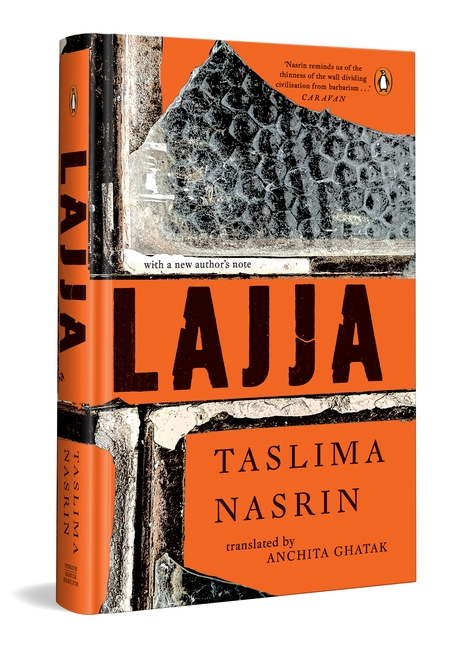
no refuge in either part of Bengal. Several of her books have been banned by the Bangladesh government, including Lajja (a fact-based novel in defence of humanity), Amar Meyebela
(a memoir of her childhood), Utal Hawa (about her teenage and early adult years), and the third and fourth parts of her autobiography, Ka (translated as Split: A Life) and Sei Sob Andhokar. West Bengal’s government also
banned Ka, although the Calcutta High Court overturned the ban two years later.
Nasrin has received numerous awards and honours. In India, she won the Ananda Purashkar twice: for Nirbachito Kolam and Amar Meyebela. She received the Sakharov Prize for Freedom of Thought from the European
Parliament, the UNESCO Prize for promoting tolerance and peace, the French government’s Human Rights Prize, the Simone de Beauvoir Prize and the Edit de Nantes Prize from France for her fi ght against religious extremism. Other honours include the Academy Award from the Royal Academies for Science and the Arts of Belgium, and the Kurt Tucholsky Prize from PEN Sweden. She has also received honorary doctorates from Ghent University and the University of Leuven in Belgium, the American
University of Paris and Paris Diderot University. She has held fellowships at Harvard and New York University.
Nasrin has authored over fifty books across poetry, short stories, novels, essays and autobiographies. Her works have been translated into twenty-five languages, including English, French, German, Italian, Spanish, Swedish, Norwegian, Icelandic, Finnish, Dutch, Arabic and Turkish.
A vocal advocate for humanism, human rights, women’s liberation and free thought, she has delivered speeches around the world, including at prestigious institutions such as Harvard, Yale, Oxford, Edinburgh and the Sorbonne. Globally, she has become a symbol of the fight for freedom of expression.