Publish with Us

Follow Penguin

Follow Penguinsters

Follow Penguin Swadesh

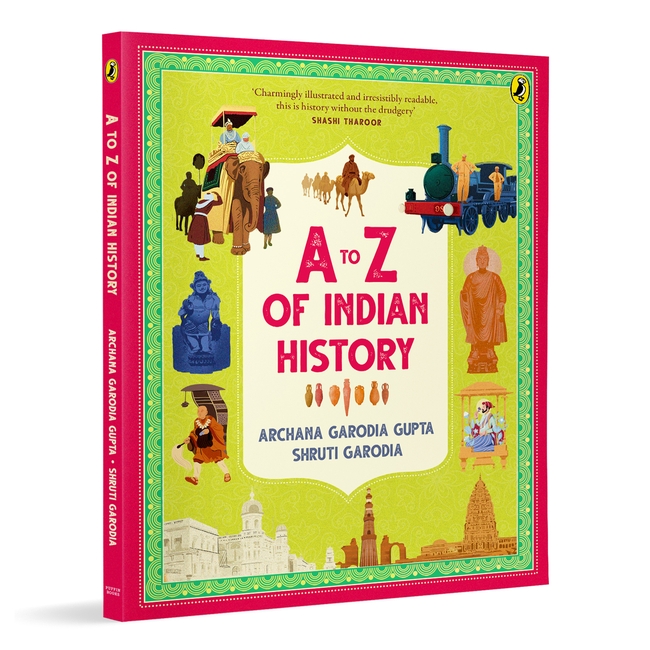
A-Z of Indian History

‘Charmingly illustrated and irresistibly readable, this is history without the drudgery’ Dr Shashi Tharoor

Did you know that in Mughal times, sixty feet of incredibly fine Indian muslin could fit into a small pocket snuffbox?

Or that the first Indian stunt heroine, the swashbuckling ‘Hunterwali’ Fearless Nadia, was actually an Australian actress called Mary Evans?

Did you know that there are more than 300 versions of the Ramayana, across India and around the world? Or that Harappan children also played games like lagori or pitthu?

With eighty quick, exciting stories, this book is perfect for curious kids who love to ask, ‘Wait . . . really?’ Every page opens a tiny door into a India’s past, filled with wow moments, strange facts and awesome surprises.
Packed with cool trivia, bright illustrations and a fun, playful design, this is the ultimate history book—without any of the boring stuff. Prepare to jump and shout, ‘I never knew that!’ again and again!
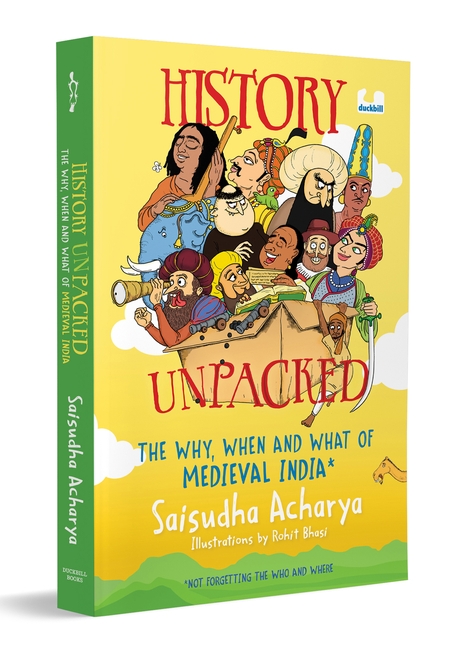
History Unpacked: The Why, When and What of Medieval India (Not Forgetting the Who and Where)

This book is an utter romp through the Middle Ages with daring rulers, mad adventurers, wild battles and unexpected international alliances. What makes medieval India so fascinating? The troublemakers, empire-builders and adventurers—Cholas on the seas, slave-turned-sultans in Delhi, migrating Ahoms, cultured kings of Vijayanagara, Portuguese who stumbled into something far bigger than pepper . . . and so many others.

History Unpacked: The Why, When and What of Medieval India dives into a thousand years of wars, poets, plunder and surprising partnerships. Through timelines, hilarious comics, clever quizzes and one cheeky poem, discover how history was written, whose stories were forgotten and why the past still argues with us today.

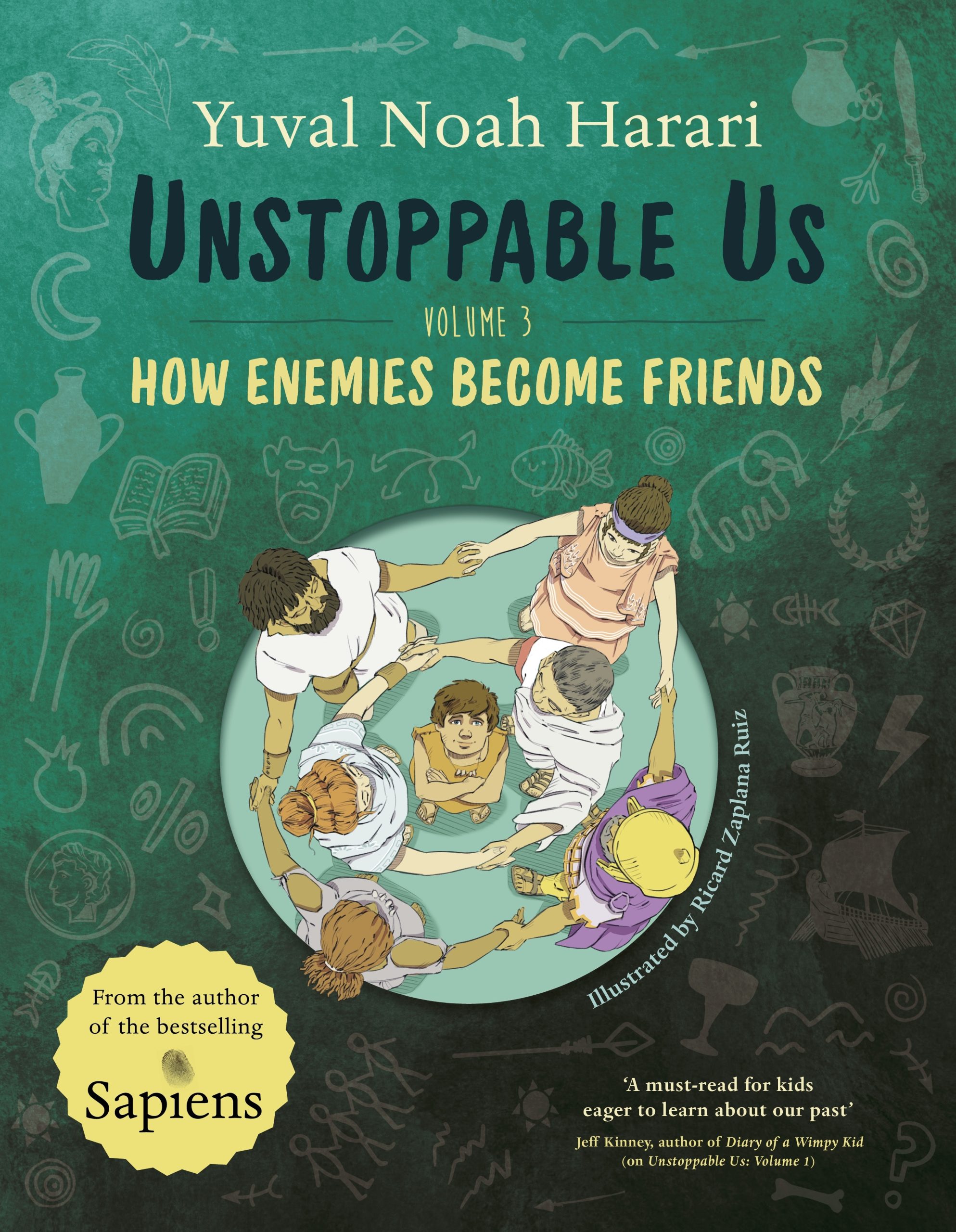
Unstoppable Us, Volume 3: How Enemies Become Friends, from the author of the multi-million bestselling Sapiens (Unstoppable Us, 3)

NEW YORK TIMES BESTSELLER SERIES

From world-renowned historian and philosopher Yuval Noah Harari, bestselling author of Sapiens, comes the third thrilling, illustrated volume in the Unstoppable Us series—an unforgettable journey into how ancient enemies became allies and helped shape the world we live in today.

How do strangers—and even enemies—become friends?

The answer is one of the most surprising true stories in human history. Thousands of years ago, long before modern borders existed, people from different lands met, traded, told stories, and sometimes married. Through these connections, new cities rose, cultures blended, and shared languages and religions emerged. But when differences grew larger than similarities, neighbors could become rivals, sparking conflicts that changed the course of history.

In Unstoppable Us, Volume 3, Harari explores how early civilizations interacted across continents: exchanging food and ideas, travelling vast oceans, building mighty empires, and forming the first countries and communities. It’s a sweeping tale of cooperation and conflict—of how humans learned to unite, compete, and create the world we know.

Following the adventures of Volumes 1 and 2, this book continues the epic story of humankind with Harari’s signature clarity and humor. Complete with a map, timeline, and vivid full-color illustrations, Volume 3 brings history to life for curious young readers, showing how the friendships (and rivalries) of the past still shape our present.

Prepare to discover how enemies became friends—and how those friendships changed everything.

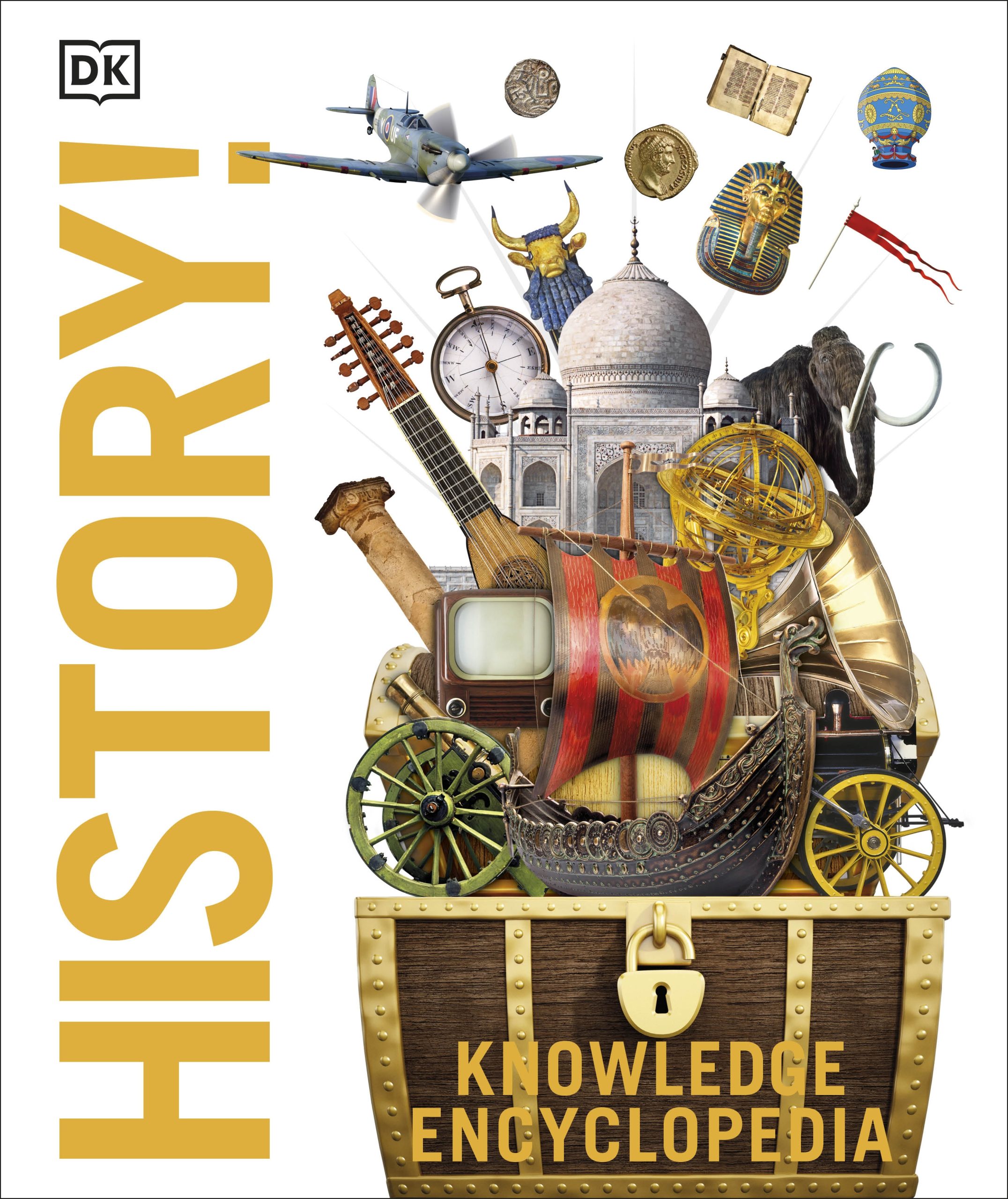
Knowledge Encyclopedia: History! | Illustrations of Ancient Civilizations to Modern Times, Maps and Fun Facts | Explore World History for Kids 9+

Journey back in time to take part in a mammoth hunt, march with a Roman soldier, and fly with the Wright brothers.

Explore what history looked like through spectacular computer-generated images of the key people, places, and events. This new book in the Knowledge Encyclopedia series will inspire young readers with its vivid depictions of history and its comprehensive and authoritative information on a huge range of topics.

Bringing subjects to life, this groundbreaking children’s reference allows readers to peer inside ancient buildings, marvel at elaborate outfits, and get close to the battles of history. You will discover what everyday life was like in medieval cultures, how inventions such as the printing press changed the world, and so much more. From the lives of ferocious samurai warriors to World War II and contemporary eco-friendly innovations, every historical event is visualized in incredible detail, providing a fascinating introduction to the world through time.

Find yourself transported to the past, from our earliest ancestors right up to the world we live in today.

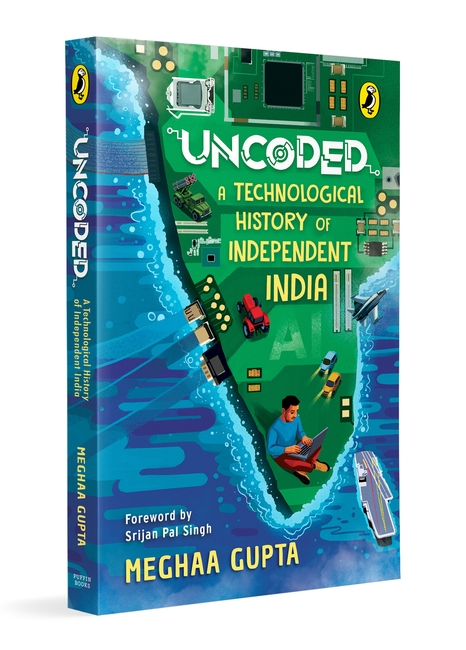
Uncoded

‘Rewires how we think of nation-building’

Charles Assisi, technology columnist at Hindustan Times

From factories to farms, battlefields to boardrooms, clinics to classrooms—in the years since Independence, modern technology has swept through all corners of Indian life.

But back in 1947, this seemed impossible. Low literacy, poverty and lack of expertise meant that newly independent India was unable to afford the mighty technologies of World War II that were reshaping the globe. Yet, a determined team of far-sighted policymakers and scientists dared to make the impossible possible.

Today, India is home to leading software companies and a world-renowned space programme. For many Indians, modern technology has become part of daily life.

Uncoded: A Technological History of Independent India is a story of one of the greatest technological transformations in the modern world. Blending a unique narrative with illustrations, trivia, anecdotes and an informative timeline, it explores how a nation used science and technology to rebuild itself and reimagine its destiny against all odds.

USPs

  • A one-of-a-kind and first book for teens on the fascinating evolution of technology in India.
  • Packed with memes, pop-culture references, and interactive elements that teens love, this isn’t an average history book but a lucid and relatable book for contemporary readers.
  • Perfect for aspiring engineers, gamers, app developers and science enthusiasts.
  • Get insider stories on how major tech revolutions happened—told through a mix of storytelling, illustrations and cool facts.
  • Explores how homegrown innovations are putting India on the global tech map.
  • Aligns with STEM and social studies curricula. Perfect for school reading lists and supplementary reading.
  • Includes infographics, timelines, and quick explainer sections.
  • Part of a history series on Independent India written for young readers, following 2 acclaimed titles: After Midnight: A History of Independent India (2022) and Unearthed: An Environmental History of Independent India (2020).

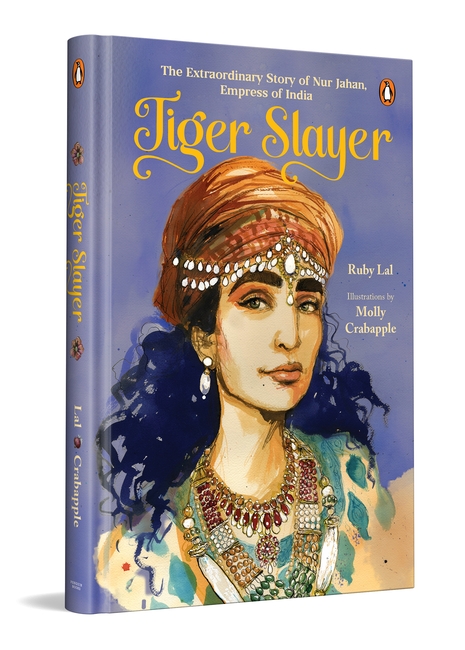
Tiger Slayer

More than four centuries ago in India, a Muslim woman ruled a magnificent empire: Nur Jahan, whose name means ‘light of the world’. Nur led troops into battle atop an elephant, hunted tigers, designed public buildings, and issued coinage and royal decrees in her own name.
In a world dominated by men, her astute handling of court politics and affairs of state propelled her to the position of co-sovereign of the vast Mughal Empire—and made her mighty enemies, who would plot to bring about her downfall.
Tiger Slayer combines the gifts of historian Ruby Lal and artist Molly Crabapple to uncover the vibrant and diverse culture of Mughal India and tell the compelling story of a daring, brilliant woman who achieved unequalled power and fame.

‘Historian Lal demonstrates exemplary historical methodology throughout as she traces the life of Nur Jahan … Crabapple’s full-colour illustrations transform the pages into windows onto Mughal India’s opulent world … a product of Lal’s extensive research for her adult biography, lending additional credibility to an already well-documented narrative that successfully combines scholarly rigor with engaging storytelling. Sets a new standard for works celebrating overlooked historical figures’ –Kirkus

‘Nur would say: Ruby Lal is a fountain of light, Molly Crabapple the prism of the age’ –Irwin Allan Sealy

‘Adulatory, deeply satisfying, well documented, and filled with strikingly gorgeous illustrations, this is a fitting tribute for an empress’ –Kathleen McBroom ― BOOKLIST Advance Review

‘Sometimes when creative souls come together for a project and pour their passion into it, the end result is a product that is utterly perfect. This is one of those rare gems’ –Jaya Bhattacharji Rose, Ace Literary Consulting

‘Celebrated historian Ruby Lal and award-winning illustrator Molly Crabapple put the spotlight on the awe-inspiring true story of empress Nur Jahan, the only woman to ever rule the Mughal Empire. With Tiger Slayer, get on board an immersive journey through Nur Jahan’s world, full of ancient rivers and rose gardens, whispered poems and fearless power plays’ –Farah Khatoon, T2 Goodlife

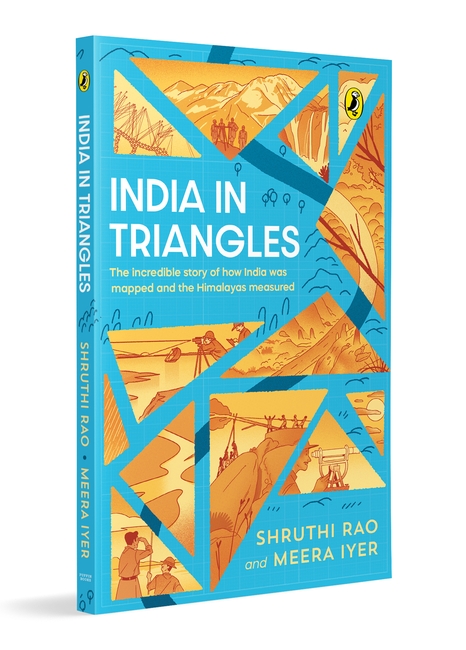
India in Triangles: The Incredible Story of How India was Mapped and the Himalayas Measured | Explore the History and Science Behind The Great Trigonometrical Survey | Ages 11+

Step into the boots of fearless surveyors as they trek across forests, mountains and monsoons—facing disease, wild animals and gruelling terrain—to chart the subcontinent with astonishing precision.

This was the Great Trigonometrical Survey, an ambitious mission to map India using triangulation—a brilliant method that helped them measure every inch with accuracy. Along the way, they calculated the height of the world’s tallest mountain and revealed the true shape of the earth.

Packed with adventure, ingenuity, mishaps and the unsung heroes of science, this is the epic true story of mathematics, grit and discovery.

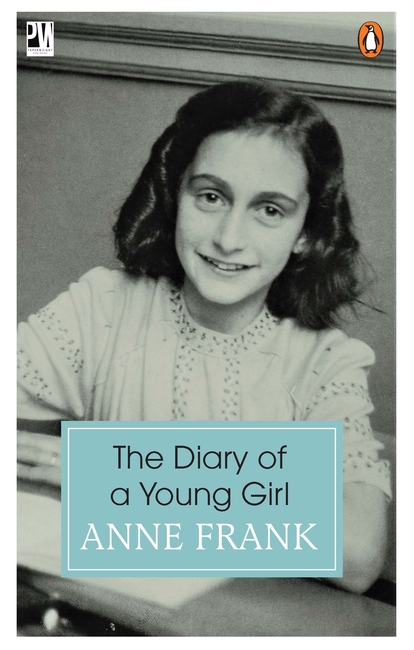
The Diary of a Young Girl

“I’ve found that there is always some beauty left?in nature, sunshine, freedom, in yourself; these can all help you.”

Anne begins her diary entries at the age of thirteen in June 1942, recording all her experiences until August 1944. All people have the right to freedom, but Anne wasn’t sure that idea included her. During WWII, Anne and her family were forced to go into hiding like many other Jews.

Vivid snippets of two years of living in an annexe, without seeing the sun, are journalled by Anne. From their bones dwindling to her emotional growth all is reflected in her writings. She writes of her passion for literature and art, her desire to travel, the struggles of family ties in hiding: showing her incredible emotional resilience.

How does she keep her spirits alive through imagination, hold onto the hopes of free life, when they weren’t allowed to bring attention to themselves?

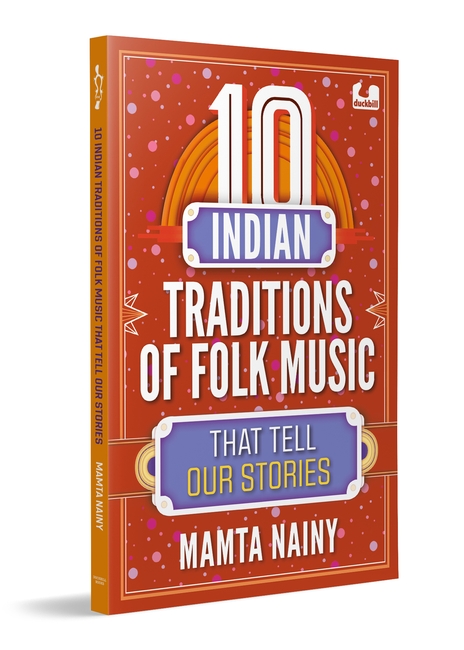
10 Indian Traditions of Folk Music That Tell Our Stories

This book explores ten traditions of folk music that have long preserved some of the many voices and diverse cultures across India. From the evocative ballads of Kashmir to the soulful rhythms of Bengal, each tradition is shaped by the region where it originated and the challenges and joys of the singers. These traditions are:

The Bidesia of Bihar
The Gathas and Kathas of Rajasthan
The Ladishah Ballads of Kashmir
The Nizami Qawwali of Dilli
The Pandavani of Chhattisgarh
The Kabir Vaani of Kutch
The Janapadas of Karnataka
The Lavani of Maharashtra
The Li of the Chakhesang Nagas

The Bhatiyali of Bengal Mamta Nainy explores the origins of these musical forms, and their evolution in the face of modernity, highlighting their power as a means of collective expression.

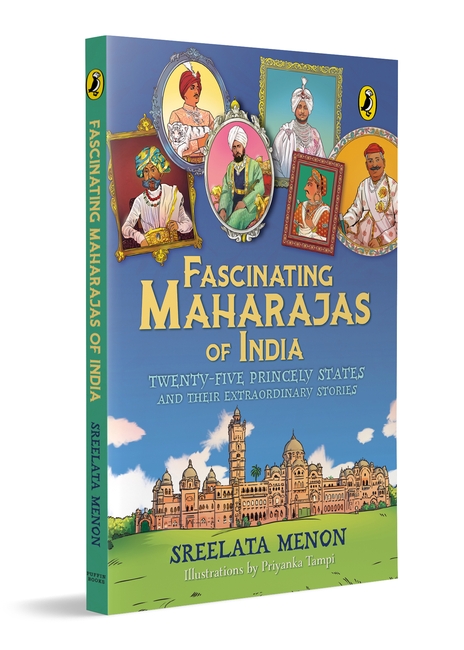
Fascinating Maharajas of India

Long, long ago, the vast Indian subcontinent was alive with powerful kingdoms and adventurous maharajas. They expanded with fervour and ruled with aplomb. They lived extravagant lives yet protected their turfs. They introduced reforms and uplifted their people. And despite their many quirks, they laid the foundation for the progress and development of modern India.

  • How did the Travancore maharajas promote education?
  • When did the Mysore maharajas begin celebrating Dasara with such pomp?
  • How unique was the Junagadh nawab’s love for his dogs?

Discover the answers to these questions and more in this gorgeously illustrated book that chronicles twenty-five such exciting Indian kingdoms—from their origin to when they became princely states under the British to finally merging with the Indian Union at the time of Independence and becoming the backbone of a brand-new nation.

error: Content is protected !!