



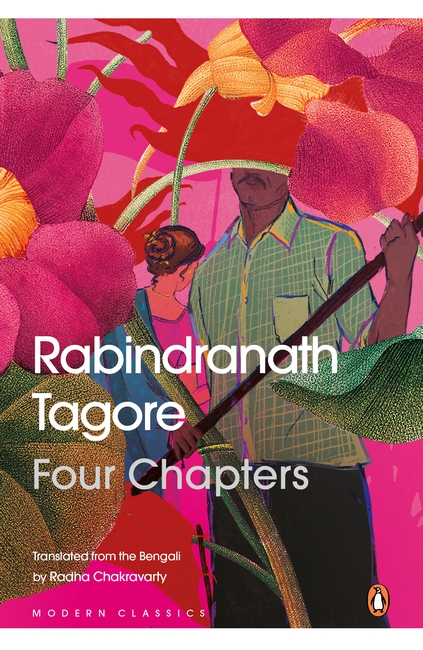
Char Adhyay (1934) was Rabindranath Tagore’s last novel, and perhaps the most controversial. Passion and politics intertwine in this narrative, set in the context of nationalist politics in pre-Independent India. Ela, a young working woman, comes under the spell of Indranath, a charismatic political activist who advocates the use of terror for the nationalist cause. She takes a vow never to marry, and to devote her life to the nationalist struggle. But she falls in love with Atindra, a poet and romantic from a decadent aristocratic family. Through their relationship, she becomes aware of the hollowness of Indranath’s politics. Afraid that she might expose them to the police, the political group gives Atin the task of eliminating Ela. In the dramatic final sequence of the novel, Ela offers herself to Atin, with tragic consequences.
This new translation, intended for twenty-first-century readers, will bring Tagore’s text to life in a contemporary idiom, while evoking the flavour of the story’s historical setting.
Catagory: Classics
Anthology of Humorous Sanskrit Verses
In recent times, whenever ancient Sanskrit works are discussed or translated into English, the focus is usually on the lofty, religious and dramatic works. Due to the interest created by Western audiences, the Kama Sutra and love poetry has also been in the limelight. But, even though the Hasya Rasa or the humorous sentiment has always been an integral part of our ancient Sanskrit literature, it is little known today.
Anthology of Humorous Sanskrit Verses is a collection of about 200 verse translations drawn from various Sanskrit works or anthologies compiled more than 500 years ago. Several such anthologies are well-known although none of them focus exclusively on humor. A.N.D. Haksar’s translation of these verses is full of wit, earthy humor and cynical satire, and an excellent addition of the canon of Sanskrit literature.
Battles of Our Own
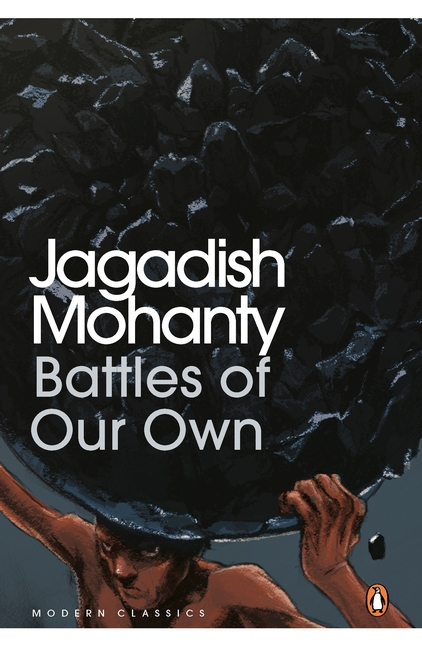
An Indian ‘industrial novel’ from the winner of the 1990 Odisha Sahitya Akademi Award
Jagadish Mohanty’s Battles of Our Own is a rare work of modern Odia and Indian fiction. It seeks to delineate a world that is off the grid. Its action unfolds in the remote and non-descript Tarbahar Colliery-a fictional name for the over hundred-year-old open-cast Himgiri Rampur coal mine in the hinterland of western Odisha. A work of gritty realism in its portrayal of a dark and dangerous underworld where coal is extracted, the novel poignantly reveals the primeval struggle between man and brute nature.
Offering a complete experience of the ‘industrial novel’-face offs between trade unions and management, trade union rivalry, and clandestine deals between enemy camps-this work brings alive Mohanty’s literary genius, which takes us to a world beyond the simplistic binary division between the worker and the master. The novel unravels a complex, fractious, and nuanced picture of the human condition.
This sensitive and evocative rendering by Himansu S. Mohapatra and Paul St-Pierre captures the thrill, beauty, horror and tragedy of this fictional tour de force.
Malloban
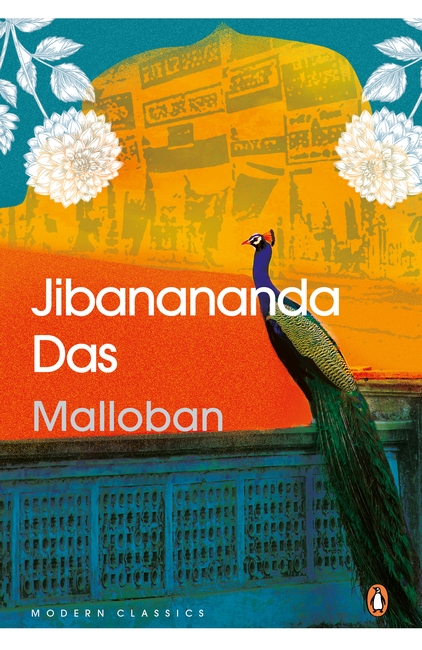
Malloban is set in North Calcutta in the winter of 1929. The eponymous protagonist, a lower-middle-class office worker, lives in College Street-a locality known for its bookstores, publishing houses, and universities-with his wife Utpala and their daughter Monu. The novel unfolds through a series of everyday scenes of dysfunction and discontent: bickering about bathrooms and budgeting, family trips to the zoo and the movies, a visit from Utpala’s brother’s family which displaces Malloban to a boarding house, and the appearance of a frequent late-night visitor to Utpala’s upstairs bedroom. Meanwhile, the daughter Monu bears the brunt of her parents’ “unlove.”
Arguably the most beloved poet in modern Bangla after Tagore, Jibanananda wrote a significant number of novels and short stories discovered and published after his death. Malloban is his most popular novel.
Dada Comrade

‘This fine translation has once again returned Yashpal’s story to that fraught arena where every warrior appears exhausted today’-Ravish Kumar
‘A daring and unusual novel’-Vasudha Dalmia
‘A remarkable contribution to literary translation in English’-Apoorvanand
Harish, a young revolutionary in pre-Independence Lahore, upsets his party by questioning its credo of underground armed resistance. Escaping the party’s wrath, he becomes a labour activist, but is soon framed by the British government. Meanwhile, Shailbala, his comrade and lover, must take a decision about her pregnancy. As she courageously defies social norms and stands up to her influential father, can she find an ally within the revolutionary party-with Dada–Harish’s erstwhile mentor and antagonist–as its autocratic leader?
Yashpal’s first and semi-autobiographical novel, Dada Comrade is considered the pioneering political novel of Hindi literature. It raises questions about freedom and equality, as well as about sexuality and marriage-subjects as urgent today as in those times. In this first-ever English translation, Simona Sawhney brilliantly captures the force and intensity of the original, which had heralded the arrival of a literary genius.
The Last Light in Delhi
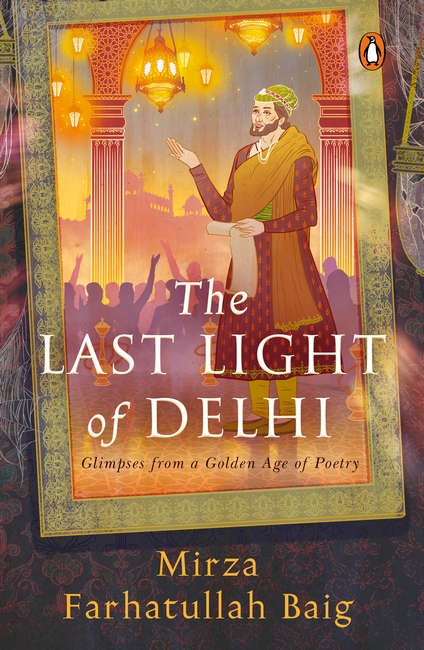
Farhatullah Baig imagines a mushaira as it might have been in the last glory days of Delhi, during the mid-nineteenth century, lit by the glowing embers of the dying Mughal empire.
The Last Light of Delhi is the story of a last grand mushaira held in the city of Delhi circa 1845. Though the mushaira is fictional, the book is a cultural document of the age, taking the reader on a journey in time to a past when poetry flowed through the streets of the city. It paints a portrait of a lost world, of the life and living styles of the upper classes of Delhi in the decade before the fateful year of 1857.
Baig takes the reader into the sitting rooms of some of the most iconic people of the time, from Mirza Ghalib to Bahadur Shah Zafar, giving us a glimpse into their private lives, describing their homes, their manners, their ways of dressing and talking, filling his portraits with colour and detail so that the poets appear vividly before us-and when they begin to recite their poems in the mushaira, it seems as if each poet is speaking out from the pages of the book.
Aranyak
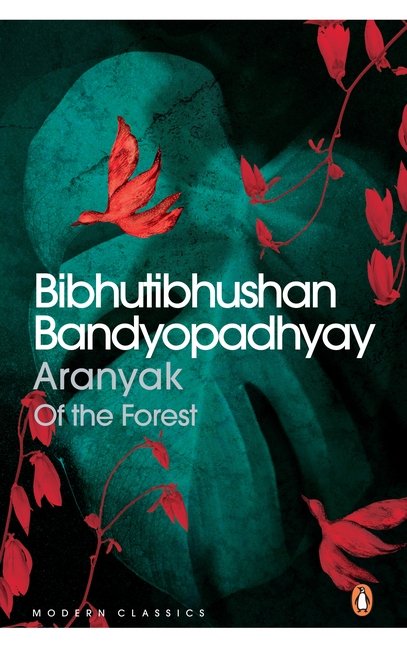
Translated from the Bengali by Bhaskar Chattopadhyay
From one of the greatest Bengali novelists of all time
Aranyak, written in 1939, is a famous Bengali novel by Bibhutibhushan Bandyopadhyay based on his long and arduous years in northern Bihar. There he came into contact with a part of the world that, even now, remains unknown to most of us. ‘Aranyak’ literally means ‘Of the Forest’.
This novel explores the simple and heart-warming story of a man who gets a job as an estate manager in Bihar, and slowly falls in love with the beautiful and tranquil forest around him. The dichotomy of urban and rural life comes alive, reflecting the great love that human beings and nature can share, one that Bandyopadhyay experienced in his heart. Written by one of the greatest Bengali authors, this haunting novel is rooted in guilt and sadness but also tremendous beauty.
Ecstasy and Other Stories
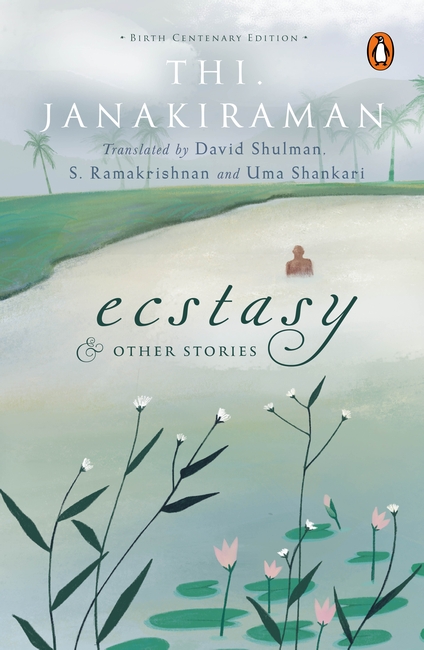
STORIES THAT TOUCH YOUR HEART BY ONE OF THE BEST MODERN TAMIL WRITERS
Special Birth Centenary Edition
Thi. Janakiraman (ThiJa) was one of the best Tamil prose writers of the twentieth century. The stories in this specially curated collection offer a view of the modernizing Tamil countryside as well as the changing landscape of human relationships. A man builds his reputation based on lies to meet the expectations of his father, a woman desiring tenderness from her abusive husband finds release in an unexpected way, a music teacher is mocked for taking on a lower-caste student, and a drowning cat becomes the centre of attention during funerary rituals. In these and other tales, Janakiraman reaches inside the depths of the human heart and lays bare its contradictory pulls.
Through their brilliant translation, Professor David Shulman and the late S. Ramakrishnan reveal the ‘perfect pitch’ of Janakiraman’s precise, exquisite Tamil. They deftly capture his fluid, sensitive style in idiomatic English, seamlessly rendering the subtle inflections of the original. Prof. Shulman’s insightful and affecting introduction places Janakiraman within the long continuum of Tamil literature. There is also a short, beautiful memoir on him, written by his daughter Uma.
Selected Satire
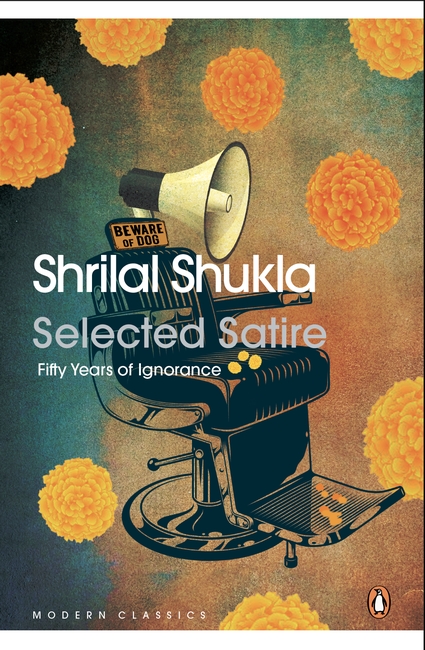
Selected Satire: Fifty Years of Ignorance brings together about 20 satire pieces of eminent Hindi writer, Shrilal Shukla. Most noted for his novel Raag Darbari, for which he received the Sahitya Akademi Award, Shukla also wrote several collections of satirical essays and short stories.
The pieces in this volume include his socio-political and cultural satires, where he caricaturizes politicians, mocks the bureaucracy (many of whom were his friends), and picks on the so-called developmental schemes of the government. A couple of pieces are also about small town attitudes and pretentions of intellectuals. The overall flavour is of an irreverence to authority and humour drawn from everyday occurrences.
Fakira
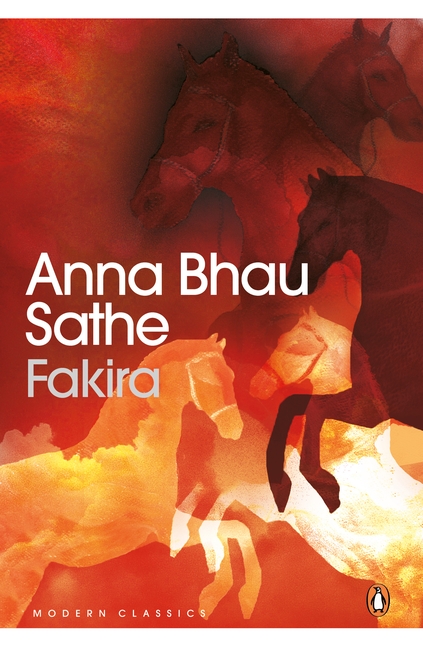
Born into an untouchable community, Anna Bhau Sathe’s upbringing and experiences shaped his writings and political activism. Winner of the Maharashtra Government’s ‘best novel’ award, Fakira, among his best-known works, is one of the first prominent Dalit novels in Marathi.
The undaunted and ceaseless battle of the eponymous character, Fakira, for the collective welfare of his community forms the narrative. He revolts against the rural orthodox caste system and the British Raj to save his village from utter starvation, humiliation, and death. His efforts are dramatic and daring, and his methods in violation of the law. When attempts to capture him fail, the British authorities hold the community hostage, stating that unless Fakira surrenders, they will torture his people to death.
Translated by Prof. Baliram Gaikwad, Dalit magnanimity, fighting spirit, and thirst to live a dignified existence are at the core of the novel. Encompassing both historical and contemporary reality as well as the truest human emotions and situations, Fakira is part of a powerful literary genre that brings to the forefront the most encouraging, moving and realistic delineation of Dalit lives.