Why did I do it? Why did I enter the country of deceit? What took me into it? I hesitate to use the word love, but what other word is there?’
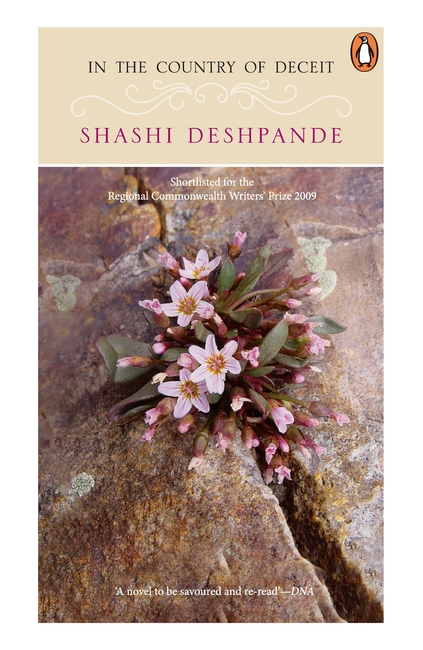
Devayani chooses to live alone in the small town of Rajnur after her parents’ death, ignoring the gently voiced disapproval of her family and friends. Teaching English, creating a garden and making friends with Rani, a former actress who settles in the town with her husband and three children, Devayani’s life is tranquil, imbued with a hard-won independence. Then she meets Ashok Chinappa, Rajnur’s new District Superintendent of Police, and they fall in love despite the fact that Ashok is much older, married, and-as both painfully acknowledge from the very beginning-it is a relationship without a future.
Deshpande’s unflinching gaze tracks the suffering, evasions and lies that overtake those caught in the web of subterfuge. There are no hostages taken in the country of deceit; no victors; only scarred lives. This understated yet compassionate examination of the nature of love, loyalty and deception establishes yet again Deshpande’s position as one of India’s most formidable writers of fiction

Like Dickens, Saratchandra had a bag of wonderful tales. The Final Question (Shesh Prashna) is one of Saratchandra Chattopadhyay’s last novels and perhaps his most radically innovative. The novel caused a sensation when it was first published in 1931, drawing censure from conservative critics but enthusiastic support from general readers, especially women. The heroine, Kamal, is exceptional for her time. She lives and travels by herself, has relationships with various men, looks poverty and suffering in the face, and asserts the autonomy of the individual being. In the process, she tears apart the frame of the expatriate Bengali society of Agra, where she lives. Through Kamal, Saratchandra questions Indian tradition and the norms of nationhood and womanhood. The Final Question transcends time and will appeal to readers of all ages. Translated by Department of English, Jadavpur University.

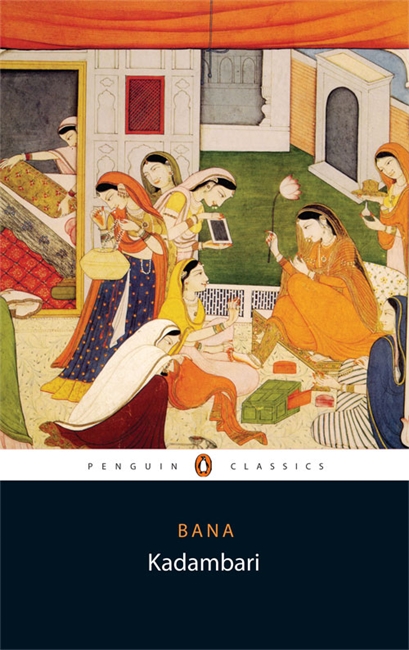
Bana is among the three most important prose writers in classical Sanskrit, all of whom lived in the late sixth and early seventh centuries AD. It is clear, from his writings, that his mind was amazingly modern, humane and sensitive, especially for the seventh-century India in which he lived. Bana had a healthy irreverence towards many of the established orthodoxies of his time and his strength lies in his skill as a storyteller and as a creator of characters vibrant with life and individuality.
Kadambari is a lyrical prose romance that narrates the love story of Kadambari, a Gandharva princess, and Chandrapida, a prince who is eventually revealed to be the moon god. Acclaimed as a great literary work, it is replete with eloquent descriptions of palaces, forests, mountains, gardens, sunrises and sunsets and love in separation and fulfillment. Featuring an intriguing parrot-narrator, the story progresses as a delightful romantic thriller played out in the magical realms between this world and the other, in which the earthly and the divine blend in idyllic splendour.

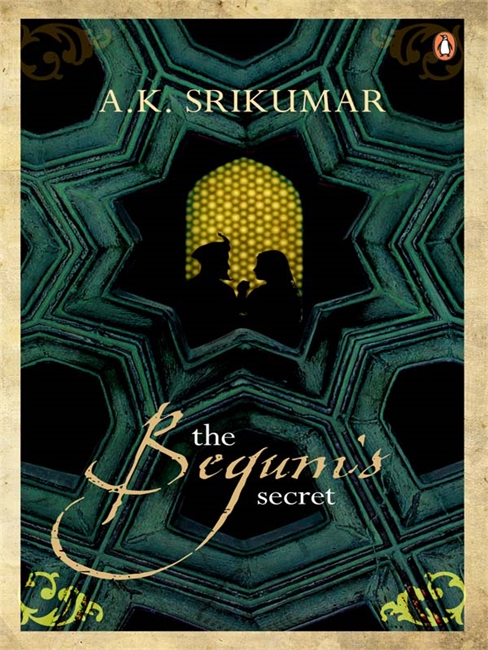
What do you suggest, then? How do we mitigate this tragedy? Three years of drought . . . three years of starvation!’ She realized it was his way of getting back at her. ‘There is an answer, Your Majesty. What if a large imambara were to be built, bigger and more magnificent than any constructed so far in Hindustan? Every Mussulman in Allah’s creation will remember Asaf-ud-daula with reverence for all time to come.’ 1784. Amid famine, poverty, a grand culture rises: Awadh. As Nawab Asaf-ud-daula tries to come to terms with new British masters, his awam seeks comfort in the vibrant poetry of Mir, the buzz of the Chowk, the thrill of the wrestling matches and the gossip of the zenankhana. In masterful prose, A.K. Srikumar tells the story of Asaf-ud-daula’s court and his people, of the uncertain fortunes of Begum Shams-un-nisa, Prince Wazir Ali, Nazir-i-Mahal Nuruddin, of the schemes of Naib Haider Baig Khan and Resident John Bristow and pretender Saadat Ali Khan, of the Bada Imambara and a culinary tradition that was born amidst the brick and mortar— dum pukht.

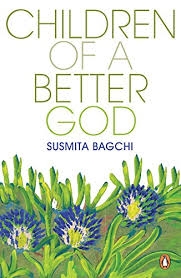
Anyone who took one look at Shweta could guess that she was suffering from some serious physical or mental disability. What future did the Shwetas of this world have? Shobha would raise her hands heavenwards and say, ‘Surely the same Creator who brought them to the earth will look after them? I believe they are children of God, hopefully a better God than the one who looks after us.’
When Anupurba comes back to India from the United States, reluctantly leaving behind a satisfying job as an art teacher, she does so with a sense of apprehension at this displacement from her comfortable, suburban American life. She never imagines that returning to India would turn out to be a profoundly transformational and life-changing decision. A chance meeting with an old college friend introduces her to Asha Jyoti, a school for children suffering from cerebral palsy. Overcoming her initial trepidation, she agrees to volunteer as a temporary art teacher. Anupurba teaches the children how to draw and paint but it is the children who teach her the real lessons: about suffering and survival, joyous friendship, love and laughter.
Children of a Better God is a deeply touching, tenderly written story about the agonizing challenges faced by children who have to live with lifelong disability, and the ways in which these very special children can powerfully enrich our lives with their grit, positive spirit and sheer courage.

Evergreen Books of Penguin Box Set is an extraordinary collection of some of the finest fiction and non-fiction titles published by Penguin publishers.
Evergreen Books of Penguin Box Set is a treasure trove of carefully selected fiction and nonfiction titles. This book is collection of some of Penguin’s wide-ranging list of classics and bestsellers by some of the most renowned writers in the Indian Subcontinent. The box set comprises of very appealing and delightful stories which will make for a riveting read for people of all age groups. Some of the titles included in the boxset are The Kitemaker, My Experiments with Truth, The Jungle Book and Valmiki Ramayana, among other selections.
As soon as I make it home I run upstairs to my room and tear my clothes off. I twist my head to get a good view of my back. And that’s when I see it. A wide line of soft, dark hair running from the nape of my neck down to the base of my spine. A stripe right down the center of my back, like a skunk. I’m not just a hairy Pakistani Muslim girl any more.I am a skunk girl.’ Nina Khan is sixteen, and has a few problems at hand. She is the only South Asian student at Deer Hook High; she doesn’t care about calculus, unlike her over-achieving older sister; she has a genetic disposition for excessive body hair; and if her parents had a whiff of her thoughts about Asher Richelli, the cute new Italian transfer student, she would be grounded forever. In this funny, wryly witty debut novel by Sheba Karim, Nina navigates her way through the first year of high school, dealing with friends who don’t even need to wax, and who don’t have a ghazal-listening father waiting round the corner. She realizes that though balancing two cultures is never easy, with a little spunk and a lot of humor, one can always find a way.

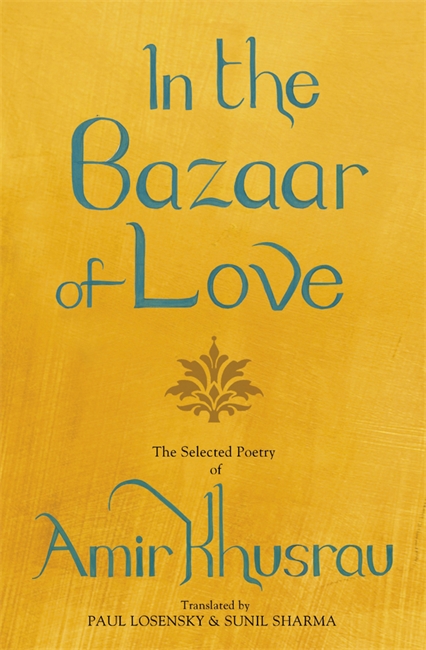
Amir Khusrau-poet, courtier, mystic, musician-straddled the worlds of politics and religion and helped forge a distinctive synthesis of Muslim and Hindu cultures. His poetry in Persian appealed equally to the Delhi sultans and to his Sufi sheikh, Nizamuddin Auliya. It was appreciated not only in India, where his Hindavi poetry has survived through a lively oral tradition, but also across a cosmopolitan Persianate world that stretched from Turkey to Bengal.
Khusrau’s poetry has thrived for centuries and continues to be read and recited to this day. But despite his vast literary output, there is a dearth of translations of his work. In the Bazaar of Love offers new translations of Khusrau’s poems in Persian and Hindavi, many of which are being translated into English for the first time. Paul Losensky’s translations of Khusrau’s ghazals, including his mystical and romantic poems, comprise fresh renditions of old favourites while also bringing to light several little-known works. Sunil Sharma brings us many of Khusrau’s short poems, including those belonging to the qawwali repertoire, as well as a mixed prose-and-verse narration ‘The Romance of Duval Rani and Khizr Khan’.
The first comprehensive selection of Amir Khusrau’s poetry, In the Bazaar of Love covers a wide range of genres and forms, evoking the magic of one of the best-loved poets of the Indian subcontinent.

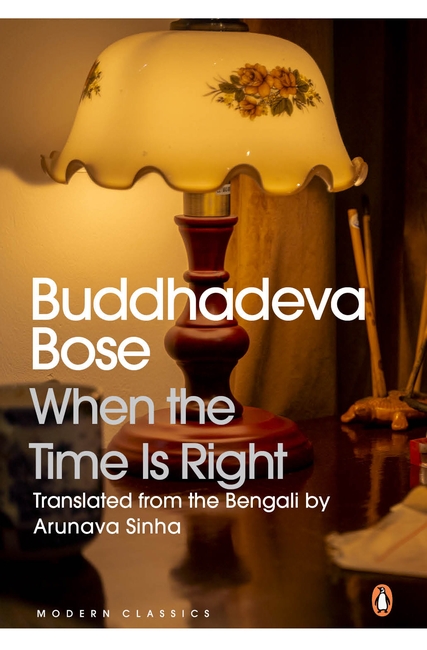
Buddhadeva Bose’s greatest novel When the Time Is Right is a grand family saga set in Calcutta during the last two decades of British rule. Of Rajen Mitra’s five lovely daughters; it is the youngest—the beautiful; intelligent Swati—who is the apple of her father’s eye. As she grows from an impetuous; spirited child to a lonely young woman; Swati is witness to the upheavals and joys of the Mitra family even as the country slides towards the promise of independence and the inevitability of war. Anxious to ensure that his daughters find suitable husbands; Rajen-babu realizes it is only a matter of time before his favourite child too must leave home. While the boorish entrepreneur Prabir Majumdar decides that she will make him a fitting wife; Swati finds herself increasingly drawn to Satyen; the young professor who introduces her to a world of books and the heady poetry of Tagore and Coleridge. First published in Bengali as Tithidore in 1949; When the Time Is Right is a moving tale of a family and a nation.