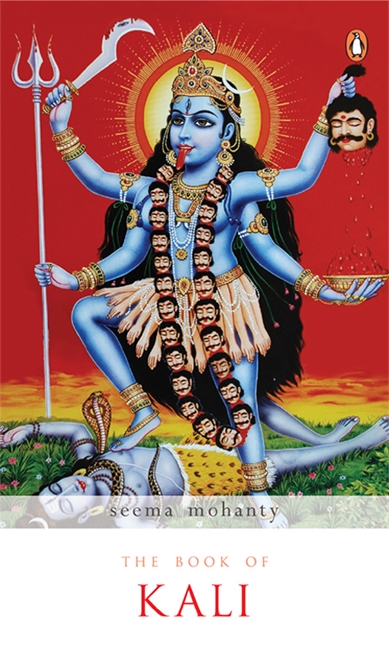
One of the most unconventional yet immensely popular deities in the Hindu pantheon, goddess Kali essentially represents the dark and contrary aspects of the cosmos. Her naked form and association with violence, blood and gore challenge the very concept of divinity. Yet, over the centuries, she has come to represent a whole gamut of conflicting images-from bloodthirsty ogress to benign goddess. So today while she is venerated as Chamunda, a deity who verges on the macabre and grotesque, she is also adored in household shrines in one of her milder forms, Dakshina-Kali.
It is this evolution of Kali-from her origin as a tantric goddess to her metamorphosis into a divinity in mainstream religion-that Seema Mohanty captures brilliantly in this book. Drawing upon a variety of sources-rituals associated with the worship of Kali, tales from the Ramayana, the Mahabharata, the Puranas, the Tantras and Agamas, folklore and films-she has succeeded in portraying in engrossing detail the myriad manifestations of the enigmatic deity that is Kali.

‘You belong to one side, if you don’t you belong to the other. SOME INNER FURY It is as simple as that . . . There is no in between. You have shown your badge, you have taken your stance . . . it was there in your face, the colour of your skin, the accents of your speech, in the clothes on your back.’
Kamala Markandaya’s Some Inner Fury is the story of Mirabai, a young woman from a partly Westernized Hindu family in pre-Independent India. Previously confident of her place in society and her love for her country, Mira begins to question beliefs when her brother Kit returns from Oxford bringing with him a new lifestyle and his friend Richard. Mira’s love for Richard grows as the country’s agitation against the British gains intensity. Caught in the crossfire are Kit, now a district magistrate, his wife Premala and Govind, Kit’s and Mira’s adoptive brother, who is rumoured to be the mastermind behind the anti-British violence. Events come to a head when tragedy befalls the family and Mira is forced to choose between her love for Richard and duty towards her country.
Some Inner Fury is Kamala Markandaya’s assertion of how no one can stand apart, undecided, when a country is divided.
It is 1953 in colonial Kenya, and eightyearold Vikram Lall witnesses the celebration of Queen Elizabeth’s coronation, even as the Mau Mau guerilla war challenges British rule. Vic and his sister Deepa, whose grandfather came to Kenya from Punjab to build the railways, must find their place in this uncertain world of violent upheaval, confusing loyalties and conflicting ideologies. And among their newly acquired playmates, the brother and sister, neither Black nor White, find themselves in between British Bill and Annie, and the African Njoroge. These friendships will haunt them the rest of their lives. We follow Vic from the changing Africa of the fifties, to the sixties— a time that holds immense promise. But when that hope is betrayed by the corruption, fear and repression of the seventies and eighties, Vic finds himself drawn into the official orbit of graft and powerbrokering. Njoroge, on the other hand, can abandon neither the idealism of his youth nor his love for Deepa. Neither the cynicism of the one nor the idealism of the other can avert the tragedies that await. Acute and bittersweet, vividly portrayed and finely nuanced, The InBetween World of Vikram Lall is told in the voice of the exiled Vic from the shores of Lake Ontario, as he contemplates the historical events that have shaped him— `one of Africa’s most corrupt men’— and the choices he has made.
Every May something extraordinary happens in the new cemetery of the sleepy little town – a laburnum tree, with buttery yellow blossoms, flowers over the spot where Lentina is buried. A brave hunter, Imchanok, totters when the ghost of his prey haunts him, till he offers it is a tuft of his hair as a prayer for forgiveness. Pokenmong, the servant boy, by dint of his wit, sells an airfield to unsuspecting villagers. A letter found on a dead insurgent blurs the boundaries between him and an innocent villager, both struggling to make ends meet. A woman’s terrible secret comes full circle, changing her daughter’s and granddaughter’s lives as well as her own. An illiterate village woman’s simple question rattles an army officer and forces him to set her husband free. A young girl loses her lover in his fight for the motherland, leaving her a frightful legacy. And a caterpillar finds wings.
From the mythical to the modern, Laburnum for My Head is a collection of short stories that embrace a gamut of emotions. Heart-rending, witty and riddled with irony, the stories depict a deep understanding of the human condition.

7 July 1924. Sultana Daku, notorious leader of a gang of bhantu dacoits that terrorized the towns and villages of the United Provinces, awaits Lt. Col. Samuel Pearce’s arrival in Haldwani jail.
It is Sultana’s last night. In the morning he will be hanged.
Wrapped in a haze of charas and nostalgia, the daku speaks all night as the Englishman listens. He recounts tales of incredible feats and narrow escapes, of the camaraderie he shared with his bhantu companions, of his love for the nautanki dancer Phulkanwar, and of the shocking betrayal that brought him to the gallows. But even as Pearce and the reader are drawn into Sultana’s confession, the contradictions that emerge reveal the daku’s own demons—his fears, superstitions and ruthless excesses—and an unshakeable belief in his criminal destiny that clashes all too often with his secret longings and hopes.
Combining swashbuckling adventure with a moving story of human frailty and fortitude, The Confession of Sultana Daku is a grand narrative that is as mesmerizing as it is unsettling. Told with remarkable flair, passion and a rare sensitivity, it seals Sujit Saraf’s reputation as a master storyteller.

Pranav Kumar is:
(a) An advertising executive
(b) An aspiring writer
(c) An anarchist
(d) A fugitive from the Mumbai Police
(e) All of the above
Pranav Kumar has had enough. He’s sick and tired of being a corporate drone convincing people that their lives are meaningless without the newest product he’s peddling. He hates that commercialism is the new mantra and people actually believe that you are what you own. Pranav Kumar wants to change the world.
But how does one man make a whole country question the way we are when no one is interested in listening?
Pranav and his friends decide to capture the eyeballs of the nation and shake up the system. Their methods are unorthodox; their message unique. They take over a TV station; expose an environmental scam; strike out at patrons of brothels; sabotage a glitzy fashion show; and paint-bomb a local train.
But as the Anarchists of Mumbai ignite sparks of a much larger movement; they realize that doing good comes at a price; that the means are as important as the ends and that being hunted by the Mumbai police is perhaps better than being hunted by contract-killers.
Bold; fresh and darkly comic; The Diary of an Unreasonable Man is an exceptional debut.
I had set up an agent. For want of a better name, let’s call it love agency, to provide a decent meeting place where men and women, lovers and friends, colud rendezvous without too much sweat… People only want to be alone together. They need time to meet and talk. They want to find themselves through a moment of love.’
Drawn to New Delhi from the hills of the North-East by hopes of adventure and the love of a married man, Anda opens a guest house for lovers and friends. In a small bungalow on a quiet lane, an unlikely assortment of couples and singles come together, for an afternoon, a day and sometimes for months. While in the big city death, like Cupid, stalks the streets and strikes at random.
This second novel by the acclaimed author of The Legends of Pensam is a graceful, quirky and ultimately moving story about relationships, complete with all their complications and joy.
‘Dai’s prose is beautiful, flowing as easily as the waters of the Siang’
The Telegraph

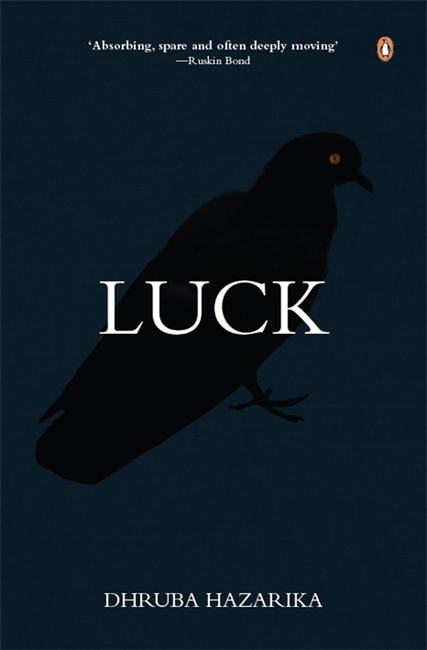
‘Absorbing, spare and often deeply moving.’-Ruskin Bond
‘Wild tales with a difference…Hazarika’s empathy with all creatures great and small comes through in these absorbing, spare and often deeply moving stories. Life in the forests and small towns of Assam is brought vividly to life by a gifted writer.’ -Ruskin Bond
A hunt goes brutally wrong in the jungles of Karbi Anglong. A young magistrate on a police raid is saved from inhumanity by the sight of a hen and her chicks. A solitary bachelor brings home a pigeon and learns the pain of loving a wild thing. An egret visits a man on a moonlit night. Three schoolboys chance upon a leopard and her kill in the hills outside Guwahati.
In lean, taut prose Dhruba Hazarika writes of moments when men encounter animals and the natural world-often, also the moments when they encounter themselves. These are poignant, memorable stories from a literary imagination of uncommon honesty and sophistication.

Like Dickens, Saratchandra had a bag of wonderful tales. The Final Question (Shesh Prashna) is one of Saratchandra Chattopadhyay’s last novels and perhaps his most radically innovative. The novel caused a sensation when it was first published in 1931, drawing censure from conservative critics but enthusiastic support from general readers, especially women. The heroine, Kamal, is exceptional for her time. She lives and travels by herself, has relationships with various men, looks poverty and suffering in the face, and asserts the autonomy of the individual being. In the process, she tears apart the frame of the expatriate Bengali society of Agra, where she lives. Through Kamal, Saratchandra questions Indian tradition and the norms of nationhood and womanhood. The Final Question transcends time and will appeal to readers of all ages. Translated by Department of English, Jadavpur University.

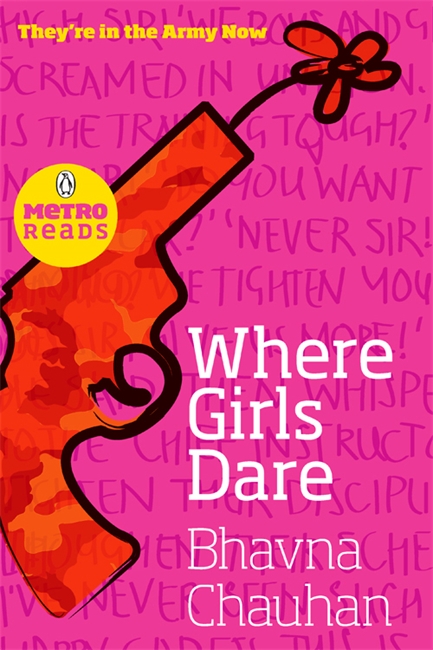
‘So cadets; how’s the morale?’
‘High Sir!’ we boys and girls screamed in unison.
‘Should we tighten your training?’
‘Yes sir; give us more!’
‘Good!’ he said. Then whispered to the chief instructor; ‘Tighten their discipline.
Toughen their schedule. I’ve never seen such happy cadets. This is not a party!’
They entered the Officers’ Training Academy at Chennai; with a single desire—to be Officers in the army. Soon they discovered it was going to be an uphill task; literally! They fought; they bickered; they cried and they raised hell. But they also learnt. They learnt to take push-ups and punishments; front rolls and figures of eight; strict discipline and night marches in their stride.
Where Girls Dare is a hilarious and entertaining story of what happens when fifty-two lady cadets (LCs) train alongside four hundred Gentleman Cadets (GCs); some of whom believe that girls in the army is a bad idea.
For more info on new series Metro Reads; please visit www.metroreads.in