A conversation, a litany, a prayer—one of these three will usually bail you out of a tricky situation. But there are times when all the three combined don’t hold enough power to keep the inevitable at bay.
Even as the woman offers all that she can, deep down she knows that what’s done is done. Her cries will disappear into a void just like everything else. She doesn’t know what else to do. What else can she do?
Manto’s genius lies in presenting the most complex characters and their circumstances in the simplest manner, and nowhere is this more evident than in By the Roadside. While the story was written more than half a decade ago, this powerful take on women in our country is still as relevant today.
Shahbaz Khan had only one problem with Hamzah Khan, the new employee at the restaurant: his looks. Hamzah was dedicated, knew how to get the coal at the best prices, treated the customers right, but that didn’t take away from the fact that he was ugly. But Hamzah Khan—or Gilgit Khan as everyone had come to call him—didn’t mind this much because he had found a companion in a puppy outside the restaurant. While Shahbaz Khan thought that the dog was even more unsightly than Gilgit Khan, the latter had never been happier.
The thing about love—even it is for an animal—is that you don’t realize its intensity until you venture too deep. Once you are aware of it, it is too late to do anything. Will it be too late by the time Gilgit Khan experiences his moment of realization?
Many of Manto’s characters display logical, but entirely human, contradictions. Whether it’s Shahbaz Khan’s piousness against his bigotry or Gilgit Khan’s kindness in the shadow of his crudeness, Manto elevates the art of storytelling. Read on to find out what lies in store for Gilgit Khan and his beloved Tan-Tan.
They were all mujahids, God’s valiant soldiers who didn’t know anything about fighting but were ready to jump into the battlefield at the first opportunity. The issue at hand was grabbing Kashmir at any cost. As the discussion continued, Haneef showed great enthusiasm for the cause but Manto could tell that something was bothering his friend. Perhaps there was something wrong at home?
But when Haneef reveals the truth, Manto realizes that it is a weight that now belongs to him too.
Only Manto’s writing has the power to make a political statement using an incredibly personal story. Beautifully layered and heart-wrenchingly poignant, I’m No Good for You! is a masterpiece.
People take pleasure in winning. But it was losing that gave him a greater thrill, especially when it came in the wake of winning.’
Bombay has always been a land of opportunities—to earn money, fame and whatever else one desires. And while Seth knows how to grab each opportunity, he has always revelled in the pleasure of losing it all. In fact, he would seize opportunities only for the pleasure of squandering all that he earned.
Strange as it was, it was a pattern that he was happily living by. Until one day, on his way to his favourite gambling den, he meets Gangu Bai, an old prostitute. Striking unusual deals was his habit but who would have known that a harmless little deal with Gangu Bai would prove to be the biggest decision he ever took.
Manto’s speciality lies in his characters that defy the norm in almost every way possible. Pleasure in Losing is an example of precisely this.
If there is one thing that Manto has always wanted to understand, but never has, is this: why is that singles—men not interested in getting married, ever—are so unnaturally obsessed with empty bottles and cans. Be it his fifty-year-old relative, his friend who is a reader at the high court, or the retired Colonel Sahib, all of them have one thing in common: a collection of empty bottles and cans spread all over their homes.
Manto wishes to make sense of this fascination, but it isn’t something that can be explained easily in psychological terms. Until, one day, he meets Ram Saroop, the superstar, who is not just single but has an entire room full of empty rum bottles and cigarette packs in his small flat by the sea at Shivaji Park. Will Ram Saroop finally help Manto solve this bizarre mystery?
One of the lighter stories from Manto’s repertoire of short fiction, Empty Bottles, Empty Cans is an interesting take on the concept of emptiness and a generation of single men experiencing it.
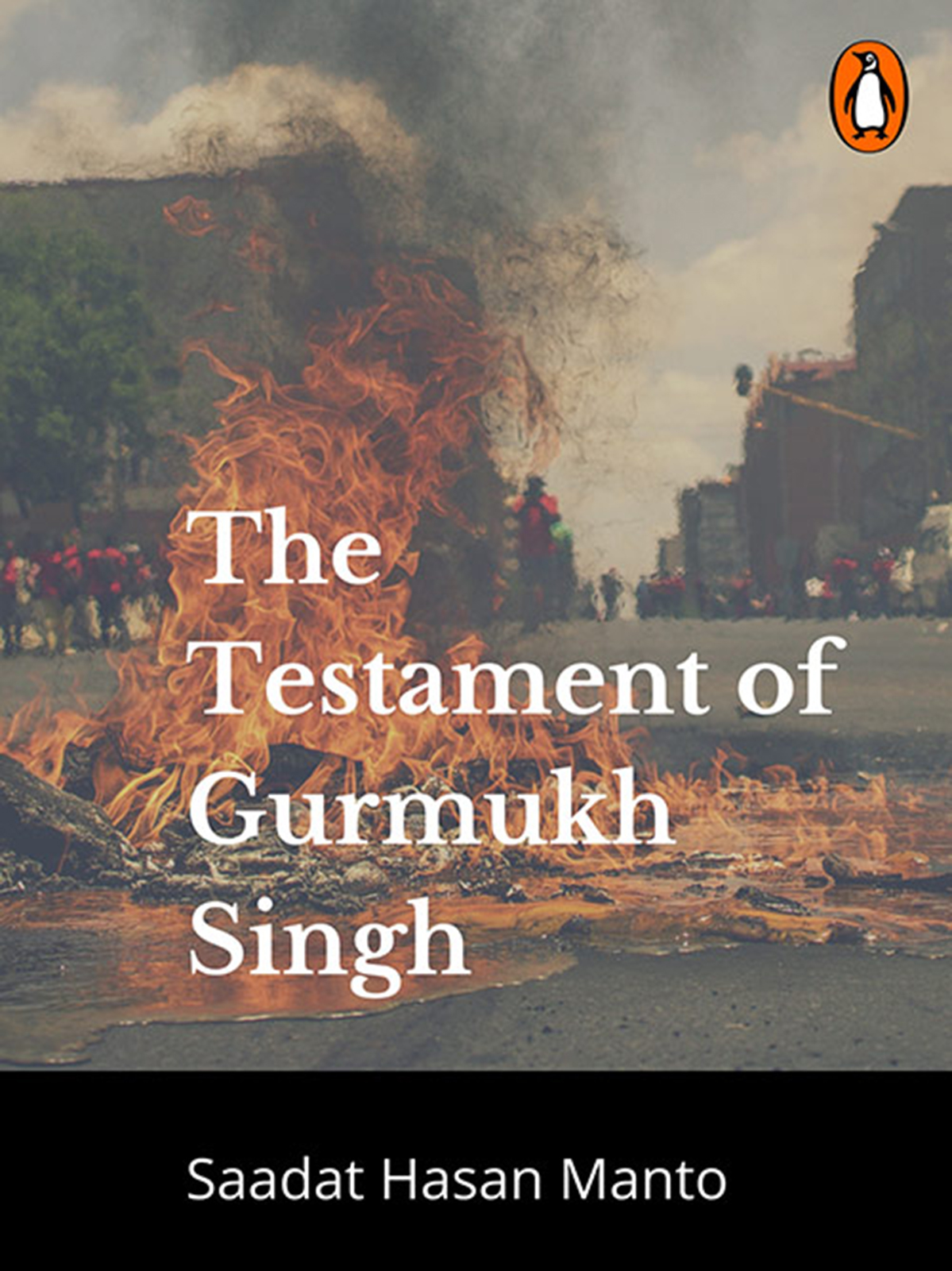
When the riots first broke out, everyone in Amritsar, including retired sub-judge Mian Abdul Hayy, thought they wouldn’t last long. They were expected to die down soon. But Sughra, Mian Sahib’s daughter, was worried, and rightly so because the situation only seemed to be getting worse. In fact, it got so bad that when Mian Sahib suffered a stroke and was critical, the family couldn’t call a doctor to see him.
But Mian Sahib didn’t lose hope. Even as he heard loud, insistent knocks on his door on Chhoti Eid, Mian Sahib didn’t let his faith waver. Surely no harm could befall his family on Chhoti Eid?
If there’s anyone who can narrate a Partition story that is as tender as it is powerful, it is Manto. Sometimes the smallest arm packs the mightiest punch and The Testament of Gurmukh Singh is a fine example of this.
For the first time ever, it had dawned on him that women who sold their bodies could have such shapely figures.’
Kanta and Khushia were part of the same profession. He was her pimp, and, in a way, one of her own. All of twenty-eight, Khushia was quite a businessman. While he knew all the girls in his circuit through and through, what he didn’t know was that one day Kanta Kumari would stand naked before him and throw him into the greatest turmoil of his life.
Manto’s characters are known to vehemently resist categorization, and this is especially true in the case of Khushia and Kanta who don’t behave as they are expected to. Read on to revisit one of Manto’s most fascinating takes on human behaviour.
“If you killed a bad man, what you would have killed was not his badness, but the man himself.”
As Mumtaz prepares to leave for Pakistan—a concept that in itself seems strange—Juggal can’t shake away the feeling of guilt. His closest friend, his confidante was leaving because of what he said and the strange thing was, Juggal wasn’t sure whether his guilt had to do with the fact that Mumtaz was leaving or the fact that he’d meant what he said: “I would kill you.”
Partition will forever be that one event that created and destroyed so much in its wake for India and Pakistan. Lands, homes, lives, and relationships suffered, turning neighbours into strangers, friends into foes. Even as Mumtaz bids a reluctant farewell to Bombay, he can’t stop thinking of Sahae, the pimp with a heart of gold, a man who lived a life of contradictions until his very last breath.
Manto’s genius lies in telling stories whose characters forever remain a suspect to conventional morality. With Sahae, he also manages to show us how his thinking was way ahead of his times. Powerful and heartwrenching, this is short fiction at its best.
The difference between a good dhobi and a bad dhobi is that the latter definitely makes his presence felt. However, Manto was lucky that Ram Khilawan was of the former kind. Because not only was he good at his job but he’d seen Manto through his impoverished days and his days of prosperity with equal enthusiasm; never insisting on getting paid as he really didn’t know “what account is”.
However, when you’re faced with circumstances that are out of your control, the strongest relationships sometimes crumble in the face of it. But is there anything that can threaten Manto and Ram Khilawan’s bond?
Incredibly moving and innately Manto, Ram Khilawan is everything you expect from a Manto story, and some more. Read on.
Meet Babu Gopinath: world’s number one gullible fool, a home-wrecker known for wrecking his own home, and a recent immigrant to Bombay. He’s brought along with him a Kashmiri ‘kabutri’—a weak-looking young woman—Zeenat Begum, who is as uninterested as she is unambitious. While this kind introduction was given by his friend Abdur Rahim Sando, Manto soon realized that not everything was actually as it seemed.
We handle things in our lives based on our past experiences and our assumptions about how things will work out, but it’s almost like the laws of reason and the world never seem to apply to Manto’s characters. As Manto gets to know Babu Gopinath and his world a little better, he takes us along this journey of discovery, to reach a destination neither of us are prepared for.
It is generally the women in Manto’s stories who are enchanting and intriguing, but Manto’s Babu Gopinath is equally, if not more, fascinating. Read on.