A gorgeous, lucid rendering of the majestic conclusion to the Mahabharata
As an epilogue to the greatest epic of all time, the Harivamsha further elaborates on the myriad conflicts of dharma and the struggle between good and evil. Stories abound-from the cosmogony of the universe to the legends of the solar and lunar dynasties and even a foreshadowing of kali yuga in the future. At the centre of all these magnificent tales is the mercurial figure of Krishna, whose miraculous life and wondrous exploits are recounted with vivid detail. In offering a glimpse into Krishna’s life-as a mischievous child, as an enchanting lover, as a discerning prince-this luminous text sheds light on many questions left unanswered in the Mahabharata.
Brimming with battles and miracles, wisdom and heroics, philosophical insight and psychological acuity, Bibek Debroy’s splendid translation of the Harivamsha is absolutely essential reading for all those who love the Mahabharata.

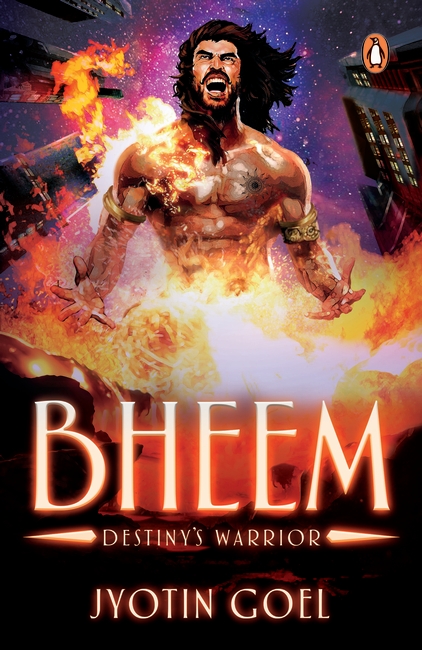
From the battlefields of Lanka and Kurukshetra rises a deadly threat to the modern world
Only one man is bold enough to confront it-the legendary warrior Bheem
As Mandodari, the queen of Lanka, watches the destruction of her golden kingdom, her fury erupts as a curse. Morphing into an incurable virus, the blight takes root in the vaanars and sets out on a destructive path through the centuries. Unknown to present-day humans, the seed of their total annihilation has already been sown . . .
Ripping through the vortex of time, Bheem arrives in the twenty-first century to seek out the only four humans who, with their natural immunity, can help develop an antidote. However, his quest becomes a perilous race against time, for a sworn enemy from the past-Ashvatthama-has also journeyed to the present to prevent the cure from being found.
Amid the glitter and chaos of modern India, an ancient war reaches its cataclysmic finale . . .

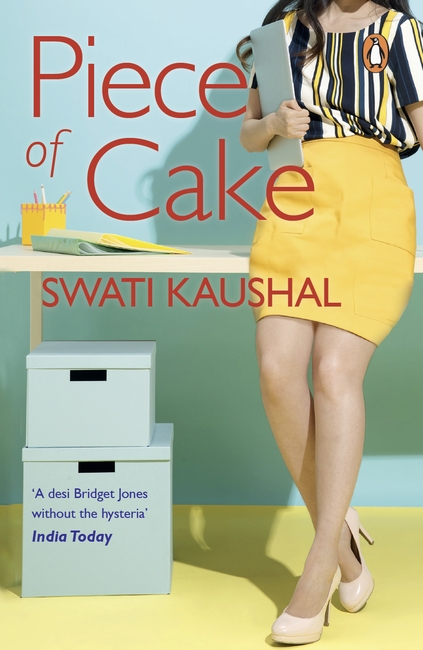
Minal Sharma, MBA, wants it all-a successful career, a lifestyle to match and a ‘totally cool’ guy who’ll buy her
diamonds, bring her flowers and laugh at her jokes. But given the unending pattern of her life’s embarrassments, it’s not going to be easy. Especially when her mother’s lined up ‘eligible’ suitors, her neighbour is a hot and happening radio jockey, and her new colleague on a make-or-break assignment is a nasty, grudge-bearing guy from her childhood!
Set in the corridors of corporate intrigue, Piece of Cake is a romantic comedy with a delightful heroine, a plot sparkling with mischief and a ton of attitude.
‘A desi Bridget Jones without the hysteria’ India Today
‘Fast, funny and thoroughly enjoyable’ Times of India
‘[Swati Kaushal] has cracked a tale that’s a fast, good read. And she’s done it with flair’ Business Standard
‘There’s much to be enjoyed in this breezy, devil-may-care first novel’ Tehelka

When on a spiritual quest, what if you come to know that there are archangels, angels, perfect masters, saints, sages, celestial, terrestrial and physical beings who guide all seekers on the path? Like a parent leading a child. We call these guides the oneness family, the Perfect Ones. // The Perfect Ones, is a collection of biographies written by spiritual guru Ruzbeh N. Bharucha about the hierarchical planes of the various spiritual guides and how they are available to all those who seek. He talks about Their lives in the physical bodies; Their teachings and Their connect with other masters; Their love, presence, protection and oneness that engulfs all.// Written with love and from personal experiences with most of the Perfect Ones, this is a journey you do not want to miss out on.

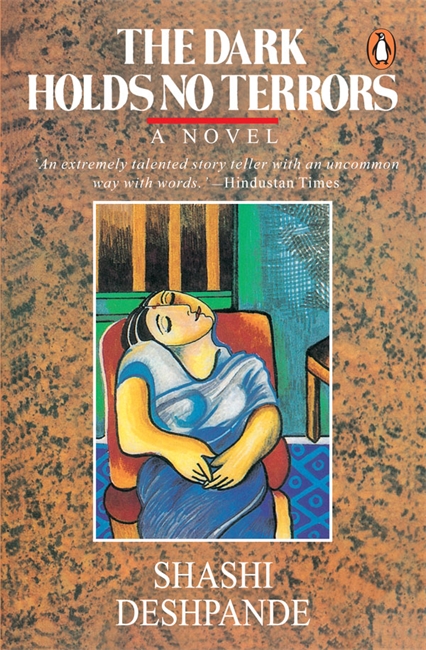
‘Why are you still alive-why didn’t you die?’
Years on, Sarita still remembers her mother’s bitter words uttered when as a little girl she was unable to save her younger brother from drowning. Now, her mother is dead and Sarita returns to the family home, ostensibly to take care of her father, but in reality to escape the nightmarish brutality her husband inflicts on her every night. In the quiet of her old father’s company Sarita reflects on the events of her life: her stultifying small town childhood, her domineering mother, her marriage to the charismatic young poet Mahohar.

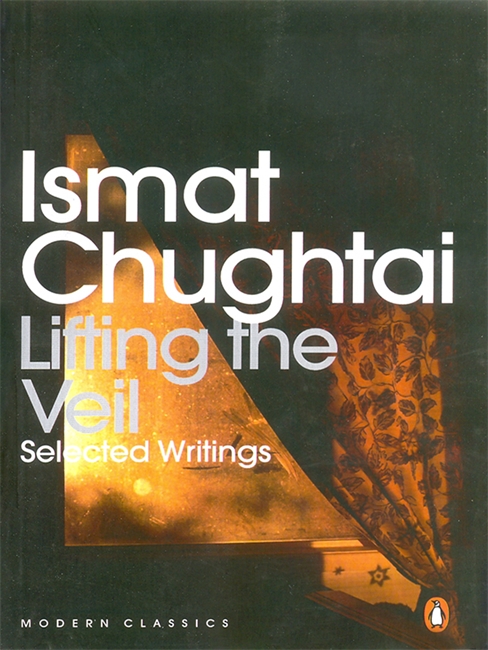
At a time when writing by and about women was rare and tentative, Ismat Chughtai explored female sexuality with unparalleled frankness and examined the political and social mores of her time.
She wrote about the world that she knew, bringing the idiom of the middle class to Urdu prose, and totally transformed the complexion of Urdu fiction.
Lifting the Veil brings together Ismat Chughtai’s fiction and non-fiction writing. The twenty-one pieces in this selection are Chughtai at her best, marked by her brilliant turn of phrase, scintillating dialogue and wry humour, her characteristic irreverence, wit and eye for detail.
A timeless tale of complex emotional relationships from an acknowledged master
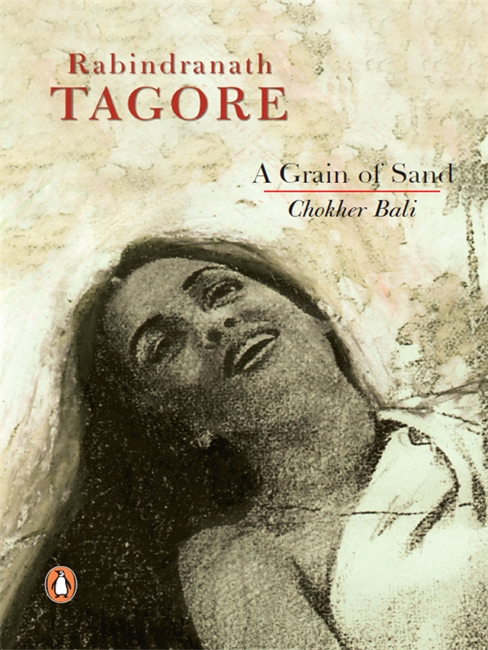
Soon to be a major motion picture directed by Rituparno Ghosh, Chokher Bali is Nobel Prize-winning author Rabindranath Tagore’s classic exposition of an extramarital affair that takes place within the confines of a joint family.
It is the story of the rich, flamboyant Mahendra and his simple, demure, beautiful wife Asha—a young couple who are befriended by the pragmatic Bihari. Their cosy domestic scenario undergoes great upheaval with the introduction of the vivacious Binodini, a young, attractive widow who comes to live with them. Asha and Binodini become bosom pals. Binodini is initially drawn to Bihari but then begins to respond to the advances of Mahendra, who has become obsessively attracted to her. After several twists and turns, Binodini elopes with Mahendra, leaving the entire family in turmoil. Bihari pursues them to Allahabad and succeeds in bringing them back to Kolkata, but the question remains: can a marriage that has once been ruptured by breach of trust be mended again into a meaningful relationship?
On the one hand, A Grain of Sand: Chokher Bali is a sensational account of two illicit relationships: Mahendra’s infatuation with Binodini which blinds him to everything else, and Binodini’s secret passion for Bihari of which she is never able to speak. On the other hand, it is a complex tapestry woven by the emotional interplay between five finely etched characters: the impulsive Mahendra, his adoring mother Rajlakshmi, the frail and sensitive Asha, the strong, silent Bihari, and the self-willed and irresistibly attractive Binodini.
A compelling portrayal of the complexity of relationships and of human character, this landmark novel is just as powerful and thought-provoking today as it was a hundred years ago, when it was written.

Tagore wrote Shey to satisfy his nine year old granddaughter’s demands for stories. Even as Tagre began to create his fantasy, he planned a story that had no end, and to keep the tales spinning he employed the help of ‘Shey’, a “man constituted entirely of words” and rather talented at concoting tall tales. So we enter the world of Shey’s extraordinary adventures, encountering a bizarre cast of characters, grotesque creatures and caricatures of contemporary figures and events as well as mythological heroes and deities – all brought to life through a sparkling play of words and illustrations in Tagore’s unique style.

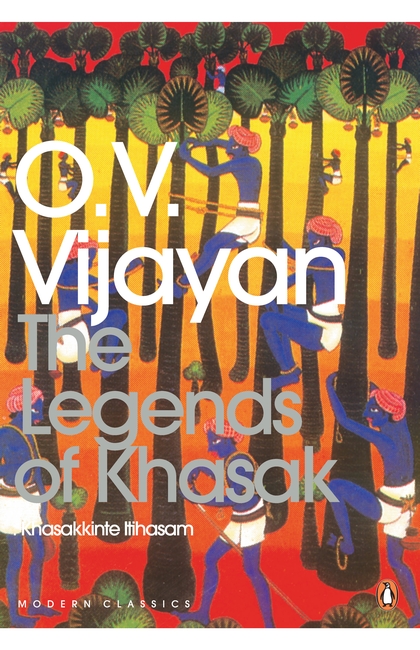
A restlessness born of guilt and despair leads Ravi to embark on a journey that ends in the remote village of Khasak in the picturesque Palghat countryside in Kerala. A land from the past, potent with dreams and legends, enfolds the traveller in a powerful and unsettling embrace. Ravi is bewitched and entranced as everything around him-the villagers; their children whom he teaches in a makeshift school; the elders who see him as a threat; the toddy-tappers; the shamans-takes on the quality of myth. And then reality, painful and threatening, begins to intrude on the sojourner’s resting place and Ravi begins to understand that there is no escape from the relentless dictates of karma… Often poetic and dark, always complex and rich, The Legends of Khasak, O.V. Vijayan’s much-acclaimed first novel, translated into English by the author, is an extraordinary achievement

Srikanta, the narrator of Saratchandra’s epic novel, is an aimless drifter, a passive spectator to his own life, a weak and impressionable soul who cannot survive without the support of an individual stronger than himself. As a child he idealizes the chaste and selfless Annada Didi. Arriving in Burma as a young man looking for new experiences, Srikanta meets the rebellious Abhaya who rejects her violent, bigamous husband to live openly with her lover. Srikanta then experiments with becoming a sanyasi, is bewitched for a while by the Vaishnavi, Kamal Lata, and wanders on till his directionless existence finally finds a focus- when he resigns himself to life with the notorious but stunning Pyari Baiji, breaking free of the social values he grew up with. Through his dynamic and arresting characters, Saratchandra brings alive nineteenth-century Bengal, rife with prejudices and ready for change.