




producttt revieee
Catagory: Arts, Film & Photography
fjf
csa
Ebrahim Alkazi
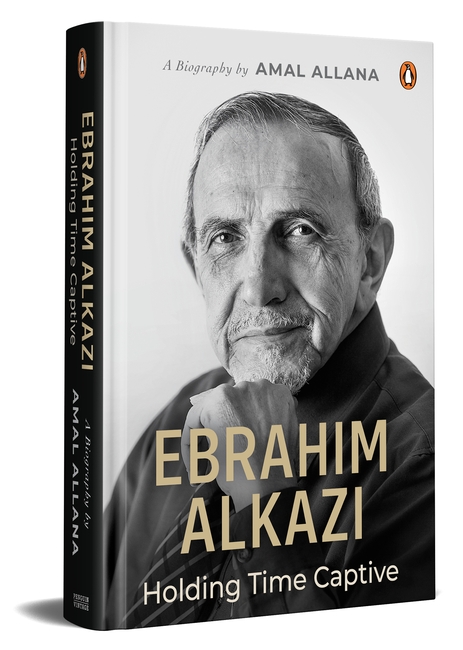
Amal Allana’s compelling biography of her father is the first carefully researched, full-length account of the life, work and times of Ebrahim Alkazi, one of the giants of twentieth-century theatre and a key promoter of the visual arts movement in India. Evoking the excitement of Alkazi’s student years in England, the controversies that surrounded his provocative ideas to transform the theatre movement in Bombay and later in Delhi, as the director of the National School of Drama (NSD), this book charts Alkazi’s meteoric rise to the top, with his modernist staging of plays and his aim of putting Hindi theatre on the map.
It was at the Sangeet Natak Akademi that Alkazi first confronted resistance to his ideas on the role of tradition in the making of a new ‘national’ culture. By the 1970s, disillusioned with the curtailing of civil liberties and a dysfunctional bureaucracy, he ultimately resigned from the NSD, developing his own independent institutions for the promotion of the visual arts in India as well as abroad. Staging the cultural history of India between the 1940s and 2000s, and featuring a galaxy of artists and actors as the dramatis personae—including M.F. Husain, F.N. Souza, Akbar Padamsee, Gieve Patel, Nissim Ezekiel, Alyque Padamsee, Girish Karnad, Manohar Singh, Vijaya Mehta, Kusum Haidar and Gerson da Cunha—Allana’s chronicle is charged with their fierce energy and commitment as contributors to a vibrant new India.
The author’s personal perspective as Alkazi’s daughter brings to the narrative an added dimension of veracity and sensitivity. With objective candour, Allana shares details of her parents’ relationship as they examine their marriage on entirely new terms, as a partnership of equals. Holding Time Captive shows a dynamic Alkazi in his quest to bring about an inclusive, international, intercultural and interdisciplinary thinking in artistic expressions that is transformative and liberating. This book offers unique glimpses into an enigmatic personality whose emotionally charged life closely reflected and ran parallel to the growth and evolution of his startlingly fresh ideas and vision for a modern cultural movement in India.
Radio for the Millions: Hindi-Urdu Broadcasting Across Borders
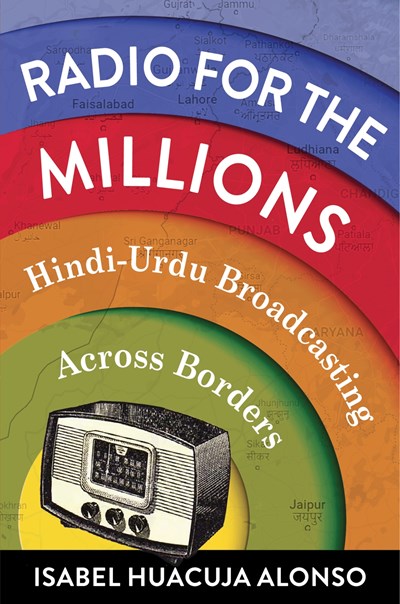
From news about World War II to the broadcasting of music from popular movies, radio played a crucial role in an increasingly divided South Asia for more than half a century. Radio for the Millions examines the history of Hindi-Urdu radio during the height of its popularity from the 1930s to the 1980s, showing how it created transnational communities of listeners.
Isabel Huacuja Alonso argues that despite British, Indian, and Pakistani politicians’ efforts to usurp the medium for state purposes, radio largely escaped their grasp. She demonstrates that the medium enabled listeners and broadcasters to resist the cultural, linguistic, and political agendas of the British colonial administration and the subsequent independent Indian and Pakistani governments. Rather than being merely a tool of nation building in South Asia, radio created affective links that defied state agendas, policies, and borders. It forged an enduring transnational soundscape, even after the 1947 Partition had made a united India a political impossibility.
Huacuja Alonso traces how people engaged with radio across news, music, and drama broadcasts, arguing for a more expansive definition of what it means to listen. She develops the concept of “radio resonance” to understand how radio relied on circuits of oral communication such as rumor and gossip and to account for the affective bonds this “talk” created. By analyzing Hindi film-song radio programs, she demonstrates how radio spurred new ways of listening to cinema. Drawing on a rich collection of sources, including newly recovered recordings, listeners’ letters to radio stations, original interviews with broadcasters, and archival documents from across three continents, Radio for the Millions rethinks assumptions about how the medium connects with audiences.
Basu Chatterji
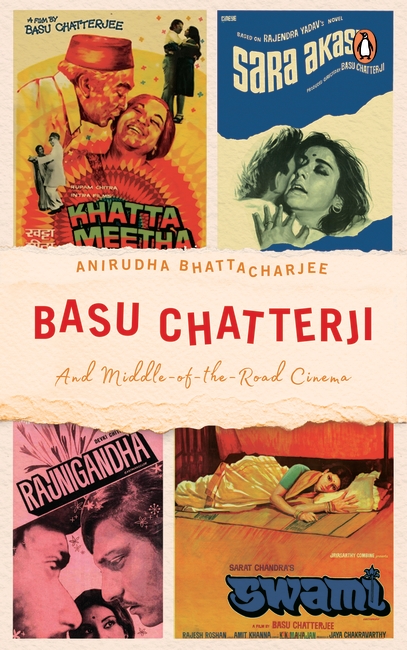
A behind-the scenes look at Basu Chatterji’s most loved films
This is the enigma of Basu Chatterji. His films did not have the box-office ingredients that could make them a distributor’s hot pick, nor were they art house cinema that needed unravelling over many cups of tea. He was the quintessential ‘middle-of-the-road’ film-maker, a genre that he founded in Bollywood. His films, whether it be Chhoti Si Baat or Rajnigandha or Chitchor, were about common people and common problems, such as employment and love, social and economic inequalities, and joint family conflicts. Like fellow cartoonist R.K. Laxman, who created the ‘common man’, Chatterji too was an auteur of the common man, whose journey he portrayed with charm, delicate warmth and humour.
As a person, Basu was much like his common man: mild, unobtrusive and media-shy. He preferred not to scout for stars and mostly made his films with rookies, giving them respectability as artists. And today, names like Amol Palekar, Vidya Sinha, Pearl Padamsee, Zarina Wahab, Nandita Thakur, Girish Karnad, Rakesh Pandey, Bindiya Goswami and Ranjit Chowdhry have become central to the history of Indian cinema, thanks to Basu.
Basu Chatterji: And Middle-of-the-Road Cinema, anecdotal in nature, goes behind the scenes of his films. It places Basu’s cinema and television work in the context of the changing times, like the emergence of Rajesh Khanna, Kishore Kumar and Amitabh Bachchan, the Emergency, the return of Sarat Chandra’s stories, the introduction of disco and the decadent phase of Hindi cinema in the 1980s. The book celebrates the work of one of the most underrated, yet successful, film-makers in Hindi cinema.
Zikr
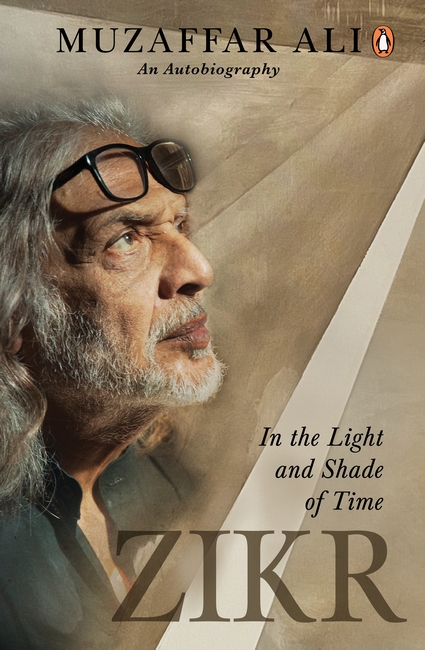
Internationally renowned, Muzaffar Ali has donned many hats in his lifetime. The scion of the princely house of Kotwara, the boy Muzaffar was shaped by the changing post-Partition India. Having studied science at Aligarh University, he started his career in an advertisement agency in Calcutta, worked with the nascent Air India and then ventured on a journey that produced cinematic masterpieces like Umrao Jaan. Along the way, his path collided with many-from Satyajit Ray to Faiz Ahmad Faiz-and he has cultivated many a passion, whether for cars or couture.
His autobiography is a peek into this wealth of experience-a close look at Ali, prince, poet, philosopher, film-maker, automobile aficionado and artist. Zikr is also a rich interior portrait of an artist, as Ali takes us behind the scenes of films like Anjuman and Gaman, speaking of the sensibilities that shaped them and the influences on his work. Above all, this is a book that resounds with a deep love for life.
Whether you’re looking for inspiration, seeking to venture off the beaten track of Bollywood or wishing to bite into a slice of erstwhile Awadhi culture, Zikr has something to offer all.
Sone Chandi Ke Buth
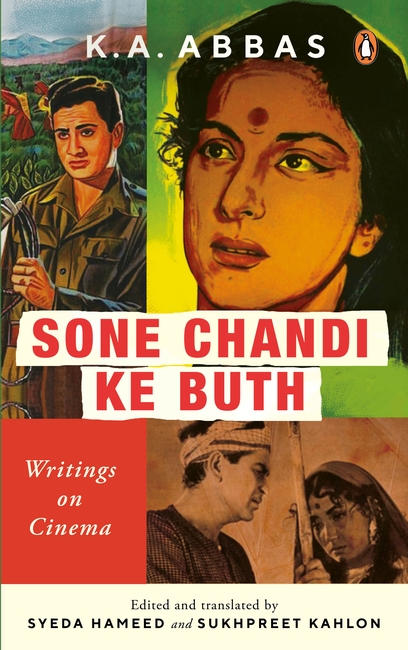
K.A. Abbas gave me my first film, Saat Hindustani. I called him Mamujaan. The book is a deep, incisive look at the gold and silver world of cinema. The sheen wears off but the spirit lives on. K.A. Abbas Trust keeps Abbas Saheb’s unrelenting spirit effervescent’ AMITABH BACHCHAN
‘An interesting read’ SHABANA AZMI
‘A must read for film lovers’ RANDHIR KAPOOR
Sone Chandi ke Buth is a collection of writings on cinema that includes the observations, thoughts and
reflections of Khwaja Ahmad Abbas. Originally written in Urdu by the well-known journalist, screenwriter and film-maker, it has now been translated for the first time into English.
The book is a collection of short stories, essays and articles on famous film personalities and varied aspects of the film industry. Abbas was a prolific writer who published seventy-four books in his seventy-three years, besides writing extensively on the film industry for the Bombay Chronicle newspaper. Sone Chandi Ke Buth, published a year before he passed away, was his last
book-a final word on the glitz, glamour and gritty reality of the Hindi film world.
It includes his candid observations on famous actors, writers and directors such as Raj Kapoor, Amitabh Bachchan, Dilip Kumar, Satyajit Ray, Meena Kumari, Balraj Sahni and V. Shantaram. A series of essay focuses on various aspects of cinema, from the changes in the film
industry to the power of film stars. The book also includes short stories set in the context of the film industry, some having veiled references to actual film stars. A common thread running through them all is his emphasis on making socially relevant films rather than those that succumb
to the pull of glamour and the box office.
This book also presents a section of his writings as a film journalist for the Bombay Chronicle. His column, ‘The Last Page’, one of the longest running in Indian journalism, began in 1935, and moved to the Blitz after the Chronicle‘s closure, where it continued until his death in 1987. They
complement the writings in Sone Chandi Ke Buth and are invaluable for cinema lovers.
Abbas’s matter-of-fact style and the didactic element in his prose illustrate the humanistic ideals that were at the very core of his thought. His writing, both humorous and incisive, is like a laser that pierces right to the heart of the matter.
I Am Onir and I Am Gay
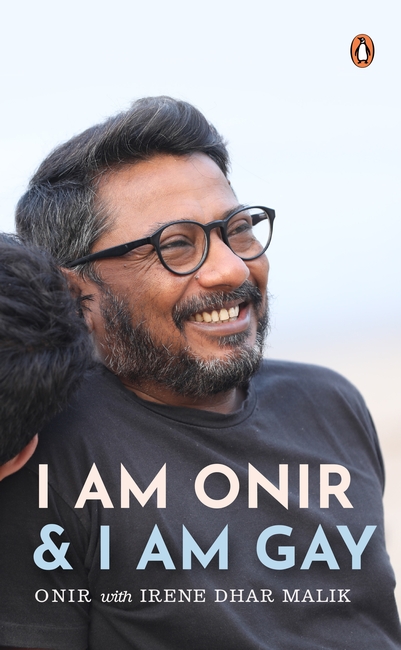
The award-winning filmmaker Onir, whose directorial debut, My Brother Nikhil (2005), broke new ground in LGBT representation on the Indian silver screen, opens up fully for the first time. From his childhood days in Bhutan to when he was a young man with no connections in the Hindi film industry who dreamt big and fought to carve a niche for himself, Onir takes the reader through his struggles and triumphs to offer an intimate glimpse of his fascinating journey to success. Now one of the few openly gay directors in Bollywood, Onir remains fearless about his identity and passionate about his role as a filmmaker in opening up the road to difficult conversations about identity and resilience.
I Am Onir and I Am Gay is a raw, eloquent and inspiring memoir about confronting and transcending frontiers. Written with his sister Irene Dhar Malik, this emotionally gritty and unabashedly honest personal story is a pathbreaking narrative of hope, love and the pursuit of dreams.
The Muslim Vanishes
“…a narrative that is controversial, explosive and unputdownable.” KABIR KHAN
“…a stark, compelling portrait of our times.”
ADOOR GOPALAKRISHNAN
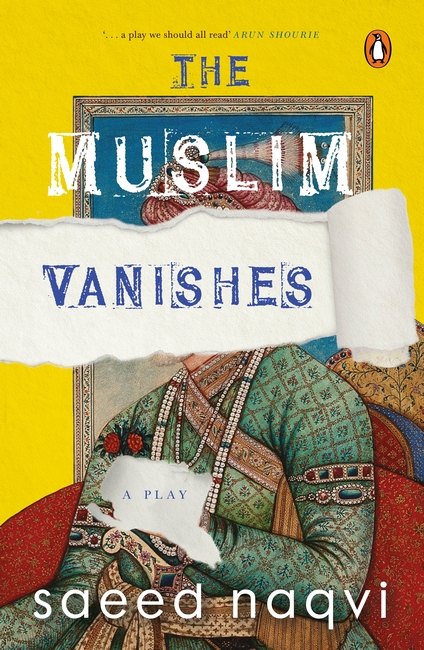
The great poet Ghalib, part of a long tradition of eclectic liberalism, found Benaras so compelling that he wrote his longest poem on the holy city. If we take Ghalib and his myriads of followers out of the equation, will Hindustan be left with a gaping hole or become something quite new? The Muslim Vanishes, a play by Saeed Naqvi, attempts to answer that question.
A Muslim-free India, as a character speculates naively in the play, would be good for socialism, since what the 200 million Muslims leave behind would be equitably shared by the general population. Meanwhile, another character, a political leader, is traumatized by the sudden disappearance of the Muslim voter base and the prospect of a direct electoral confrontation with the numerically stronger Dalits and other backward classes.
Caste, the Hindu-Muslim divide, Pakistan and Kashmir-the decibel levels on these subjects are too high for a conversation to take place, with each side fiercely defending their own narrative. What is the way out of this trap?
How to douse the social and political flames? In this razor-sharp, gentle and funny play, Saeed Naqvi draws on a mix of influences-from grandma’s bedtime stories to Aesop’s fables and Mullah Nasruddin’s satirical tales-to spring an inspired surprise on us, taking us on a journey into the realms of both history and fantasy.
A Place in My Heart
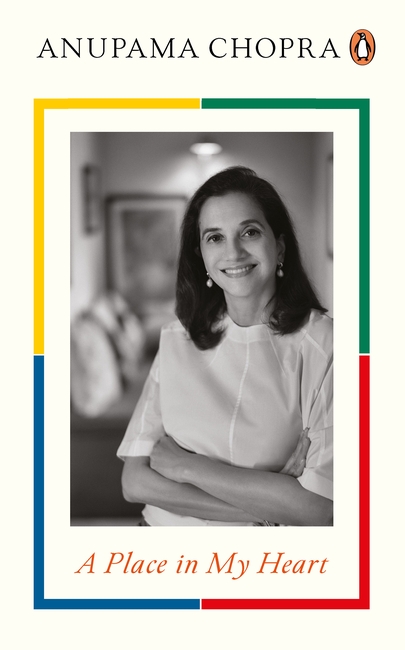
A Place in My Heart is a many-splendored thing. It is a listicle. It is a celebration of the power of storytelling. It is also an account of a life lived in the Bollywood trenches. National Award-winning author, journalist and film critic Anupama Chopra writes about fifty films, artistes and events that have left an indelible impression on her and shaped her twenty-five-year-long career. Shah Rukh Khan is here. So are Super Deluxe and the Cannes Film Festival. A Place in My Heart is a blend of recommendations and remembrances, nostalgia and narratives. It is a smorgasbord of cinematic delights, written, as Marie Kondo would say, to ‘spark joy.’ Above all, it is a testament to Chopra’s enduring love for all things cinema.