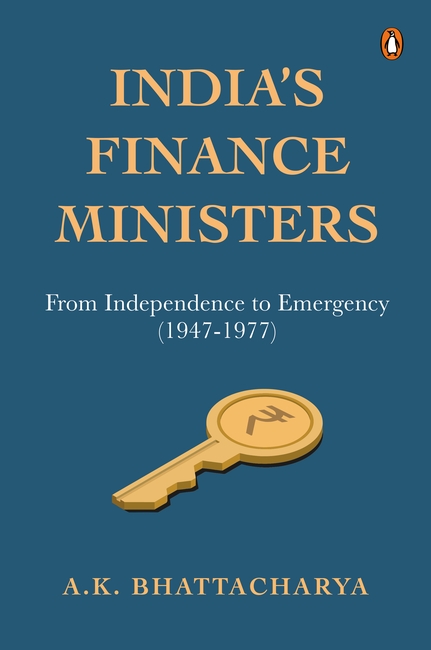
Independent India has so far witnessed twenty-eight finance ministers. But only a handful of them could leave their mark on the exchequer or North Block, the headquarters of the Indian finance ministry. From Independence to Emergency: India’s Finance Ministers 1947-1977 is the story of India’s unforgettable finance ministers who shaped India’s economy in the first thirty years after Independence. The book highlights the significant difference that these finance ministers made to the management of the Indian economy and to the policy evolution of the government, and who thus left an indelible mark on the psyche of Indian citizens. It attempts to measure the impact these decisions left, not only on India’s economic system but also on its political system, and looks at to what extent the decisions were influenced by the socio-economic backgrounds of the finance ministers.
Full of interesting anecdotes, the book is the first in-depth account of the crucial role these finance ministers have played in the functioning of India’s economy.

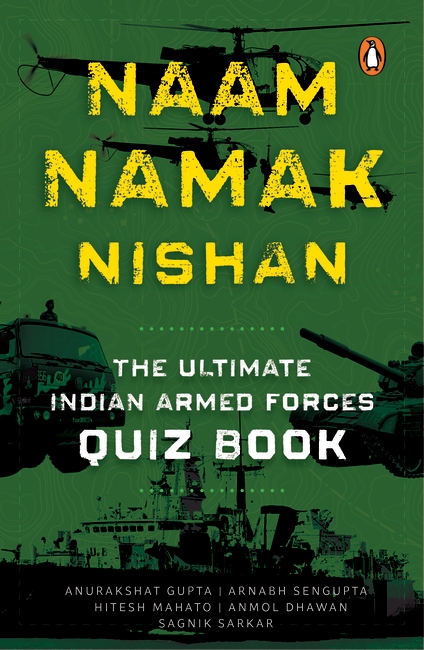
Do you know why the Indian Navy counts ‘One, Two, Six’ instead of ‘One, Two, Three’ while doing group tasks?
Or that the Intelligence Bureau was set up in response to an assassination?
Or that a Frenchman who had served three nations before turning thirty eventually rose to become the most powerful general of the Marathas?
Or that an army man gave his name to the highest mountain without ever having set foot on it?
Find out the answers to these and more as a team of quizzer-doctors from the Armed Forces Medical College (AFMC) Pune takes you on a journey across 250 questions, exploring trivia that connects the Indian Armed Forces to topics ranging from mythology, history and art to geography, fashion and sport.
This and more in a quiz book that will help you see the Indian Armed Forces through a lens you might never have seen before.
Happy exploring!

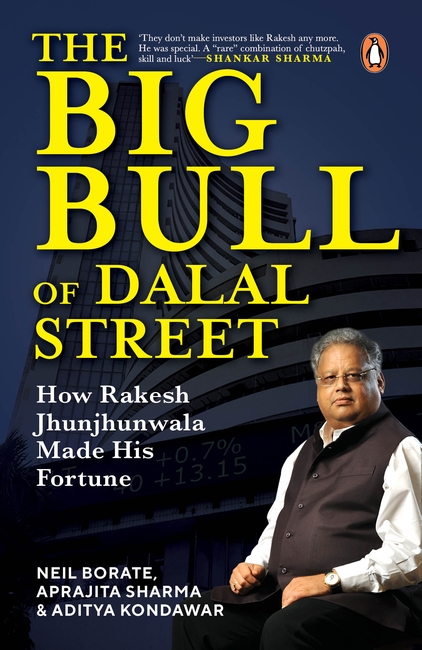
‘Respect the market. Have an open mind. Know what to stake. Know when to take a loss. Be responsible,’ this is what Rakesh Jhunjhunwala, India’s iconic stock market investor, often used to say.
This book looks at the life of India’s big bull, as Rakesh was famously known, both as a person and as a professional. Providing a fascinating account of his journey, it analyses the records of Jhunjhunwala’s investments and interviews he has given over the years. More than just a biography, a large section of the book is devoted to understanding the stocks that made him rich and the mistakes he made. Looking at the journey of the legendary investor, the book offers retail investors some useful insights—-benefits of long-term investing, mistakes one should avoid in the stock market, risk associated with leveraged trades, among others.

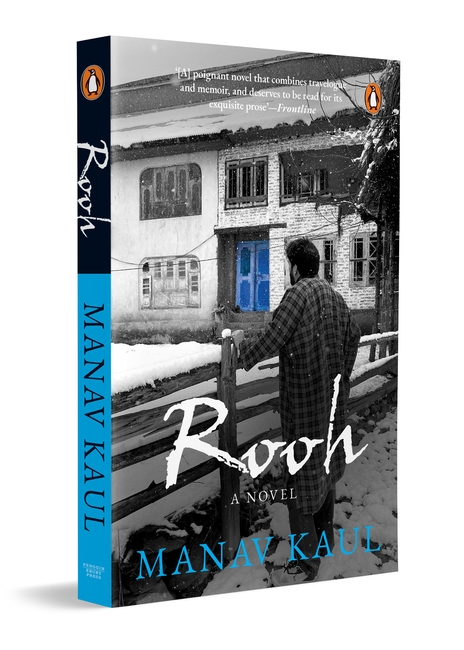
When Rooh tells Manav in a bar in New York that he ought to go to back home to the hills in Kashmir, he’s suddenly thrown into the loop of his past-a blue door, white walls and a house at the end of a lane. Soon, the seemingly small worlds in which his memories reside coalesce into a giant mass and envelop both his past and present, like dark clouds covering a brilliant blue sky.
Two young boys on the cusp of growing up, the cruelty of being a refugee in their own country, a father who is unable to come to terms with this confusing reality-an undercurrent of pain sweeps through his life. In this stream-of-consciousness novel, the protagonist, Manav, makes a physical and metaphorical journey back to Kashmir and relives the past as a part of the present. Rooh emerges as a deeply touching story of tender but broken people he meets along this journey.
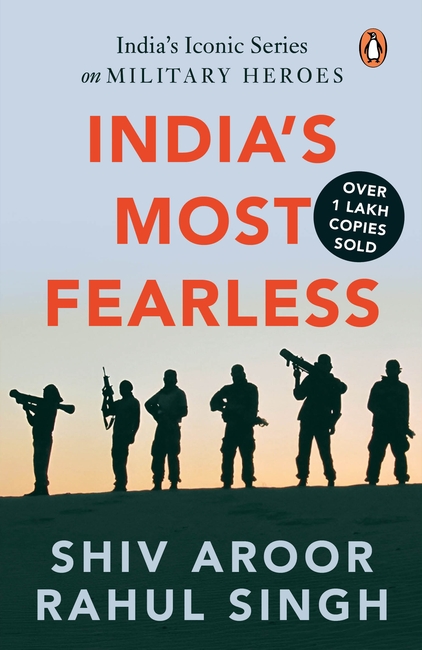
The men who hunted down terrorists in a magical
Kashmir forest where day turned to night. The Army major who led the legendary September 2016 surgical strikes on terror launch pads across the LoC. A Navy officer who sailed into a treacherous port to rescue hundreds from an exploding war. A bleeding Air Force pilot who found himself flying a jet that had become a screaming fireball. An e xclusive first-hand account of the 2020 Galwan clash.
Featuring thirty-eight untold accounts, this box set brings together the three books from the India’s Most Fearless series-a collection of true stories of extraordinary courage and fearlessness that provide glimpses into the kind of heroism our soldiers display in unthinkably hostile conditions and under grave provocation.
Incredibly moving and hauntingly honest, Water in a Broken Pot is the memoir of Yogesh Maitreya, a leading independent Indian Dalit publisher, writer, and poet. Encompassing experiences of pain, loneliness, depravation, alienation, and the political consciousness of his caste identity, this intimately moving memoir is a story of resilience and raw brutality. Growing up in a working-class family with meagre wages to get by in life, Yogesh writes of his father’s struggle against alcohol and passion for cinema; of intergenerational dreams shattered; working day and night shifts in factories; the struggle of being lost, overlooked and unmentored in India’s schooling, college and University systems which continue to be casteist, exclusionary and hostile; and feelings of lovelessness, loss and heartaches.
Having hopped from gig to gig to make ends meet, he writes of his eventual discovery of the written word, literature and the Ambedkarite legacy, which helped shape his dreams, identity and the eventual career choice of publishing books. In sharing his story, this fresh and radical voice tells his truth in the most frank and unfiltered of ways, as it happened, giving us readers permission to also be vulnerable in telling our tales.

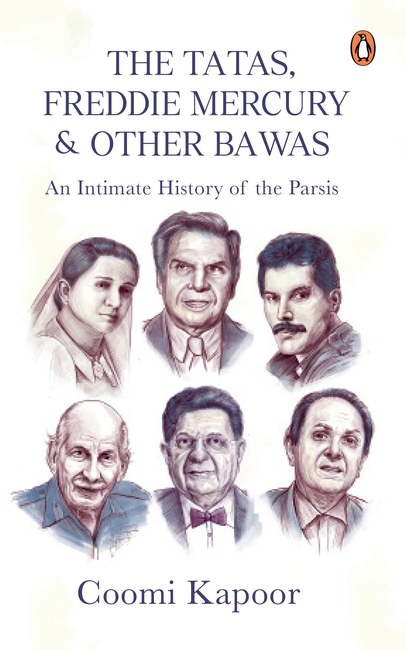
The Parsis are fast disappearing. There are now only around 50,000 members of the community in all of India. But since their arrival here from Central Asia, somewhere between the eighth and tenth centuries, the Parsis’ contribution to their adopted home has been extraordinary. The history of India over the last century or so is filigreed with such contributions in every field, from nuclear physics to rock and roll, by names such as Dadabhai Naoroji, Dinshaw Petit, Homi Bhabha, Sam Manekshaw, Jamsetji Tata, Ardeshir Godrej, Cyrus Poonawalla, Zubin Mehta and Farrokh Bulsara (aka Freddie Mercury). This is a revised and updated new edition – engaging and accessible – making it as the most intimate history of the Parsis by senior journalist and columnist Coomi Kapoor, herself a Parsi. The book pores through the names, stories, achievements and the continuing success of this tiny but extraordinary minority. She delves deep into both the question of what it means to be Parsi in India, as well as how the community’s contributions-from tanchoi silk to chikoos-became integral to what it meant to be Indian. In Kapoor’s hands, the story of the Parsis becomes a rip-roaring, incident-filled adventure: from dominating the trade with China to being synonymous with Bombay, once, arguably, a city defined by its Parsis; from the business success of the Tatas, the Mistrys, the Godrejs and the Wadias, to such current contributions as the manufacturing of COVID-19 vaccines by the Parsi-founded Serum Institute of India.
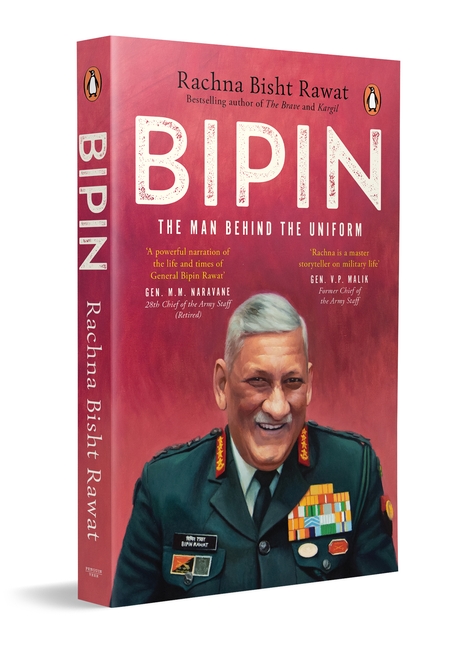
On the morning of 8 December 2021, India’s Chief of Defence Staff, General Bipin Rawat, and his wife, Madhulika, said goodbye to their daughter, Tarini, and dogs, and left their Delhi home to board a flight for Sulur in Tamil Nadu. Around 11.48 a.m., they boarded an Mi-17 V5 helicopter that took off from Sulur to Wellington, where Gen. Rawat was to deliver a lecture at the Defence Services Staff College. Just a few minutes away from its destination, the chopper crashed, and all fourteen passengers onboard eventually perished. It was a sudden and shocking end to the life of a man who had risen like a meteor in the defence forces.
Bipin: The Man behind the Uniform is the story of the NDA cadet who was relegated in the third term for not being able to do a mandatory jump into the swimming pool; of the young Second Lieutenant who was tricked into losing his ID card at the Amritsar railway station by a 5/11 Gorkha Rifles officer posing as his sahayak; of the Major with a leg in plaster who was carried up to his company post on the Pakistan border because he insisted on joining his men for Dusshera celebrations under direct enemy observation; of the Army Chief who decided India would retaliate immediately and openly to every act of cross-border terrorism; of the Chief of Defence Staff who was happiest dancing the jhamre with his Gorkha troops.
Written by bestselling author Rachna Bisht Rawat and featuring in-depth interviews with Bipin Rawat’s friends, family members and comrades, this book is a befitting tribute to one of India’s greatest and most controversial Generals.

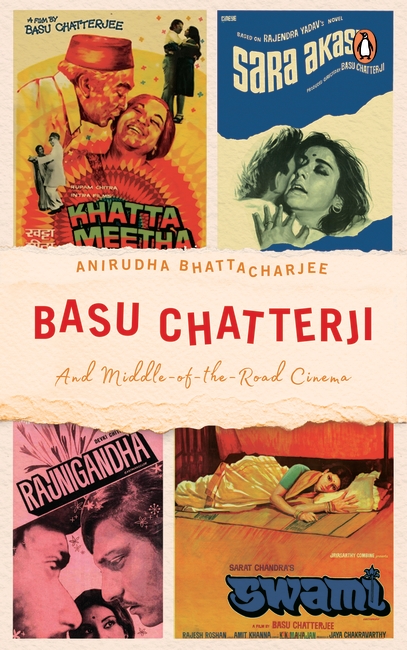
A behind-the scenes look at Basu Chatterji’s most loved films
This is the enigma of Basu Chatterji. His films did not have the box-office ingredients that could make them a distributor’s hot pick, nor were they art house cinema that needed unravelling over many cups of tea. He was the quintessential ‘middle-of-the-road’ film-maker, a genre that he founded in Bollywood. His films, whether it be Chhoti Si Baat or Rajnigandha or Chitchor, were about common people and common problems, such as employment and love, social and economic inequalities, and joint family conflicts. Like fellow cartoonist R.K. Laxman, who created the ‘common man’, Chatterji too was an auteur of the common man, whose journey he portrayed with charm, delicate warmth and humour.
As a person, Basu was much like his common man: mild, unobtrusive and media-shy. He preferred not to scout for stars and mostly made his films with rookies, giving them respectability as artists. And today, names like Amol Palekar, Vidya Sinha, Pearl Padamsee, Zarina Wahab, Nandita Thakur, Girish Karnad, Rakesh Pandey, Bindiya Goswami and Ranjit Chowdhry have become central to the history of Indian cinema, thanks to Basu.
Basu Chatterji: And Middle-of-the-Road Cinema, anecdotal in nature, goes behind the scenes of his films. It places Basu’s cinema and television work in the context of the changing times, like the emergence of Rajesh Khanna, Kishore Kumar and Amitabh Bachchan, the Emergency, the return of Sarat Chandra’s stories, the introduction of disco and the decadent phase of Hindi cinema in the 1980s. The book celebrates the work of one of the most underrated, yet successful, film-makers in Hindi cinema.
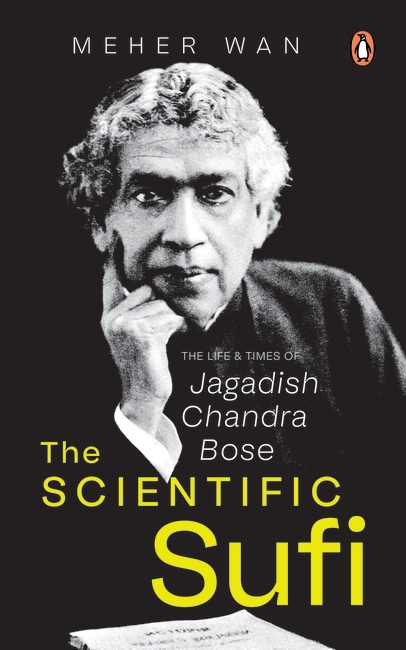
The Scientific Sufi is the most definitive English language biography of Sir Jagdish Chandra Bose, the father of modern science in India. In his time, he came close to, and many believe was robbed of, his due to winning at least two Nobel Prizes, if not one, for his work on wireless communication and the discovery of nervous system in plants. This biography carefully reconstructs his life, times, work, legacy, childhood, early years, influences and paint an intimate portrait of the father of modern science in India.