



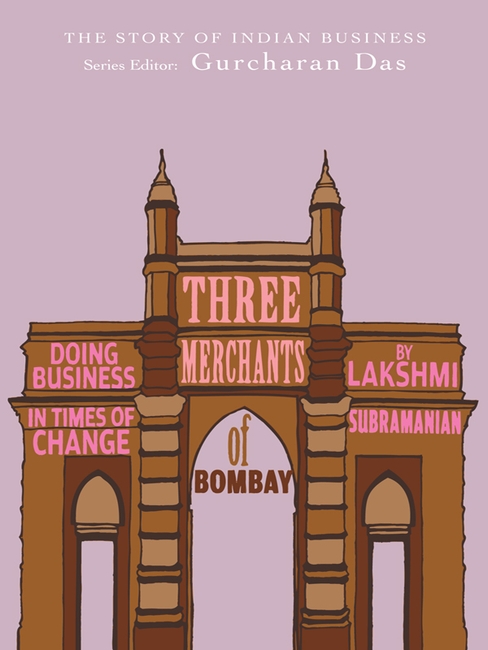
Three Merchants of Bombay is the story of three intrepid merchants-Trawadi Arjunji Nathji, Jamsetjee Jeejeebhoy and Premchand Roychand-who traded out of Bombay in the nineteenth century, founding pioneering business empires.Trailblazing in their enterprise, these adventurers possessed the unique ability to find and then exploit the big opportunities that came their way. It was a time of transition, and they prospered because they thought big and took risks. Set against the backdrop of global and local economies undergoing rapid and unforeseen change, the story of these three unique men stands as a proud milestone in the history of indigenous capitalism in India.In this lucid and very readable account, Lakshmi Subramanian traces that history and locates it in the greater narrative of the history of economic development in South Asia.
Catagory: Biographies, Diaries & True Accounts
The Other Side of Belief
Described as the thinker who shuns thought, U.G. Krishnamurti is the most enigmatic and iconoclastic ‘anti-guru’ of our times. His conviction that doubt is the other side of belief emerged from an uncompromising negation of everything that can be expressed, not from a desire for some ‘comfy dialectical thesis’.
The Other Side of Belief Interpreting U G. Krishnamurti is a candid and refreshing chronicle ofUG’s life and the evolution of his radical outlook and ideas. Tracing the development of UG’s notion of enlightenment as a series of biological mutations devoid of mystical or religious connotations, Mukunda Rao weaves a complex portrait—of a man who doesn’t hesitate to challenge and demolish society’s most cherished and comforting values and ideals, but nonetheless commands a most fervent respect and veneration from multitudes of admirers.
UG has always been adamant that life must be described in pure and simple physical and physiological terms so that it is de-psychologized and demystified. He underwent, in his own words, a ‘calamity’: a series of bodily metamorphoses that catapulted him into the unique state of the ‘declutched’ mind. This book gives the reader a vivid description of UG’s cellular revolution’ and an intensely personal insight into UG’s unflinching and relentless insistence on freedom from the ‘stranglehold of thought.’
With a foreword by Mahesh Bhatt, film-maker and lifelong admirer of UG, The Other Side of Belief offers a searching exploration of the incredible charisma of a man who has transformed the lives of people all over the world.
Conversations With Waheeda Rehman

‘A remarkable book’ — Vogue
In this highly acclaimed book of conversations with Nasreen Munni Kabir, Waheeda Rehman speaks about her life and work with refreshing honesty, humour and insight: from detailing her personal triumphs and tribulations to giving enthralling accounts of working with cinematic personalities like Guru Dutt, Satyajit Ray, Raj Kapoor and Dev Anand. Against all odds, she successfully made a life in cinema on her own terms. Filled with compelling anecdotes and astute observations, this is a riveting slice of film history that provides a rare view of a much-adored and award-winning screen legend.
‘Insightful . . . Rehman speaks with honesty and humour’-India Today
‘An engaging and revealing account’-Rajeev Masand
‘A fascinating account of a great actor’s life’-Anupama Chopra
‘Delightful . . . Candid, real and personal’-Dawn
And We Came Outside and Saw the Stars Again
In this rich, eye-opening and uplifting anthology, dozens of esteemed writers, poets, artists and translators from more than thirty countries offer a profound, kaleidoscopic portrait of lives transformed by the coronavirus pandemic.
As COVID-19 has become the defining global experience of our time, writers offer a powerful antidote to the fearful confines of isolation: a window onto corners of the world beyond our own. And We Came Outside and Saw the Stars Again takes its title from the last line of Dante’s Inferno, when the poet and his guide emerge from hell to once again behold the beauty of the heavens. In that spirit, the stories, essays, poems, and artwork in this collection detail the harrowing realities of the pandemic, while pointing toward a more connected future.
Mohandas
Sachin Tendulkar

‘”Sachin Sachin” will reverberate in my ears till I stop breathing’
Sachin Tendulkar: The Man Cricket Loved Back is an ESPNcricinfo anthology of fine writing on India’s greatest cricketer. This collection brings together affectionate and perceptive appreciations from teammates and rivals who played alongside and against Tendulkar (among them, V.V.S. Laxman, Rahul Dravid, Sourav Ganguly, John Wright, Allan Donald, Greg Chappell, Sanjay Manjrekar and Aakash Chopra) and contributions from the who’s who of cricket writing, including Gideon Haigh, Mike Marqusee, Ayaz Memon, Ed Smith, Mark Nicholas, Rohit Brijnath, Sharda Ugra and Mukul Kesavan. It also features several interviews conducted with Tendulkar over the years, and superb pictures of him on and off the field, making for a comprehensive portrait of the cricketer and the man through the eyes of those who have watched and studied him from up close.
Haar Se Jeet Tak
This is Hindi Translation from English Book ‘Why I Failed: Lessons from Leaders’.
Fail! And we are stamped for life. Don’t we try and run from failure all our lives? But, ‘spontaneous doing has to go through failures.’ Acknowledging failure is singularly the most difficult thing to do. It takes tremendous courage to come out and say, yes, I failed. Shweta Punj chronicles sixteen such leaders who have celebrated their failure as much as their success. Each story is an anatomy of failure. So whether it was the difference between ‘need’ and ‘want’ that led Abhinav Bindra to miss that winning shot, or whether it was a suicide attempt that pushed Sabyasachi Mukherjee into fully realizing his potential—these stories will prod you to look at failure differently.
Kapoors

There is no film family quite like the Kapoors. A family of professional actors and directors, they span almost eighty years of film-making in India, from the 1920s to the present. Each decade in the history of Indi films has had at least one Kapoor-if not more-playing a large part in defining it. Never before have four generations of this family-or five, if you include Bashesharnath Kapoor, Prithviraj Kapoor’s father, who played the judge in Awara-been brought together in one book. The Kapoors details the careers and personal lives of each generation’s box-office successes and failures, the ideologies that informed their work, the larger-than-life Kapoor weddings and Holi celebrations, their extraordinary romantic liaisons and family relationships, their love for food and their dark passages with alcohol. Based on extensive personal interviews conducted over seven years with family members and friends, Madhu Jain goes behind the façade of each member of the Kapoor clan to reveal what makes them tick. The Kapoors resembles the films that the great showman Raj Kapoor made: grand and sweeping, with moments of high drama and touching emotion.
Pandeymonium
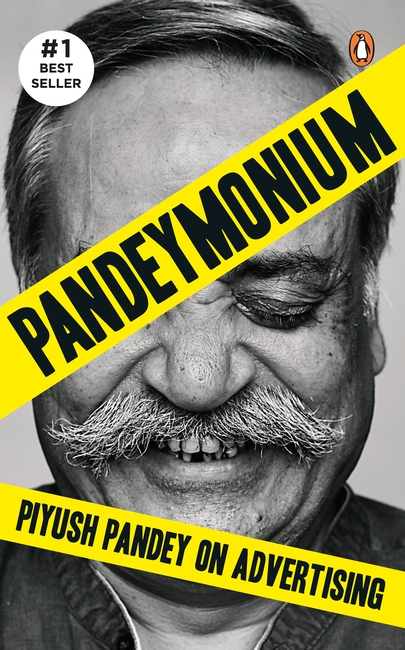
What makes Piyush Pandey an extraordinary advertising man, friend, partner and leader of men? How does he manage to exude childlike enthusiasm and bring such deep commitment to his work?
You’ve seen most of the things that Pandey has seen in his life. You’ve seen cobblers, carpenters, cricketers, trains, villages, towns and cities. What makes him different is the perspective with which he views the same things, his ability to store all that he sees into some recesses of his brain and then retrieve them at short notice when he needs to. That ability combined with his love, passion and understanding of advertising and of consumers make him the master storyteller that he is.
In Pandeymonium, Pandey talks about his influences, right from his childhood in Jaipur and being a Ranji cricketer to his philosophy, failures and lessons in advertising in particular and life in general. Lucid, inspiring and unputdownable, this memoir gives you an inside peek into the mind and creative genius of the man who defines advertising in India.
God’s Own Office
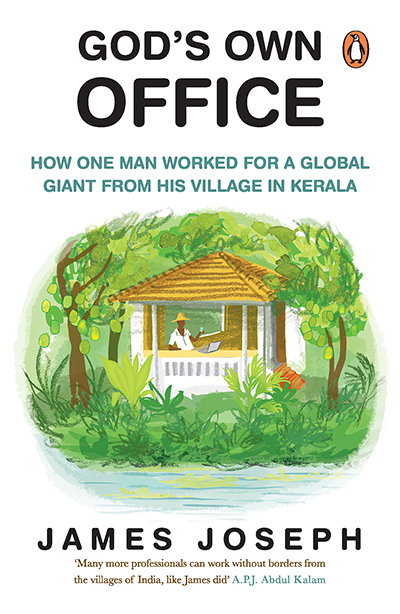
James Joseph was in his late thirties, well ensconced in his job as a director with Microsoft, when he decided to take a family vacation in Aluva, Kerala. His six-year-old daughter tasted a jackfruit from a tree in their own yard and remarked, ‘Daddy, this is so delicious. I wish I could eat the fruits from this tree every year.’
Part memoir, part how-to, this is his amazing story of starting out from the backwaters of Kerala, becoming a corporate captain in America and then finding a way to have a successful career while working out of his village in Kerala.This book also contains tips and techniques for anyone frustrated with living in cities. How do you set up a home office? How do you integrate with the local community? Where do your kids go to school? How do you convince your company to give you this opportunity? God’s Own Office may well inspire you to transform your life.