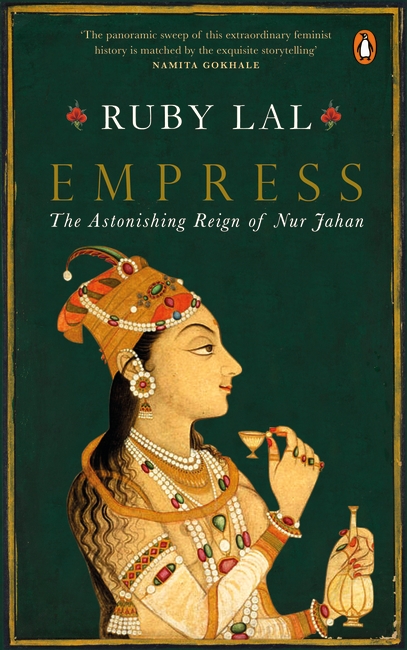
When it came to hunting, she was a master shot. As a dress designer, few could match. An ingenious architect, she innovated the use of marble in her parents’ mausoleum on the banks of the Yamuna, which inspired her stepson’s Taj Mahal. And she was both celebrated and reviled for her political acumen and diplomatic skill, which rivaled those of her female counterparts in Europe and beyond.
In 1611, thirty-four-year-old Nur Jahan, daughter of a Persian noble and widow of a subversive official, became the twentieth and most cherished wife of Emperor Jahangir. While other wives were secluded behind walls, Nur ruled the vast Mughal Empire alongside her husband, and governed in his stead when his health failed and his attention wandered from matters of state. An astute politician and a devoted partner, Nur led troops into battle to free Jahangir when he was imprisioned by one of his officers. She signed and issued imperial orders, and coins of the realm bore her name.
Acclaimed historian Ruby Lal uncovers the rich life and world of Nur Jahan, rescuing this dazzling figure from patriarchal and orientalist cliches of romance and intrigue, while giving a new insight into the lives of the women and the girls during the Mughal Empire, even where scholars claim there are no sources. Nur’s confident assertion of authority and talent is revelatory. In Empress, she finally receives her due in a deeply researched and evocative biography that awakens us to a fascinating history.

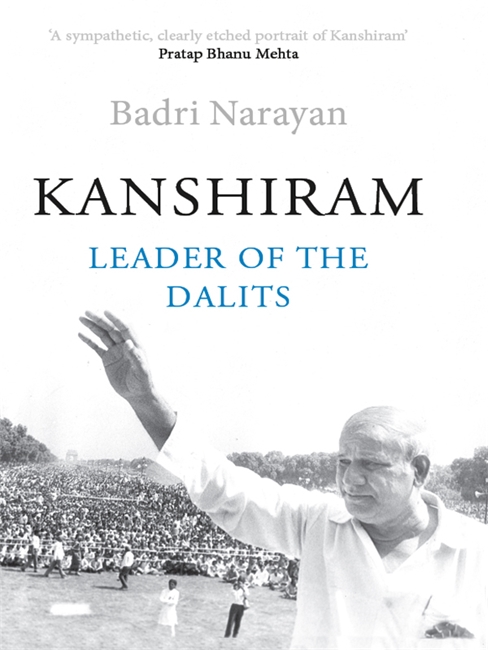
Venerated as a dalit icon, Kanshiram (1934–2006) is regarded as being next only to Ambedkar today. This book illuminates his journey, from the early years in rural Punjab and with Ambedkarites in Pune, to his launching BAMCEF, an umbrella organization uniting backward castes, scheduled tribes, dalits and minorities, and eventually the Bahujan Samaj Party in 1984.
Drawing on myriad oral and written sources, Badri Narayan shows how Kanshiram mobilized dalits with his homespun idiom, cycle rallies and, uniquely, the use of local folk heroes and myths, rousing their self-respect, and how he struck opportunistic alliances with higher-caste parties to seize power for dalits. Evocatively described is his extraordinary relationship with Mayawati, right until his death, and the role she has played in fulfilling his vision, during and after his lifetime.
Contrasting the approach of the two men, Narayan highlights the turn Kanshiram gave to Ambedkar’s ideas. Unlike Ambedkar, who sought its annihilation, he saw caste as a basis for forging a dalit identity and a source of political empowerment.
Authoritative and insightful, this is a rare portrait of the man who changed the face of dalit society and, indeed, of Indian politics.

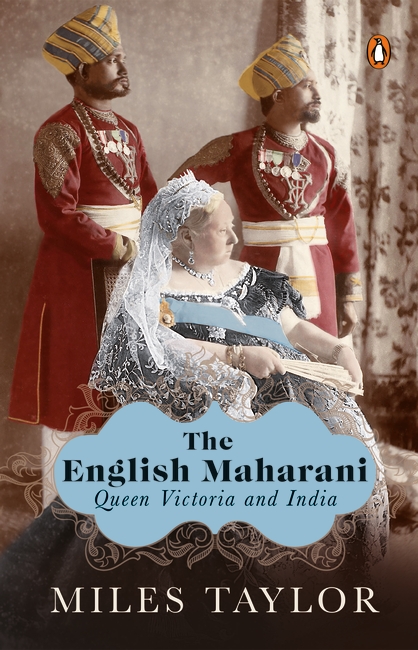
Queen Victoria was at the head of the Raj, Britain’s Indian empire, for much of her long reign. Passionately involved, she intervened in Indian politics, commissioned artists and photographers to record a landscape and people that she never saw herself, sent her sons as ambassadors to the subcontinent, and surrounded herself with the trappings of the Indian conquest, from the Koh-i-Noor diamond to her own Indian troop escort and servants.
Indian politics and society were in turn fundamentally reshaped by her influence: maharajas vied for her favour, missionaries used her as a tool for conversion and Indian reformers turned to her as a symbol of justice and equality. She also became an object of fascination and veneration: hundreds of popular biographies and tributes emerged from the vernacular printing presses, and her two jubilees of 1887 and 1897 were celebrated with unprecedented gusto.
In this new and original account, Miles Taylor charts the remarkable effects India had on the queen as well as the pivotal role she played in India. Drawing on official papers and an abundance of poems, songs, diaries and photographs, Taylor challenges the notion that Victoria enjoyed only ceremonial power and that India’s loyalty to her was without popular support. On the contrary, the rule of the queen-empress penetrated deep into Indian life and contributed significantly to the country’s modernisation, both political and economic.
In this subtle portrayal of Victoria’s India, Taylor suggests that the Raj was one of her greatest successes.
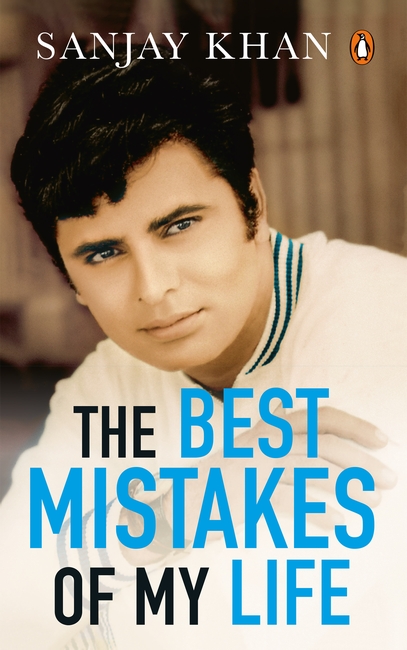
Once deemed the most handsome man in Bollywood, Sanjay Khan’s tryst with fame and stardom led him to many adventures across the world. He is best remembered for his performances in films like Ek Phool Do Mali and Abdullah as well as his portrayal of the great Tipu Sultan on television. In this exclusive autobiography he bares the details of a life full of action, excitement, drama, tragedy and, above all, courage. Written in a witty and engaging style, the book speaks of his formative years, his relationships with family, friends and co-stars, his interactions with world leaders, the stories behind his most remarkable films, and the fire on the set of The Sword of Tipu Sultan that almost killed him. Honest, engaging and revelatory, The Best Mistakes of My Life is the story of a star and a survivor who has resurrected himself with a vengeance each time life has thrown a curveball at him.

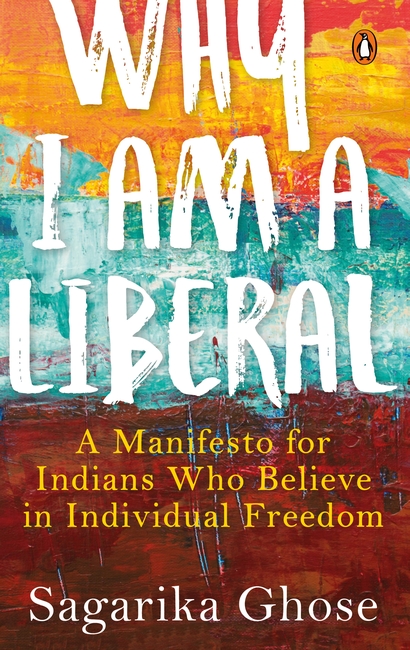
The stamping out of difference, the quelling of diversity and the burial of argument is, in fact, most un-Indian. Anyone who seeks to end that dialogue process is ignoring Indianness and patriotism. The liberal Indian argues for the rights of the marginalized in the tradition of Gandhi for trust, mutual understanding and bridge-building. Real patriotism lies in old-fashioned ideas of accommodation, friendship and generosity; not in force, muscle flexing and dominance. Why I Am a Liberal is Sagarika Ghose’s impassioned meditation on why India needs to be liberal.

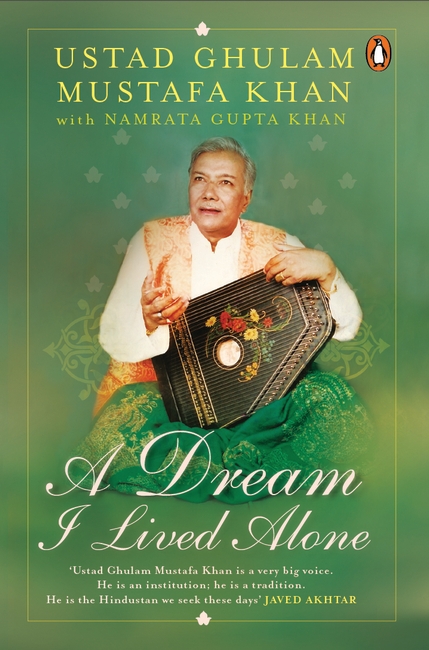
Padma Vibhushan-awardee Ustad Ghulam Mustafa Khan narrates his life’s story-from practicing music in a graveyard as a young boy to teaching stalwarts of the music industry, his journey is as lyrical as his songs.
The octogenarian has nourished his family with love and care, even in his absence. Guru to Shaan, Sonu Nigam, Lata Mangeshkar, and many others, he is modest even about his own achievements. Captured in its essence by Namrata Gupta Khan, his daughter-in-law, A Dream I Lived Alone is a heart-warming story of love, riyaz, dedication and the maestro of music, Ustad Ghulam Mustafa Khan.

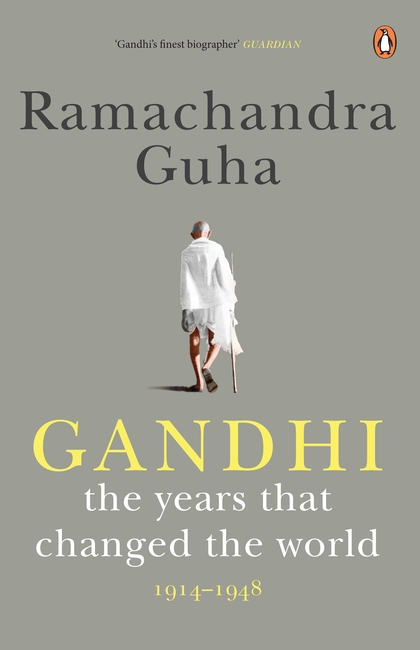
Gandhi lived one of the great 20th-century lives. He inspired and enraged, challenged and delighted millions of men and women around the world. He lived almost entirely in the shadow of the British Raj, which for much of his life seemed a permanent fact, but which he did more than anyone else to bring down. In a world defined by violence and warfare and by fascist and communist dictatorships, he was armed with nothing more than his arguments and example. While fighting for national freedom, he also attacked caste and gender hierarchies, and fought (and died) for inter-religious harmony.
This magnificent book tells the story of Gandhi’s life from his departure from South Africa to his dramatic assassination in 1948. It has a Tolstoyan sweep, showing us Gandhi as he was understood by his contemporaries, with new readings of his arguments with (among others) Ambedkar, Jinnah, and Churchill, and new insights on our freedom movement and its many strands. Drawing on never-before-seen sources and animated by its author’s wonderful sense of drama and politics, Gandhi: The Years That Changed the World is the most ambitious book on the father of the nation.

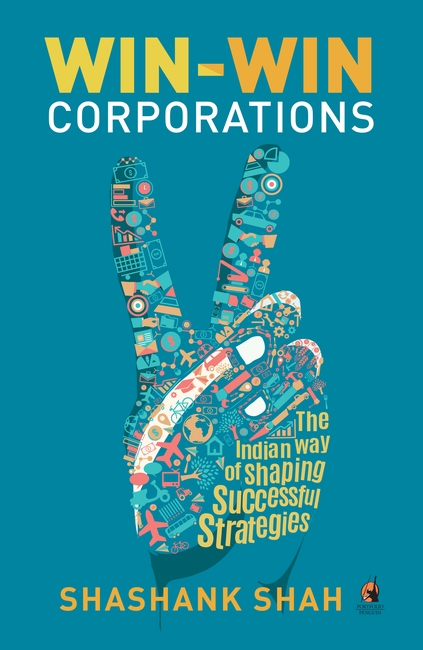
Why did Ratan Tata decide to pay for all the
victims of 26/11, whether injured in the Taj
or elsewhere?
How did Hindustan Unilever develop a cheaper
and better product to beat its competitor Nirma?
How did TVS Motor Company craft a turnaround
after breaking up with Suzuki?
How did Larsen & Toubro Construction
complete the Tirumala Water Supply Project
in just seventy-seven days?
What do the Taj Hotels, Hindustan Unilever,
TVS Motor Company, Larsen & Toubro, HDFC
Bank and Bharat Petroleum have in common?
They are Win-Win Corporations! Based on over
a decade of research, Shashank Shah identifies
six Indian companies and tells you how they are
truly outstanding in the way they do business.
Each of them has remarkable practices when it
comes to stakeholder management. Whether the
stakeholder is a customer, employee, investor,
vendor, dealer or even society at large, these
companies exemplify that looking at their interests
doesn’t really mean compromising on your own.
Often, the two complement each other and that is
what makes it a win-win solution for everyone.
This book gives an insightful glimpse into what
motivates exceptional companies and how they
are a cut above the rest. It also tells you how you
can make your company a Win-Win Corporation.
Full of fascinating anecdotes, the management
philosophies of eminent leaders, background
stories of organizations and an implementation
toolkit-this book is an inspiring read.
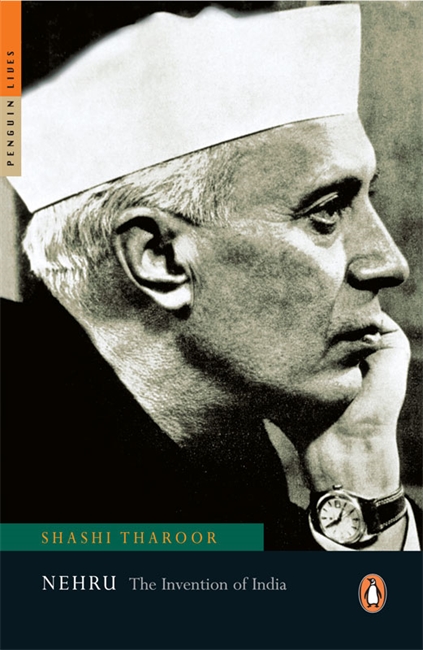
The author of India: From Midnight to the Millennium provides a close-up portrait of Jawaharlal Nehru, India’s first prime minister, the influential politician who led his newly independent nation from colonialism into the modern world, and his lasting legacy in terms of India’s history and world.
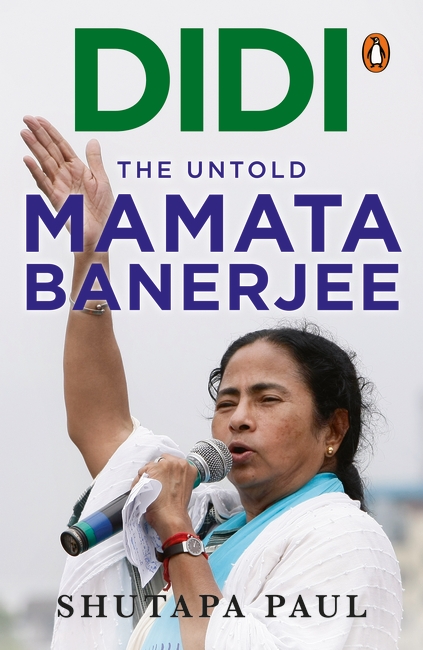
Mamata Banerjee, with her unique style of politics, was able to defeat the formidable three-decade-old Left Front Government in 2011. Exploring her struggles and achievements, Didi opens a window to the life and times of one of the most dynamic politicians of our country.
‘The general elections of 2019 can see [Mamata Banerjee] play kingmaker . . . She is the only regional leader who can claim to have that kind of clout. Jayalalithaa is no more and Nitish Kumar has changed over to the NDA. The year 2018 also witnessed the demise of another pedagogue of Dravidian politics, K. Karunanidhi. With the Congress showing signs of resurgence, and regional parties agreeing to forge a Federal Front, Mamata is more than aware that if she gets her electoral mathematics right, she could play a decisive role in the next Lok Sabha polls-maybe even stand a chance at prime ministership.’
Mamata Banerjee, with her unique style of politics, was able to defeat the formidable three-decade-old Left Front Government in 2011. Exploring her struggles and achievements, Didi opens a window to the life and times of one of the most dynamic politicians of our country.
‘The general elections of 2019 can see [Mamata Banerjee] play kingmaker . . . She is the only regional leader who can claim to have that kind of clout. Jayalalithaa is no more and Nitish Kumar has changed over to the NDA. The year 2018 also witnessed the demise of another pedagogue of Dravidian politics, K. Karunanidhi. With the Congress showing signs of resurgence, and regional parties agreeing to forge.