



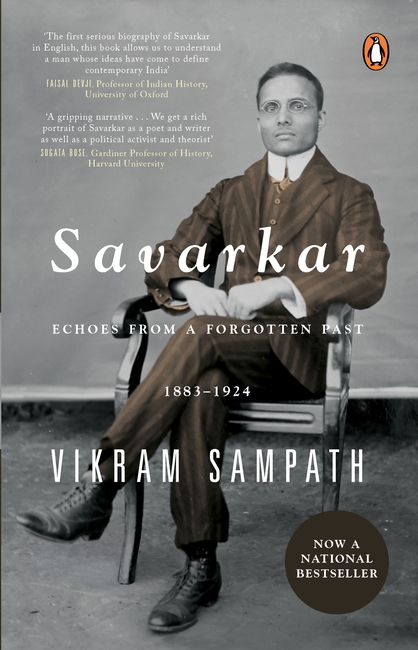
As the intellectual fountainhead of the ideology of Hindutva, which is in political ascendancy in India today, Vinayak Damodar Savarkar is undoubtedly one of the most contentious political thinkers and leaders of the twentieth century. Accounts of his eventful and stormy life have oscillated from eulogizing hagiographies to disparaging demonization. The truth, as always, lies somewhere in between and has unfortunately never been brought to light. Savarkar and his ideology stood as one of the strongest and most virulent opponents of Gandhi, his pacifist philosophy and the Indian National Congress.
An alleged atheist and a staunch rationalist who opposed orthodox Hindu beliefs, encouraged inter-caste marriage and dining, and dismissed cow worship as mere superstition, Savarkar was, arguably, the most vocal political voice for the Hindu community through the entire course of India’s freedom struggle. From the heady days of revolution and generating international support for the cause of India’s freedom as a law student in London, Savarkar found himself arrested, unfairly tried for sedition, transported and incarcerated at the Cellular Jail, in the Andamans, for over a decade, where he underwent unimaginable torture.
From being an optimistic advocate of Hindu-Muslim unity in his treatise on the 1857 War of Independence, what was it that transformed him in the Cellular Jail to a proponent of ‘Hindutva’, which viewed Muslims with suspicion?
Drawing from a vast range of original archival documents across India and abroad, this biography in two parts-the first focusing on the years leading up to his incarceration and eventual release from the Kalapani-puts Savarkar, his life and philosophy in a new perspective and looks at the man with all his achievements and failings.
Catagory: Biographies, Diaries & True Accounts
Behind Bars in Byculla

Renowned journalist Jyotirmoy Dey-fondly known as J, Dey-was murdered by members of the Chhota Rajan gang in 2011. A few months later, a fellow journalist and crime reporter Jigna Vora was arrested in connection with the murder. Seven years later, some of which were spent in prison, Jigna was acquitted of all charges. This is her story in her own words, of the time in prison, the court hearings and her years as a crime reporter of breaking many front-page stories.
Jigna’s work brought her in contact with people like Himanshu Roy, the former additional director general of police of Maharashtra, while her time in jail put her in the company of inmates such as Pragya Thakur. Behind Bars in Byculla traces the intricate web of power dynamics that govern the inmates of a prison and what it takes to survive behind bars.
Centrestage
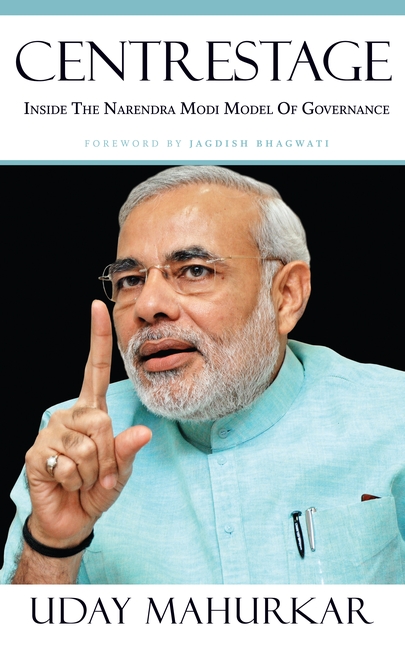
Is Narendra Modi’s government innovative and free of vote-bank politics? How did Narendra Modi bring 24-hour, three-phase domestic power supply to 18,000 villages in Gujarat? How did Modi turn the forlorn Kutch into a top tourist destination?
One of the most hotly debated topics in the general elections has been the development and governance of Narendra Modi’s government in Gujarat. In Centrestage, Uday Mahurkar tries to present a balanced assessment of Narendra Modi’s government by uncovering and analysing the Modi mantra of governance. With chapters on energy, technology, agriculture, finance and innovation, to name a few, Mahurkar aims at understanding and revealing the ground reality through facts and research beyond the media hype. Has Gujarat really made progress under Narendra Modi? Is Narendra Modi really a visionary and a good administrator? Read Centrestage to find out and get an insider’s view of Narendra Modi’s governance from a man who has followed him closely for the past three decades.
The Non-Conformist
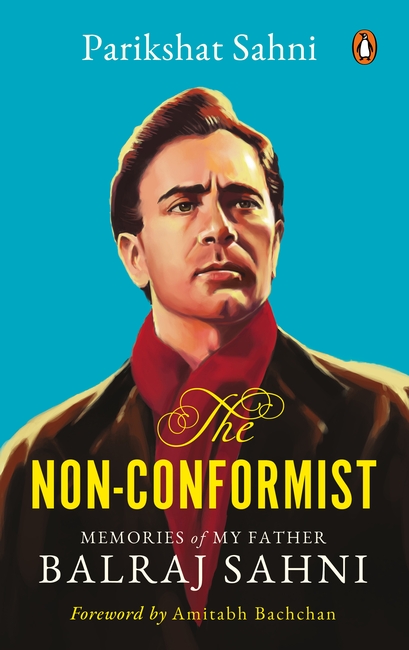
A legend with a host of admirers like Amitabh Bachchan and Om Puri, Balraj Sahni led the golden era of Indian cinema. He was known to be true to his principles, a non-conformist often remembered for his portrayals of the underprivileged. This is the untold story of one of the most iconic leading actors of this country. Written by his son Parikshat Sahni, the book–packed with unseen photos–provides personal and intimate glimpses of Balraj Sahni as a man and an actor, as a husband and friend, as a parent and patriot. It celebrates the life, times and impact of a simple man who inspired an entire generation of actors and continues to do so even today.
The Beauty of All My Days
So here I am, delving into the past like Monsieur Poirot, not to solve a mystery, but to try to understand some of the events that have helped define the sort of person I have become. Some of it, naturally, is in the genes; but much of it is in the environment, in the circumstances in which we grow up, in the people who come into our lives, even in the air we breathe.
Had I grown up in London or Timbuktu, I would have been a different sort of person, I’m sure. My parents (and those before them) made me. But India made me too. The soil, the air, the wind, the rain, the trees, the grass, the proximity of people-all these things made me . . .
Different things at different times helped to make the individual that is me, just as different things at different times helped to make you, just as they went into making your brothers and sisters, who are very different from you.
‘Do I contradict myself? Very well, then, I contradict myself,’ said Walt Whitman.
Each chapter of this memoir is a remembrance of times past, an attempt to resurrect a person or a period or an episode, a reflection on the unpredictability of life. Some paths lead nowhere; others lead to a spring of pure water. Take any path and hope for the best. At least it will lead you out of the shadows.
Shiksha

From schools of excellence to brilliant improvement in the board examinations and state-of-the-art facilities, government schools in Delhi rock. The implementation of innovative concepts like ‘happiness curriculum’ and ‘entrepreneurship mindset programme’ in Delhi government schools has brought about revolutionary change in the public school education system in the national capital of India.
Manish Sisodia, Delhi’s deputy chief minister and education minister, is the visionary instrumental in ushering in such a transformation. Recounting his experiences and experiments as an education minister, this book offers blow-by-blow account of this amazing success story. Shiksha, a book of hope and possibilities, will inspire everyone who is poised to make a difference in society through education.
Autumn Light

Returning to his long-time home in Japan after a sudden death, Pico Iyer picks up the steadying patterns of his everyday rites: going to the post office, watching the maples begin to blaze, engaging in furious games of ping-pong every evening. As he does so, he starts to unfold a meditation on changelessness that anyone can relate to: parents age, children scatter, and he and his wife turn to whatever can sustain them as everything falls away.
After his first year in Japan, almost thirty years ago, Iyer gave us a springtime romance for the ages, The Lady and the Monk; now, half a lifetime later, he shows us a more seasoned place-and observer-looking for what lasts in a life that feels ever more fragile.
Shiksha
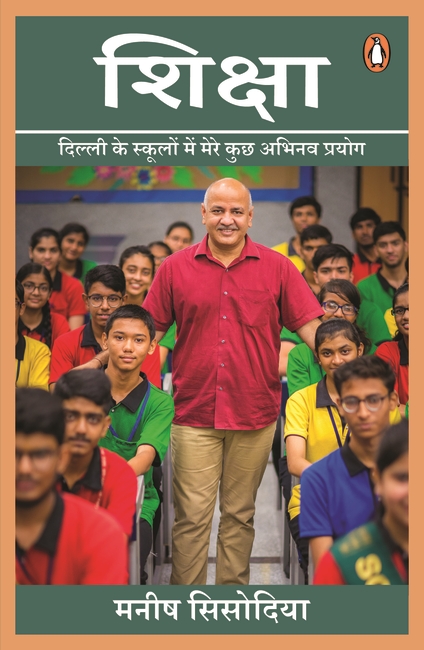
From schools of excellence to brilliant improvement in the board examinations and state-of-the-art facilities, government schools in Delhi rock. The implementation of innovative concepts like ‘happiness curriculum’ and ‘entrepreneurship mindset programme’ in Delhi government schools has brought about revolutionary change in the public school education system in the national capital of India.
Manish Sisodia, Delhi’s deputy chief minister and education minister, is the visionary instrumental in ushering in such a transformation. Recounting his experiences and experiments as an education minister, this book offers blow-by-blow account of this amazing success story. Shiksha, a book of hope and possibilities, will inspire everyone who is poised to make a difference in society through education.
The Cousins Thackeray
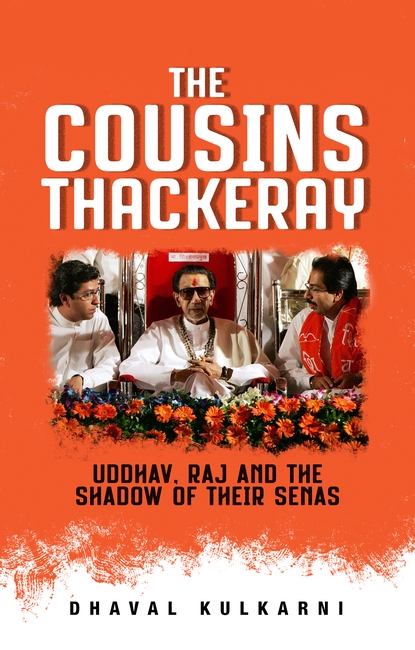
They are first cousins twice over, but have had widely divergent political trajectories. One, an abrasive, fire-breathing demagogue, was seen as his uncle’s political heir whose behavioural traits he cultivated. The other, an introvert, is at his best when plotting strategies on the drawing board rather than the rough-and-tumble of street-corner politics that his party is known for in India’s financial capital.
Starting out as brothers-in-arms, they had a bitter falling out over inheriting the party mantle. The younger cousin branched out on his own, hijacked the populist, ethno-centric plank of his parent party, putting his cousin-turned-political foe on the defensive. A series of miscalculations later, the boot seems to be on the other foot. The elder cousin has managed to keep his flock together and cemented his position as his late father Bal Thackeray’s political heir, while the other, one of the most popular crowd-pullers in Maharashtra, is itching for an electoral comeback.
The Cousins Thackeray evaluates the political careers of Shiv Sena president Uddhav Thackeray and Maharashtra Navnirman Sena (MNS) chief Raj Thackeray. It also examines questions about identity politics, and the social, cultural and economic matrix that catalysed the formation of the Shiv Sena and the MNS from it. Above all, it is a look at what makes the Thackeray cousins so integral to the politics of India, Maharashtra and Mumbai.
Rokda
Baniya—a derivative of the Sanskrit word Vanij, is a term synonymous with India’s trader class. Over the decades, these capitalists spread their footprint across vast sectors of the economy from steel and mining to telecom and retail. And now even e-tail.
Nikhil Inamdar’s Rokda features the stories of a few pioneering men from this mercantile community—Radheshyam Agarwal and Radheshyam Goenka, founders of the cosmetic major Emami; Rohit Bansal, co-founder of Snapdeal; Neeraj Gupta, founder of Meru Cabs; and V.K. Bansal, a humble mathematics tutor whose genius spawned a massive coaching industry in Kota—amongst others.
Through the triumphs and tribulations of these men in the epoch marking India’s entire post independence struggle with entrepreneurship—from the License Raj to the opening up of the floodgates in 1991, and the dawn of the digital era—Rokda seeks to uncover the indomitable spirit of the Baniya.