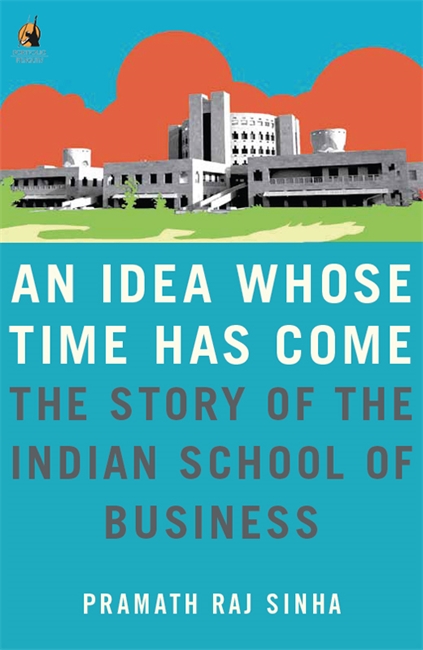
Ten years ago, the founders of the Indian School of Business, Hyderabad articulated a vision that was as daunting to execute as it was simple to state: to build a world-class business school in India.
The rest is history: within a decade the ISB grew from a start-up venture to globally top-ranked business school, named among the top twenty business schools in the world three years in a row, with the distinction of being the youngest business school ever to enter the world top twenty rankings.
An Idea Whose Time Has Come traces the ISB’s eventful history and also examines the reasons that account for the institute’s success. What emerges is a tale of perseverance and dedication, of challenges met and rewards reaped, and of an unshakeable idea that was painstakingly transformed into an invincible institution. It is no wonder that the ISB continues to attract thousands of confident, purposeful men and women every year and moulds them into talented professionals.

This is not a biography.
Nor is it a linear march of a man from childhood to success.
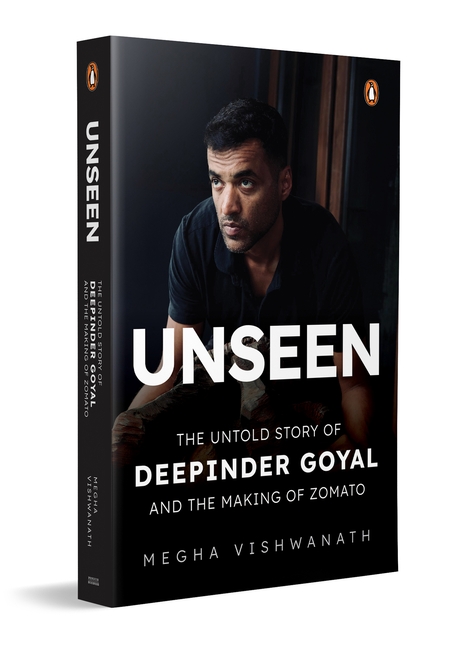
Unseen is the anatomy of a founder who doesn’t chase stability but thrives in contradictions—restless yet laser focused, flirting with high stakes and uncertain outcomes.
In July 2021, as Zomato became India’s first tech unicorn to go public, its founder, Deepinder Goyal, was largely untouched by the reverberating glory. Unseen begins where most stories end, at the peak, only to pull you into the shadows that shaped it.
Through the eyes of former journalist Megha Vishwanath, this is the deeply personal journey of a stuttering boy from small-town Punjab who grew into the reluctant face of a billion-dollar brand. Vishwanath pieces the narrative through hundreds of interviews, capturing the voices of those who worked with Deepinder, fought with him and followed him—through years of watching him build, break and build again.
Assembled from fragments of private battles, impossible questions and split-second decisions that altered the course of one of the largest companies of our generation, this book reveals what happens when ambition is stripped of vanity, brilliance sheds its theatre and success arrives without peace.

If you saw a toothpick on the floor, what would you do?
This seemingly innocuous question was posed to Subir Chowdhury by one of his long-time clients, and ultimately lead him to a profound realization: good enough is not enough. In this pithy and thought-provoking new book, bestselling author Subir Chowdhury shares the secret of how some organizations only improve incrementally while others improve exponentially. The Difference, he reveals, is in the star facets of a caring mindset laid out in the book.
‘Those who fail to adopt the caring mindset Subir Chowdhury describes in The Difference will find themselves falling behind in innovation, employee engagement, and productivity. Reading and practicing the ideas in The Difference will change your life’- Marshall Goldsmith

Ambitious digital-driven startups are now creating and cornering new markets in every sector. And yet, most legacy businesses continue to operate by old playbooks. Most are not keeping pace with the changes in their industry, let alone leading the way-what is yours doing? The Digital Matrix will help you understand the three types of players that are shaping the new business landscape; the three phases of transformation that every firm will encounter on its journey to business reinvention; and the three winning moves that will ensure your company’s success along the way.
With The Digital Matrix, you will:
Learn to navigate the world of digital ecosystems.
Discover ways of competing and collaborating with other companies to create and capture value.
Realize how powerful machines can amplify your company’s human talent.
Learn to assemble the team to experiment with new ideas, re-examine your core beliefs, and reinvent your business rulebook for the digital future.
Your company’s future depends on its ability to harness digital technology.
Don’t wait!

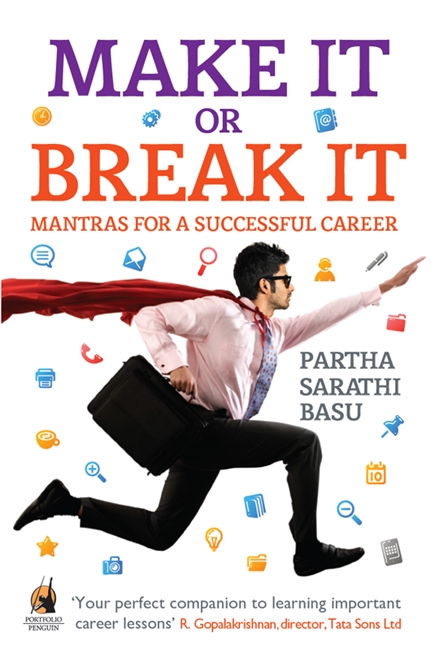
The corporate world can be ruthless with its unwritten rules and hidden pitfalls. To succeed, it is crucial to learn the tricks of survival quickly. Make It or Break It is an indispensible guide to imbibing these skills early on in one’s career. Packed with important life lessons, it shows you how to get started on the right foot and emerge a winner.

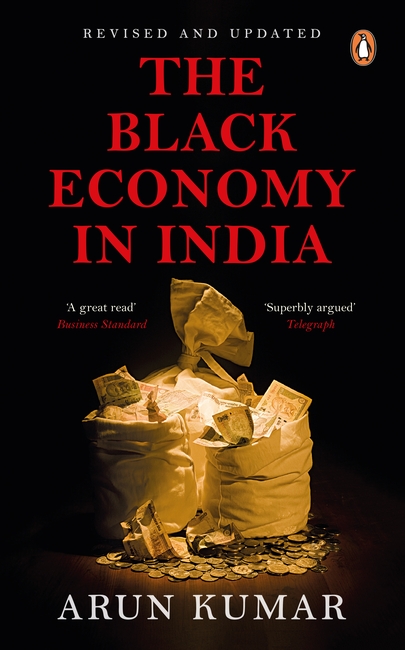
India’s white economy is inextricably linked with its black economy. Where in 1991 the black economy constituted about 35 per cent of the national economy, it had increased to 62 per cent by 2013. Both legal (industry, services, real estate, the share market) and illegal (havala, smuggling, narcotics) activities, as well as instances of corruption, contributed to this situation. But the cash, or ‘black money’, circulating in the country is merely around 3 per cent of the total domestic black economy. In this scenario, how effective has the central government’s move to demonetize 500- and 1000-rupee notes in November 2016 been?
In the only such book on the subject, written especially for the general reader, Arun Kumar critically examines the causes and consequences of black income generation and the possible ways to curb it. Backed by empirical data, his incisive analysis lays bare the pernicious effects of black income on the macroeconomy and the resultant inefficiency in society. It also focuses on the nexus of businessmen, politicians and the executive in perpetuating the black economy.
A groundbreaking book, The Black Economy in India shows how demonetization is not the way to end black economy, since what India must do is empower citizens and make leaders accountable.

Do I need to a founder’s agreement even if my co-promoters are my childhood friends?
What is a mentor agreement and how is it different from an investor agreement?
What clauses do I need to worry about in a seed investor agreement?
Do I need to patent everything I build on my own?
Is product management different for Indian start-ups?
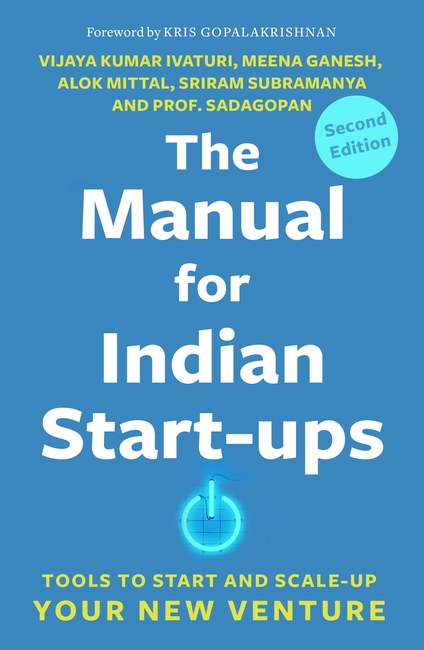
These are the typical questions that bother an early-stage entrepreneur in the burgeoning Indian start-up ecosystem. The Manual for Indian Start-ups has been ideated as a handy guide meant for daily use. Authored by industry leaders, this book provides relevant templates based on the stage the venture is in for the first three years of the entrepreneurial journey.

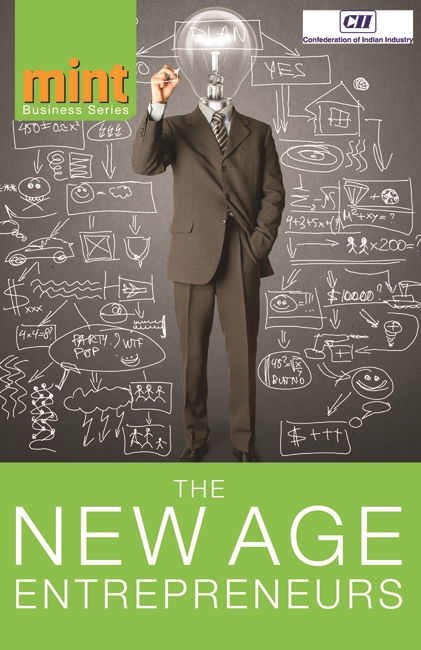
Have you wondered what goes on in the heads of entrepreneurs? What makes them tick? The New Age Entrepreneurs provides a peek into the lives of thirty successful entrepreneurs, including N.R. Panicker of Accel Ltd., Ramachandra Galla of Amaron and M. Murali of Sri Krishna Sweets, who established flourishing businesses borne out of innovative ideas. These trailblazers delved into diverse industries, ranging from information technology to luxury hotels and Indian sweets. With snappy, insightful and motivating tales, interspersed with interviews and vivid profiles, The New Age Entrepreneurs is a collection of vignettes of men who made their own rules and set standards for the rest of the industry to follow.

All hell broke loose with a simple confession from Ramalinga Raju, founder and chairman of Satyam Computers, the fourth largest IT company in India with over 50,000 employees and business in more than 66 countries. His admission in 2009 of cooking the books to show exaggerated profits combined with the diving economy rocked India Inc. and forced it to look inwards.
With robust research, interviews and stories, Zafar Anjum tracks the chronicle from Raju’s confession and Satyam’s free-fall to the phoenix’s rise as Mahindra Satyam. This is a tale of betrayal and devastation, but more importantly of hope and resurrection. With an afterword by Anand Mahindra, chairman and managing director of Mahindra Group, The Resurgence of Satyam is the definitive book that will answer all that you wanted to know about the Satyam saga.
Less than 2 per cent of entrepreneurs succeed, only 15 per cent of employees get the best hikes, promotions and appraisal ratings. Less than 1 per cent get to senior management positions and higher. Does this mean the rest do not work as hard or are not as smart? They are! But there are subtle yet profound differences. According to bestseller author T.G.C. Prasad, there is more to accomplishments than just working hard or at times even being smarter. Working Hard Is Not Good Enough is an insightful management book for all who want to make a difference to their performance, potential and life in general, to achieve success and happiness.