



Digital intelligence-the ability to understand and use the power of information technology-is becoming critical for organizations and managers to thrive in the global marketplace. The digital revolution is impacting almost every industry, functional area and business process, as shown by innovative market entrants such as Uber and Airbnb. Success in the digital economy will require leaders and managers to invest in their own digital intelligence and that of their teams to navigate the ongoing transformations.
Technical skills and knowledge are important in any dynamic and growing economy, and especially in economies such as India where technology provides a way to leapfrog competitors and accelerate growth. Here, managing and nurturing digital intelligence is not only key for economic success, but also necessary to achieve sustainable development for millions of consumers and workers at the base of the pyramid.
This remarkable book by an expert and leading scholar on digital strategy tells you how to innovate digitally and make your organization future-ready.
Catagory: Business & Economics
The Value Elephant: The Head and Tail of Wealth Creation
If six sightless men were asked to describe ‘value’, they’d probably touch it and describe it in parts, without getting a sense of the whole. But to build lasting wealth, you must perceive the entire ‘value elephant’.
Great fortunes are made and lost in financial markets. Sanjay Kulkarni’s approach, called V-GRO, enables identification of fundamentally strong businesses which are available at a discount; debunks a number of myths like ‘price is always right’ and ‘earnings are everything’; and creates positive results for investors.
But that’s not all. The same fundamentals, Kulkarni argues, can be applied inside a business to create value. He demonstrates how CEOs, professional managers and owners of businesses can ride the ‘value elephant’ to make businesses more valuable, regardless of ownership and industry segment.
Invoking the experiences of several business leaders who have created lasting wealth for their investors, The Value Elephant reveals what it takes to successfully create value in the Indian environment.
The Two-Minute Revolution
Unlike usual business books, The Two-Minute Revolution provokes you to think big-about innovation as well as excellence in on-the-ground execution.
Sangeeta Talwar, the first woman executive in the FMCG industry, who established one of the most beloved and enduring brands of India-Maggi Noodles-shares creative and strategic lessons which can help you grow and add value to your business. Drawing from decades of first-hand experience in Nestle, Tata Tea and Mattel, she prescribes a plan of action that includes tactics such as keeping all the balls in the air, executing to perfection, being consumer obsessed and pivoting on profitability.
Insightful and packed with fascinating examples-from creating and launching Maggi Noodles to spearheading the highly effective Jaago Re campaign for Tata Tea-this book suggests tried and trusted strategies for building extraordinary brands.
Haar Se Jeet Tak
This is Hindi Translation from English Book ‘Why I Failed: Lessons from Leaders’.
Fail! And we are stamped for life. Don’t we try and run from failure all our lives? But, ‘spontaneous doing has to go through failures.’ Acknowledging failure is singularly the most difficult thing to do. It takes tremendous courage to come out and say, yes, I failed. Shweta Punj chronicles sixteen such leaders who have celebrated their failure as much as their success. Each story is an anatomy of failure. So whether it was the difference between ‘need’ and ‘want’ that led Abhinav Bindra to miss that winning shot, or whether it was a suicide attempt that pushed Sabyasachi Mukherjee into fully realizing his potential—these stories will prod you to look at failure differently.
Going for Gold
After 2008, as the world lurched from one financial crisis to another, the price of gold rose to over Rs 35,000 per 10 g in 2013. It has since fallen precipitously to a five-year low-under Rs 25,000 for 10 g.
Where will the price of gold go now? How will it perform as an investment? And can we profit from it?
We all want to invest for the future-perhaps for retirement, for a child’s education or to build a nest egg. Whether you are an ordinary or professional investor, a student or an academician, you are faced with a bewildering array of portfolio choices. Where can you find a safe haven for investment that will give you a reliable store of wealth and value untouched by the turmoil of the modern world? In Going for Gold, Nanda Menon outlines the dynamics of the gold market, its demand and supply, its cost of production and geopolitics. Aimed at experts as well as the general reader, this book will answer all your questions on why gold is one of the top investment choices for wealth creation and preservation for Indians.
Quote Me if You Can
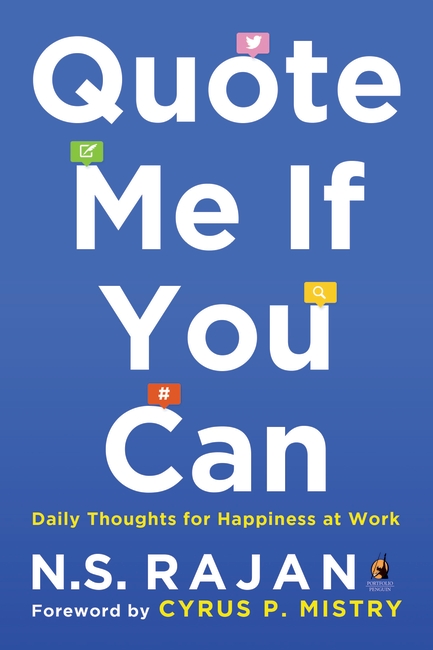
Love what you do till you find what you love to do.
When the culture of an enterprise is not rooted in values, you grow weeds, not flowers.
Winners are like kites, which fly high when pulled back and even higher when the wind is against them.
Quote Me if You Can is a book of thoughts by Dr N.S. Rajan, a member of the Group Executive Council and Group Chief Human Resources Officer of Tata Sons. A widely-followed thought leader, Rajan has been studying happiness at work for decades. In this book he packs profound insight into simple words. It is a must-read for all those living in the corporate jungle looking for purpose, harmony and happiness.
A Never-Before World
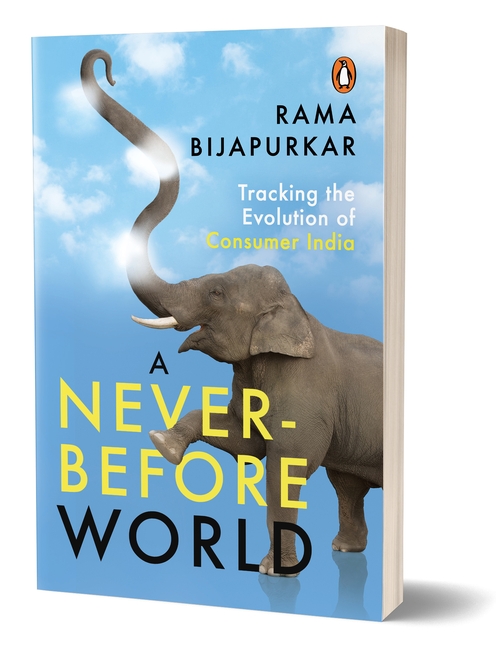
Five years after We Are Like That Only, her seminal and bestselling study on the logic of consumer India, Rama Bijapurkar takes stock of its evolution in her new book. She starts from the point that emerging markets-the queen of which is India-are a never-before world, and businesses approaching them need to understand the environment in which consumers live, how they think, how heterogeneous they are and how they are changing. All of these have key implications for correctly evaluating business opportunity and determining market strategy. India has entered the third decade after liberalization, buffeted by changes on all fronts. Consumption structures and consumer behaviour are changing, and consumer needs and desires are growing faster than incomes. The real war for the consumer rupee begins now-the trick is to understand, without prejudice or preconceived notions, the new world of consumer India. Setting consumerism in the context of society and people’s lives, looking not just at how much money people have, what they spend it on and how, but at how businesses can be relevant to consumers’ lives and life aspirations, A Never-Before World explores everything that businesses need to know and think about to win in the crucial Indian market.
Nimble
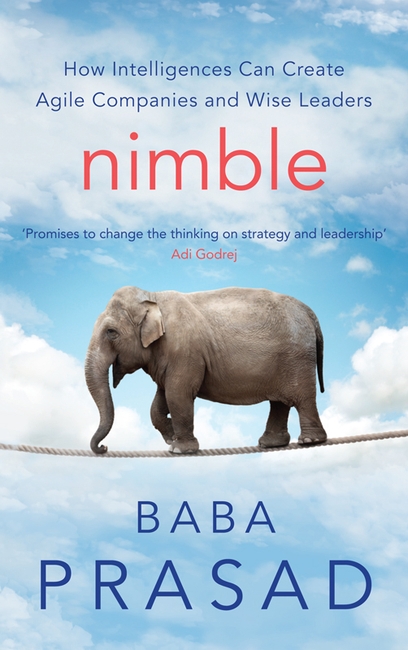
The world today can be best described by one word: turbulence. As change rages all around, how can you—as an individual or as an organization—take advantage of unexpected opportunities and succeed in difficult circumstances?
In a book that challenges traditional notions of strategy, Baba Prasad draws on his research at some of the world’s best business schools to show how intelligence can help you and your business navigate this maelstrom. The Intelligences Framework presented in Nimble goes beyond the common management concept of ‘agility’—it presents an immensely practical and hands-on approach for companies and individuals to develop five kinds of intelligences and apply them in different settings for maximum benefit.
Bridging strategy, leadership and innovation—and with vivid illustrations—Nimble provides a path-breaking assessment methodology and a systematic four-step approach that every company and individual can use to lead amid turbulence.
Pandeymonium
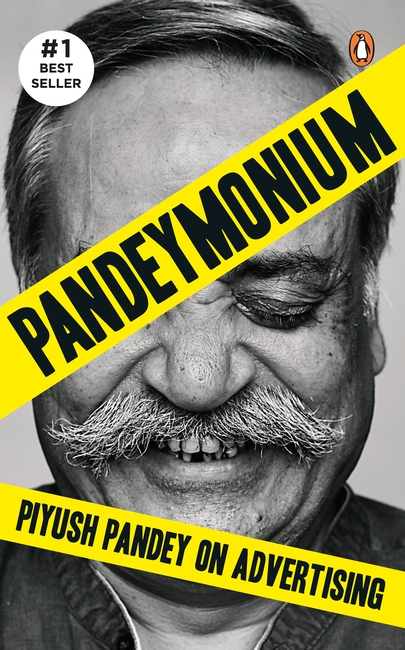
What makes Piyush Pandey an extraordinary advertising man, friend, partner and leader of men? How does he manage to exude childlike enthusiasm and bring such deep commitment to his work?
You’ve seen most of the things that Pandey has seen in his life. You’ve seen cobblers, carpenters, cricketers, trains, villages, towns and cities. What makes him different is the perspective with which he views the same things, his ability to store all that he sees into some recesses of his brain and then retrieve them at short notice when he needs to. That ability combined with his love, passion and understanding of advertising and of consumers make him the master storyteller that he is.
In Pandeymonium, Pandey talks about his influences, right from his childhood in Jaipur and being a Ranji cricketer to his philosophy, failures and lessons in advertising in particular and life in general. Lucid, inspiring and unputdownable, this memoir gives you an inside peek into the mind and creative genius of the man who defines advertising in India.
Genie in the Machine
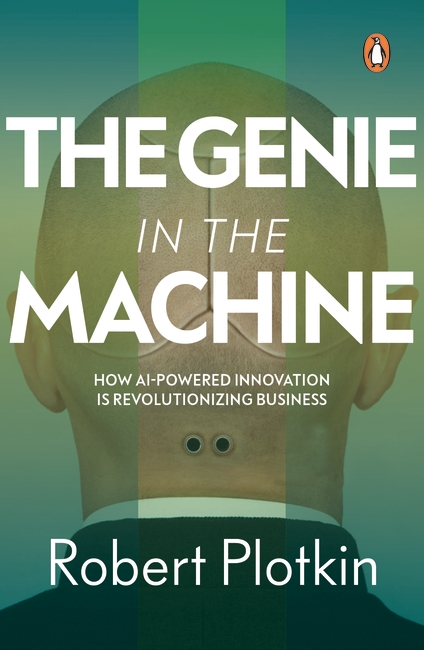
The future of businesses depends on how they respond to the lightning-speed changes in innovation technology
We have long considered inventing to be a uniquely human activity. But software today can automatically generate designs for everything, from toothbrushes to automobile frames, more quickly and inexpensively than ever before. Artificial invention is enabling small teams of inventors to compete with mega-corporations who depend on old methods, and is making it possible for even consumers to design and manufacture new inventions from the comfort of their home.
The Genie in the Machine is a landmark book that explores the impact of AI-powered innovation on businesses. Along with practical advice for inventors, high-tech companies and patent lawyers, this futuristic book attempts to answer two necessary questions: Should inventions designed by software be patentable? Should the software that produces those designs be patentable?
Our decisions about these inventions today will dictate who gets to control this powerful technology tomorrow.