



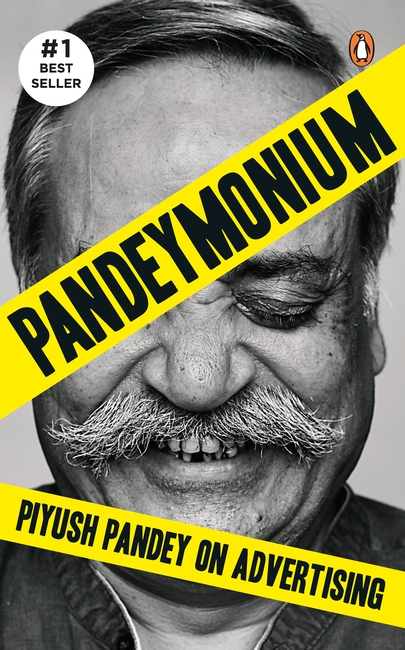
What makes Piyush Pandey an extraordinary advertising man, friend, partner and leader of men? How does he manage to exude childlike enthusiasm and bring such deep commitment to his work?
You’ve seen most of the things that Pandey has seen in his life. You’ve seen cobblers, carpenters, cricketers, trains, villages, towns and cities. What makes him different is the perspective with which he views the same things, his ability to store all that he sees into some recesses of his brain and then retrieve them at short notice when he needs to. That ability combined with his love, passion and understanding of advertising and of consumers make him the master storyteller that he is.
In Pandeymonium, Pandey talks about his influences, right from his childhood in Jaipur and being a Ranji cricketer to his philosophy, failures and lessons in advertising in particular and life in general. Lucid, inspiring and unputdownable, this memoir gives you an inside peek into the mind and creative genius of the man who defines advertising in India.
Catagory: Business & Economics
Genie in the Machine
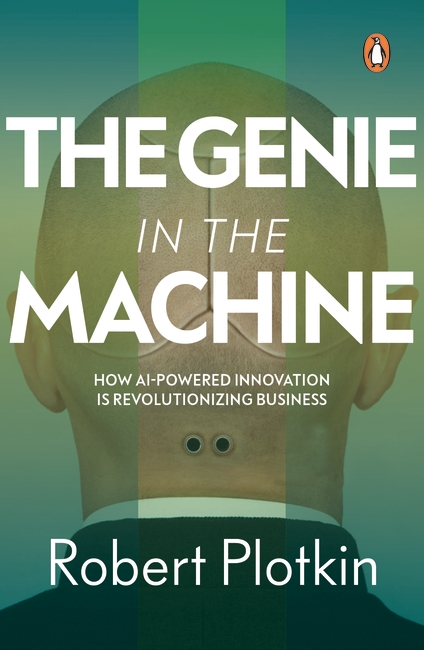
The future of businesses depends on how they respond to the lightning-speed changes in innovation technology
We have long considered inventing to be a uniquely human activity. But software today can automatically generate designs for everything, from toothbrushes to automobile frames, more quickly and inexpensively than ever before. Artificial invention is enabling small teams of inventors to compete with mega-corporations who depend on old methods, and is making it possible for even consumers to design and manufacture new inventions from the comfort of their home.
The Genie in the Machine is a landmark book that explores the impact of AI-powered innovation on businesses. Along with practical advice for inventors, high-tech companies and patent lawyers, this futuristic book attempts to answer two necessary questions: Should inventions designed by software be patentable? Should the software that produces those designs be patentable?
Our decisions about these inventions today will dictate who gets to control this powerful technology tomorrow.
Making Dreams Come True
In just over five years of its existence, the Tech Mahindra Foundation (TMF) has helped bring about a significant change in the lives of thousands of underprivileged children and youth. Funded entirely by Tech Mahindra, it has risen to the Herculean challenge of providing them educational opportunities from primary schooling to vocational training. In this endeavour, it has laid special emphasis on those who are more vulnerable: the girl child, the physically challenged and religious minorities. And with each passing year, its philanthropic operations and its successes continue to grow, bringing hope to an ever-increasing number of disadvantaged young people.
Making Dreams Come True provides valuable insights into how a medium-sized private foundation has become a significant contributor to some of the country’s most important developmental goals. Moreover, it is a testament to the passion and hard work of not only the TMF and its personnel but also others involved in this important project of building a more inclusive India.
Alice In Corporateland
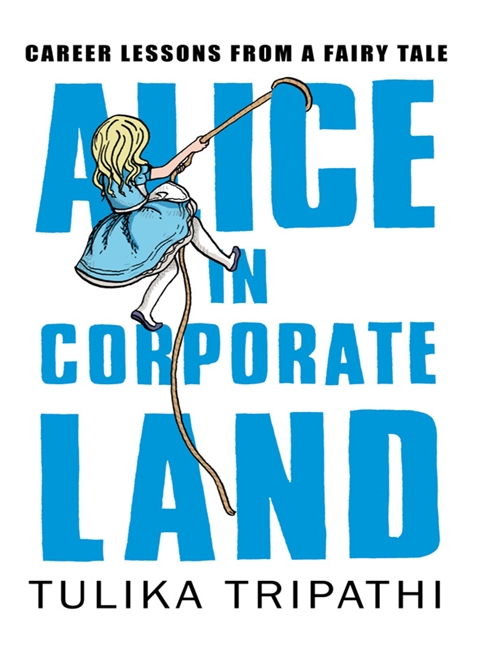
Alice teaches you to climb the corporate ladder
This is a lovely little book based on the Alice in Wonderland fairy tale with a twist. A nervous and confused young girl is trying to get a good night’s rest before her first day at work. Alice’s rabbit leads her on a magical journey where she meets Pinocchio, Rapunzel, Cinderella and the Seven Dwarfs who coach her by imparting important career lessons in their own inimitable style.
Tulika Tripathi has rapidly scaled the corporate ladder to become a leader at a global executive search firm. This, combined with a love for fairy tales, puts her in the unique position to distil and offer career wisdom to those who are beginning their journey.
Go Kiss the World

‘Go, kiss the world’ were Subroto Bagchi’s blind mother’s last words to him. These words became the guiding principle of his life. Bagchi grew up amidst what he calls the ‘material simplicity’ of rural and small-town Orissa, imbibing from his family a sense of contentment, constant wonder, connectedness to a larger whole and learning from unusual sources. From humble beginnings, he went on to achieve extraordinary professional success, eventually co-founding Mindtree, one of India’s most admired software services companies. Through personal anecdotes and simple words of wisdom, Bagchi brings to the young professionals lessons in working and living, energizing ordinary people to lead extraordinary lives. Go Kiss the World will be an inspiration to ‘young India’, and to those who come from small-town India, urging them to recognize and develop their inner strengths, thereby helping them realize their own potential.
The Future of Competition
The Future of Competition argues that in a world in which information is readily available to everyone, the role of the customer has changed dramatically.
Once passive recipients of the products and services companies created for them, customers are now active participants who actually co-create the value they receive from products and services they help develop, test and distribute.
In the 1990s competitive advantage was derived from the ‘core competencies’ (the activities a company does better than anyone else), but in the future it will come from how proficient companies are at providing opportunities for customers to co-create unique experiences.
Prahalad and Ramaswamy present four key building blocks that will enable companies to co-create the future with customers-transparency, access, dialogues and risk management-and illustrate them through rich examples from a wide range of companies. As bold and far-reaching as Competing for the Future a decade ago, this book will redefine strategy for the information age.
Final Victory

On 8 January 1979, in the late evening, Naval, the third son of Pirojsha Godrej, was brutally stabbed at his residence, along with his daughter-in-law and mother-in-law. This dastardly attack, incited by a powerful trade union leader in Mumbai, outraged people in trade circles and the public at large. The victim was one of those rare industrialists who had forged a legendary bond with his workers; he trusted their essential goodness, believing he could have no enemies—a fatal flaw according to the author—, in as much as they thought Naval could never do them wrong.
In Final Victory: The Life—and Death—of Naval Pirojsha Godrej, B.K. Karanjia draws upon his reminiscences of Naval from their five-decade-long friendship, interviews with Naval’s family, friends, associates and workers at Godrej, and his private papers, to paint a warm and compelling portrait of a man with an exceptional strength of mind and character. We get a glimpse of Naval, a mechanical wizard, who was chosen by his father to join the business straight out of high school. Learning skills from the shop floor upwards, led Naval to support a hands-on approach in tackling problems, ‘never expecting others to do what he would not undertake himself.’ His affinity for machines led Naval to develop the Godrej Tool Room, and to initiate the hugely successful typewriter and refrigeration lines of business that, with safes and Storwels, made Godrej a household name. He was deeply involved in the construction of the Godrej industrial garden township at Vikhroli, considered among the monst environment-friendly.
In keeping with the Godrej family’s deep commitment to worker welfare and human development, Naval played an important role in setting up the Naoroji Godrej Plant Research Center, the Foundation for Medical Research, and the Mandwa Project of the Foundation for Research in Community Health.
Rich in detail, the book also brings out Naval’s humility and simplicity, his tremendous drive and energy, his quick anger at preceived injustice, his mischievous wit, and love of sports, especially sailing. Full of anecdotes, this lively account of an extraordinary life, affirms Naval’s place as one of the builders of the House of Godrej.
Business Mantras
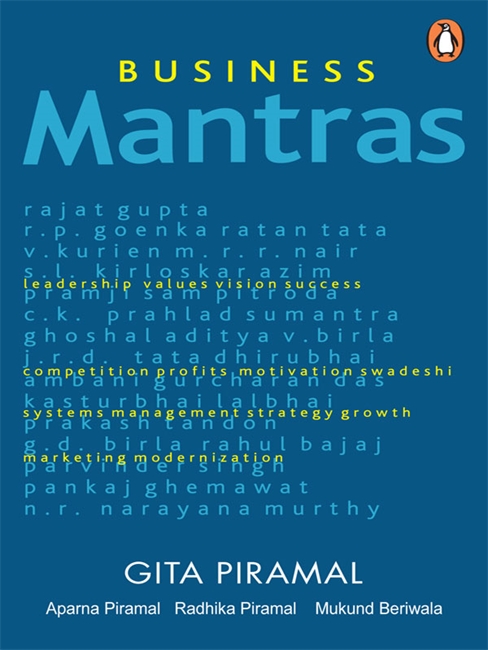
Business Mantras, business at it best,Why are some people more successfull than others?,What drives super achievers?,How is their thinking radically diffrent?What does vision mean and how important are values?These are some of the issues covered in this punchy collection of Business WISDOM from the finest minds in industry and management. Including here are G.D. Birla, J.R.D. Tata, Azim Premji, N.R. Narayana Murthy, V. Kurien, Sumantra Ghoshal et al. Their perceptive Observations on management skills, growth and Motivation are of special relevance in the Context of a globalizing Economy and make this collection, carefully edited by leadin business athor Gita Piramal and Mukund Beriwala, a one-stop guide to business success.
Rethinc
Corporations are crucial to society’s well-being. Yet, not many have chosen to adapt themselves to the expectations of employees and society at large in the times we live. In Rethinc, Ram Mohan identifies the three main problems that ail companies, and proposes ways in which these can be combated. Most companies are still run from the top and make next to no attempts to involve employees at the lower levels in decision-making. Executive compensation has spiralled steeply in recent years because the process of determining it is seriously flawed. Boards of directors are ineffective and have abetted the cult of the charismatic CEO who is expected to work wonders.
Rethinc contends that the solution lies in the near-total dismantling of hierarchy or the creation of a ‘bossless’ organization. In such an organization, the structure is flat, employees operate through self-driven teams, there is peer review, freedom to express oneself, power rests on one’s contribution and not one’s title, and the organizational purpose goes beyond the making of profit. There are limits on variable pay linked to performance and pay is more egalitarian. Board effectiveness is ensured through a very different process of selection of independent directors. The office of the CEO is demystfied, and it is the system that is the star, not the individual. Once all this is done, we will have an successful organization that is also a humane organization-an organization in which the employees are raring to get to work every day.
Funding Your Startup
Are you finding it tough to fund your start-up? Especially in the post-COVID-19 world, where money is scarce? Well, then, this book is for you.
It takes you through stories of early-stage start-ups and how they successfully managed to raise funding. Even better, it takes you through stories of failures-start-ups that couldn’t raise funding, and why. After all, you can learn as much from failures as you can from successes.
The authors also inter view some of the most accomplished founders in the world of business, such as Deep Kalra of
MakeMyTrip, Yashish Dahiya of PolicyBazaar, Dinesh Agarwal of IndiaMART and Sairee Chahal of SHEROES. Their stories
all come together in a useful ‘PERSISTENT’ framework, which helps make a start-up investment-ready.