



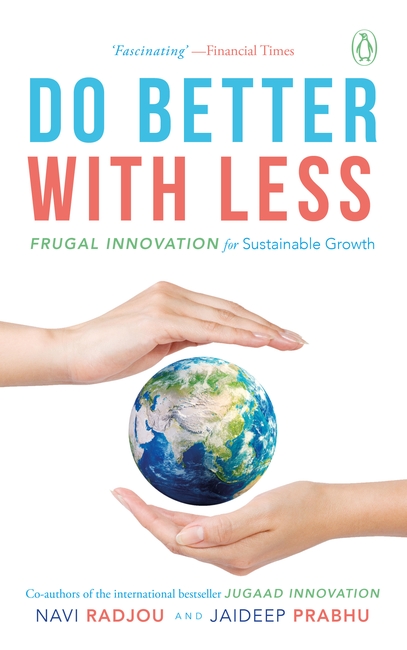
This groundbreaking book, by the bestselling authors of Jugaad Innovation, shows how India can harness the three megatrends — the sharing economy, the maker movement and the circular economy — and disruptive technologies such as AI and 3D printing to generate jobs and drive inclusive and sustainable growth in the decades to come.
The world faces a stark challenge: meeting the needs of over 7 billion people without bankrupting the planet. India, with its large population and limited resources, is at the very epicentre of this challenge. It also offers a creative way out. Its resilient jugaad mindset, dynamic ecosystem of start-ups and enterprises, and the practice of NGOs and governments working together promises not only to meet its own requirements in a sustainable way but also the needs of billions around the world.
Packed with over fifty case studies, Do Better with Less offers six proven principles that Indian entrepreneurs and businesses can use to co-create frugal solutions in education, energy, healthcare, food and finance that are highly relevant to India and the world.
This book is India’s guide to claiming global leadership in frugal innovation.
Catagory: Business & Economics
The Lost Decade (2008-18)
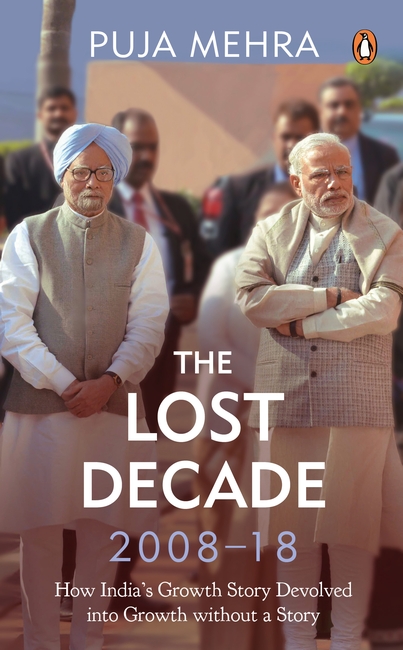
Before the global financial meltdown of 2008, India’s economy was thriving and its
GDP growth was cruising at an impressive 8.8 per cent. The economic boom impacted
a large section of Indians, even if unequally. With sustained high growth over an extended
period, India could have achieved what economists call a ‘take-off’ (rapid and
self-sustained GDP growth). The global financial meltdown disrupted this
momentum in 2008.
In the decade that followed, each time the country’s economy came close to returning
to that growth trajectory, political events knocked it off course.
In 2019, India’s GDP is growing at the rate of 7 per cent, making it the fastest-growing
major economy in the world, but little on the ground suggests that Indians are actually
better off. Economic discontent and insecurity are on the rise, farmers are restive and
land-owning classes are demanding quotas in government jobs. The middle
class is palpably disaffected, the informal economy is struggling and big businesses
are no longer expanding aggressively.
India is not the star it was in 2008 and in effect, the ‘India growth story’ has devolved
into ‘growth without a story’. The Lost Decade tells the story of the slide
and examines the political context in which the Indian economy failed to recover
lost momentum.
The Great Disappointment
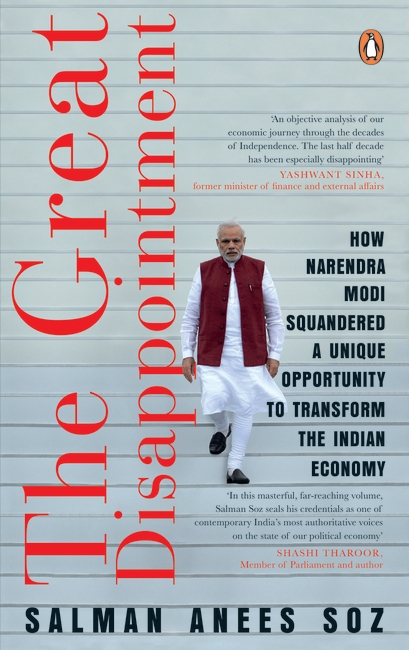
As the National Democratic Alliance (NDA) government completes its current term ahead of the General Elections 2019, it is time to evaluate its performance, specifically in terms of its management of the economy. This book is a critical assessment of five years of the brand of economics Prime Minister Narendra Modi has championed, often referred to as ‘Modinomics’.
Brought into power with the biggest political mandate in almost three decades, did the NDA government succeed in gainfully transforming India’s economic trajectory or did it squander a once-in-a-generation opportunity? The book conjectures it is the latter, and analyses why the Modi government’s stewardship of the economy is a ‘great disappointment’.
Kalam on Progress
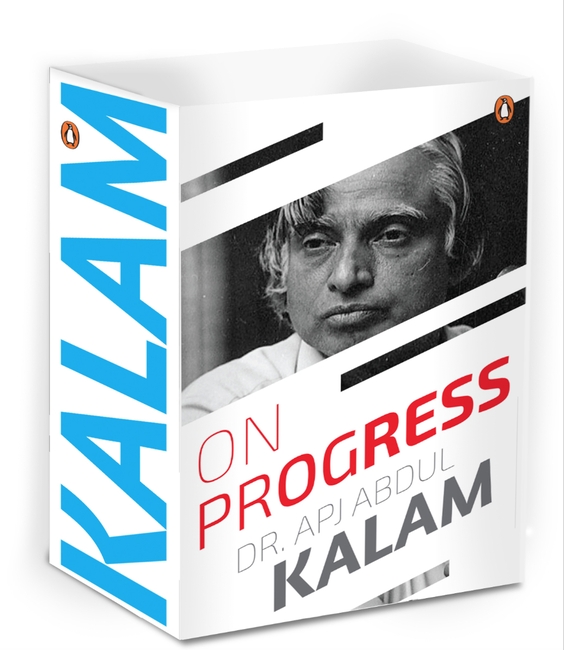
The box set contains:
Target 3 Billion: Innovative Solutions Towards Sustainable Development:
The book talks about the 3 billion people across the globe who live in villages and are often deprived of basic resources. It integrates the challenges and opportunities of the present human civilization and elaborates on providing Urban Amenities in Rural Areas (PURA), a sustainable and environment-friendly system that will uplift the rural masses. The authors pose the question-what can I do to empower 3 billion people? The answers have been provided from the perspectives of citizens, students and senior citizens.
India 2020: A Vision for the New Millennium:
The authors offer a blueprint for India to be counted among the world’s top five economic powers by the year 2020. They cite growth rates and development trends to show that the goal is not unrealistic. Past successes-the green revolution and satellite-based communication linking remote regions of the country, for instance bear them out.
Beyond 2020: A Vision for Tomorrow’s India:
Kalam and Rajan argue that a renewed policy focus is now needed for agriculture, manufacturing, mining, the chemicals industry, healthcare and infrastructure to invigorate these sectors and boost economic growth. India can still make it to the list of developed nations in a decade.
The Inheritors

Why did Harsh Mariwala leave his family business?
Why did the Burman family quit the day-to-day operations of Dabur?
How did the Dhingras turn a collapsing business into India’s second-largest paint company?
The Inheritors offers a fascinating behind-the-scenes look at what goes on in Marico, Dabur, Keventers, Berger Paints, Select Group, Antara, Cyril Amarchand Mangaldas, Luxor and Motilal Oswal. The book focuses on culture, family politics, ego battles, business rivalries and a lot more. And then, of course, there are the inheritors themselves-some take the businesses to even greater heights while others lead them to doom.
My Seditious Heart

Twenty years, a thousand pages, and now a single beautiful edition of Arundhati Roy’s complete non-fiction.
My Seditious Heart collects the work of a two-decade period when Arundhati Roy devoted herself to the political essay as a way of opening up space for justice, rights and freedoms in an increasingly hostile environment. Taken together, these essays trace her twenty year journey from the Booker Prize-winning The God of Small Things to the extraordinary The Ministry of Utmost Happiness: a journey marked by compassion, clarity and courage. Radical and readable, they speak always in defence of the collective, of the individual and of the land, in the face of the destructive logic of financial, social, religious, military and governmental elites.
In constant conversation with the themes and settings of her novels, the essays form a near-unbroken memoir of Arundhati Roy’s journey as both a writer and a citizen, of both India and the world, from ‘The End of Imagination’, which begins this book, to ‘My Seditious Heart’, with which it ends.
The Reluctant Billionaire
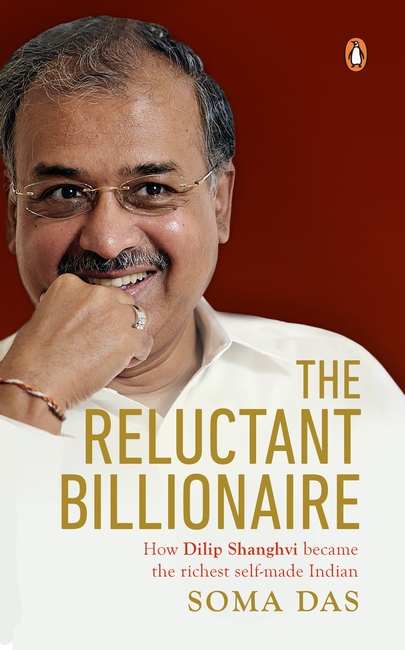
NOMINATED FOR TATA LITERATURE LIVE AWARDS AND SHORTLISTED FOR GAJA CAPITAL BEST BUSINESS BOOK PRIZE
The book is an untold human story of an enterprise and its creator, Dilip Shanghvi, who raced ahead of Mukesh Ambani to become the richest Indian in 2015
Shanghvi is one of the most interesting and least understood business minds of India whose journey has been shrouded in mystery because of his reticence.
The book reveals the riveting story of the fiercely intense personality that lies beneath his calm demeanour. Based on interviews with over 150 friends, family members, rivals, former aides and Shanghvi himself, it traces his transformation from a quiet, curious child working in his father’s small shop to an astute strategist, who built India’s largest pharma company, Sun Pharma, despite being untrained in science.
The tale unravels his contrarian and controversial bets that made Sun a global force, and him a ‘turn-around’ artist. It is also about the friends and family Shanghvi started his company with, the hurt and emotional conflicts surrounding their separation, and how Shanghvi staked his closest relationships to professionalize Sun.
This book is an extraordinary story of an ordinary man, who chooses to stay anti-famous. He would rather have his face unrecognized, his story untold. But at a time, when a billion dreams are simmering in an aspiring India, this tale is for everyone who has once had a secret dream, an insanely bold one.
The Rise of Goliath
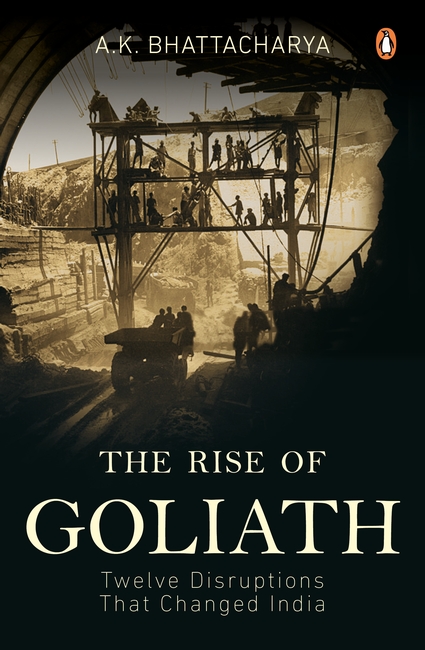
What can best illustrate India’s journey in the last seven decades? Disruptions.
Almost every decade of India’s history since Independence has been marked by major disruptions.
India became independent through an act of disruption-Partition-that killed millions in communal violence and turned many more into refugees. The turn towards a model of state-led economic development delivered as big a shock to the economy as did the food crisis or the spike in crude oil price. If the Emergency in 1975 shook the foundations of India’s democracy, the unprecedented balance-of-payments crisis of 1990 turned India towards a path of economic reforms. Just as the reservation of jobs for backward castes changed the idiom of India’s politics, the movement for building a temple for Ram drove India closer to becoming a majoritarian state. No less disruptive have been the telecom revolution, the banking crisis, demonetization and the launch of the goods and services tax.
How did these disruptions impact India? How did they influence the rise of this Goliath?
This is the story of twelve disruptions that changed India. The book also provides a peek into the kind of disruptions India could face in the coming years.
The Making of Star India
When Rupert Murdoch, executive chairman, News Corporation, blew up more than $870 million buying Star TV from Richard Li in the early 1990s, analysts were dismayed. Why on earth had Murdoch invested in a pan-Asian broadcaster that was neither fish nor fowl?
More than twenty-five years later, with revenues of over $2 billion, Star India is one of the country’s three largest media firms. Murdoch’s instinct had done what a hundred investor summits could not: showcased the potential of the Indian media market to the world. Vanita Kohli-Khandekar tells the thrilling story of Indian television through its most notable protagonist: Star TV. The narrative is peppered with delicious anecdotes and a fascinating cast of characters that includes Rathikant Basu, Peter Mukerjea, Uday Shankar, Sameer Nair and the Murdochs, who loom large over every scene.
The Tata Saga
How did Jamsetji Tata win over British resistance to start Tata Steel?
How did JRD lose control of Air India?
Why did Ratan Tata face opposition to become the chairman of Tata Sons?
What happened inside the Taj Hotel on 26/11?
The Tata Saga is a collection of handpicked stories published on India’s most iconic business group. The anthology features snippets from the lives of various business leaders of the company: Ratan Tata, J.R.D. Tata, Jamsetji Tata, Xerxes Desai, Sumant Moolgaokar, F.C. Kohli, among others. There are tales of outstanding successes, crushing failures and extraordinary challenges that faced the Tata Group.
These riveting business stories, by some of India’s top writers on the subject, bear testament to the ruthless persistence and grit of the Tata Group and make for an incredible collector’s edition.