Day to Day Economics is an enjoyable, accessible, and extremely user-friendly book that explains the modern day Indian economy to the layperson.
The economy isn’t just for the economists to debate on. All of us are affected by its ups and downs-global recession, rise in interest rates, or hike in food prices. But do we understand the principles at work and how and why they really affect us?
In this must-read finance book, Professor Deodhar explains the role of the government and its involvement in different aspects of the economy; the need for the RBI and its functions; and how taxes, stock markets, and recessions work. Day to Day Economics will help you go beyond the facts and figures in the budget and connect the trends to your daily life. As with all IIMA Business Books, it comes illustrated with numerous Indian examples and case studies making this the ultimate rookie’s guide to the Indian economy.

What qualities do you need to be a successful manager, and how can you develop the qualities you already possess? Managers Who Make a Difference examines how managers’ perceptions about themselves shape their behaviour at work, and studies the ways in which people can translate their ambition, sense of purpose, perseverance, confidence, and resourcefulness into successful management. How can you train yourself to spot competences in others and build on them to create an effective team? How do you achieve the right balance between adherence to existing systems, and creative or experimental problem-solving? And do you have the people skills-the ability to network extensively and build trust-based relationships-required to be a leader? Richly illustrated with anecdotes and experiences of well-known managers, and with a broad array of tips and self-assessment tools to sharpen your management skills, this book is a must read for all practising and aspiring managers. The IIM Ahmedabad Business Books bring key issues in management and business to a general audience. With a wealth of information and illustrations from contemporary Indian businesses, these non-academic and user-friendly books from the faculty of IIM Ahmedabad are essential corporate reading.

This is the story of Bandhan, the only bank that emerged in eastern India after Independence. Founded by the son of a sweet vendor, with a mere Rs 2 lakh, the sum total of his life savings.
On 17 June, 2015, Chandra Shekhar Ghosh stepped out of the Reserve Bank of India building in Mumbai with the much-coveted banking licence, beating some of the country’s top corporate houses. This moment compensated for all the frustrations that had come along the way. A year later, Bandhan Bank was launched with 6.7 million small borrowers.
So, how did Ghosh build India’s biggest MFI from scratch and then, along with his team, transform it into a universal bank? Bandhan: The Making of a Bank chronicles that journey.
This is also Ghosh’s personal story-of a boy growing up in small-town Agartala struggling with poverty, but relentless in his ambition to make it big. He battles competition, hostile moneylenders, a tough economic climate and the perpetual lack of resources. Nobody in India perhaps knows better than him the psyche of a small borrower and the alchemy of doing business with the poor, profitably.
This is one of India’s biggest entrepreneurial stories.
One of the most exciting feelings in the world is when you take the leap to become an entrepreneur and launch your own start-up. However, there are a couple of obvious questions that come to your mind when you take that entrepreneurial plunge: What are the things you should plan ahead for? What are the pitfalls you need to watch out for?
In Entrepreneurship Simplified, Ashok Soota and S.R. Gopalan not only answer these questions but also distil their decades of experience into a concise, comprehensive and practical guide for every aspiring entrepreneur, as well as for those who have already embarked on their entrepreneurial journey. From idea generation and validation to raising funds and dealing with VCs, from building the organization and its mission, vision and values, defining a business and marketing strategy to creating and sharing wealth and, finally, taking your company public through an IPO – Soota and Gopalan discuss the entire gamut of the entrepreneurial experience.
Full of anecdotes, practical wisdom and key takeaways, Entrepreneurship Simplified is the definitive book on the subject that replicates the passion, fun and sense of fulfilment that accompany the start-up adventure.

The Case of the Bonsai Manager is the perfect antidote for managers who feels they are not achieving their full potential.Effective leadership is not just about hard facts but also about listening to, and using, your intuition. Using anecdotes from nature and the world of management, R.Gopalakrishnan explores how you can be more intuitive, inclusive and humane.
The revised and updated edition of this bestselling book, with its easy to read anecdotal style, adds additional material to re-enforce the key messages, including a new self-help workbook.

Every year, top performers join management ranks in their companies. As they assume their new roles, managers often receive inadequate training on adopting the right mindsets and behaviors to succeed.
Combining his experience as the founder and CEO of MAQ Software, with research by leading management thinkers such as Peter Drucker and Henry Mintzberg, Rajeev Agarwal offers insights on key issues faced by managers, including motivating team members, what a manager does and why they are so busy, how to delegate, train a team, provide feedback, retain employees and whether pay matters
Whether you are a recent MBA graduate or an aspiring manager, What I Did Not Learn in B-School provides useful tools to set you on the path to managerial success.

How did the Indian banking industry protect itself from the Lehman crash?
What nearly wiped out the MFI sector in India?
Why are public-sector banks suffering from a large pile of NPAs?
What is the conflict between the RBI and the finance ministry?
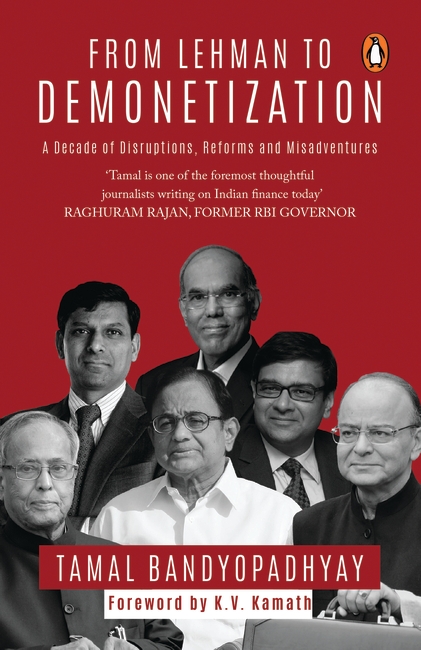
From Lehman to Demonetization is the epic story of banking in India in the last decade. The years from 2007 to 2017 were the most tumultuous and exciting time for this sector, which saw D. Subbarao, Raghuram Rajan and Urjit Patel as RBI governors working with finance ministers Pranab Mukherjee, P. Chidambaram and Arun Jaitley.
What a decade it has been-from India’s first MFI, SKS Microfinance, entering the capital market to the near death of the industry; the RBI giving the nod to twenty-three banks and becoming an inflation targeter; from 9 per cent economic growth for three consecutive years to the jolt of demonetization.
Featuring essays and interviews with the who’s who of this sector, including Deepak Parekh, K.V. Kamath, Arundhati Bhattacharya, Chanda Kochchar, Aditya Puri, Shikha Sharma, Raghuram Rajan, U.K. Sinha and Viral Acharya, this book makes for a riveting read.
If you had to read one book on banking in India, let this be it!
A good job, hard work, IQ, EQ, good communication skills-these are all ingredients for a successful life. The presence of these elements alone, however, does not guarantee success. To convert them into long-term success, you need certain stimuli which precipitate or accelerate your growth. This robustly effective book identifies the various catalysts that you can cultivate and how you can leverage them to propel yourself in your work and life.
Accessible, engaging and easy to follow, and written by someone who has experienced all this in real life and not in theory, Catalyst will arm you with the right tools to succeed at your work place and get the most out of every moment, every day.
Chanakya’s Arthashastra is an unrivalled political treatise that has been used by scholars, academics and leaders across the world. In Chanakya and the Art of Getting Rich, Radhakrishnan Pillai brings out the inherent lessons from Arthashastra to present a strategic and practical way of wealth creation. This is a holistic study, written for anyone and everyone.
In The High Performance Entrepreneur, Subroto Bagchi draws from his own experiences to offer guidance from the idea stage to the initial public offering level. This includes deciding when one is ready to launch an enterprise, selecting a team, defining the values and objectives of the company, writing the business plan, choosing the right investors, managing adversity and building the brand. Additionally, in an especially illuminating chapter, Bagchi recounts the systems and values which have brought Indian IT companies on a par with the best in the world. High-performance entrepreneurs create great wealth, for themselves as well as for others. They provide jobs, which are crucial for an expanding workforce, and drive innovation. More than a guide, this book will tap the entrepreneurial energy within you.