The earthly King Pururavas rescues the celestial nymph Urvashi from a demon, and thus begins a majestic love story that brings heaven and earth together. Both are struck with Kama’s arrow in their very first meeting, but each shies away from saying anything because the distance between them seems insurmountable. Even when they do confess their love, magical transformations and heavenly curses keep the lovers apart. Will Pururavas succeed in his quest for Urvashi?
A magnificent drama based on an episode from the Rig Veda, Vikramorvashiyam is filled with dramatic turns of event, music and dance. The scenes, characters and dialogues are at once lively and theatrical as well as sensitive and speculative. Believed to be the second of Kalidasa’s three plays, Vikramorvashiyam is an undisputed classic from ancient Indian literature. A.N.D. Haksar’s brilliant new translation gives contemporary readers an opportunity to savour this delightful tale.

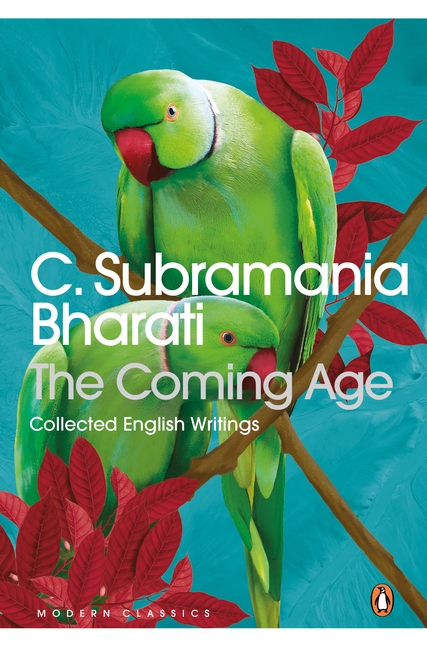
C. Subramania Bharati (1882-1921) has an unrivalled reputation in twentieth-century Tamil literature and has come to be known as the Tamil ‘Mahakavi’, meaning ‘Supreme Poet’. His work as a poet and prose-writer ignited a Renaissance in modern Tamil writing. However, he also wrote and published regularly in English.
The Coming Age brings together Bharati’s important English writings in an authoritative and reliable edition presented by his great-granddaughter. The pieces in this volume reveal a well informed and cosmopolitan writer, engaging with the world around him, passionately sharing his opinions.
Exploring Indian history and culture, offering a shattering contemporary view of the colonial experience, commenting on political events, advocating for women’s rights and caste equality, and sharing his deep knowledge of the Tamil language and literary tradition, these pieces present Bharati in a new light for a new generation.

Crafted with extraordinary vision and forged through intense debate, The Constitution of India stands as one of humanity’s most remarkable experiments in democratic nation-building. Adopted on 26 January 1950, this foundational text not only establishes the foundational structure of India but also enshrines the ideals of justice, liberty, equality and fraternity for more than a billion citizens.
This Penguin luxury edition presents The Constitution of India as both a legal charter and a moral compass—an evolving document that continues to shape India’s political, social and cultural life. Readers will discover the profound balance it strikes between individual rights and collective responsibilities, the federal framework that binds a diverse nation, and the guiding principles that empower institutions while safeguarding citizens.
Whether you are a student, a scholar, or a curious reader, this edition of The Constitution of India, accompanied by a comprehensive contextual introduction, invites you to engage with the living heartbeat of the Republic—a masterpiece of governance, hope and enduring democratic aspiration.

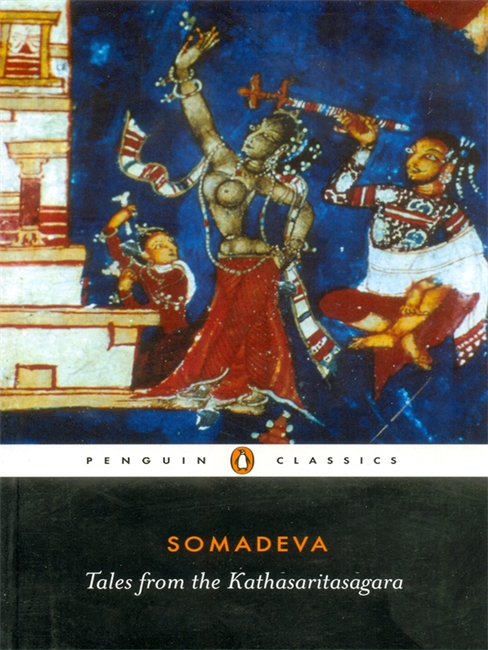
The vast ocean of stories that influenced storytelling the world over ‘The Kathasaritasagara’ is said to have been compiled by a Kashmiri Saivite Brahmin called Somadeva in AD 1070, although the date has not been conclusively established. Legend has it that Somadeva composed the Kathasaritasagara for Queen Suryavati, wife of King Anantadeva who ruled Kashmir in the eleventh century. The stories in this book are retold from ten of the eighteen books of the original Kathasaritasagara. The most remarkable feature of the Kathasaritasagara is that unlike other texts of the time, it offers no moral conclusions, no principles to live by and is throughout a celebration of earthly life. The tale of Naravahanadatta, the prince of the vidyadharas, the sky-dwellers with magical powers, comprises the main narrative and is used as an outer frame to introduce the stories in the text. Promiscuous married women and clever courtesans, imbecile Brahmins, incompetent kings and wise ministers, wicked mendicants and holy ascetics, cursed men and men who are granted boons, evil non-human creatures and friendly magical beings, all jostle for attention in Arshia Sattar’s masterful translation of this timeless collection of tales.

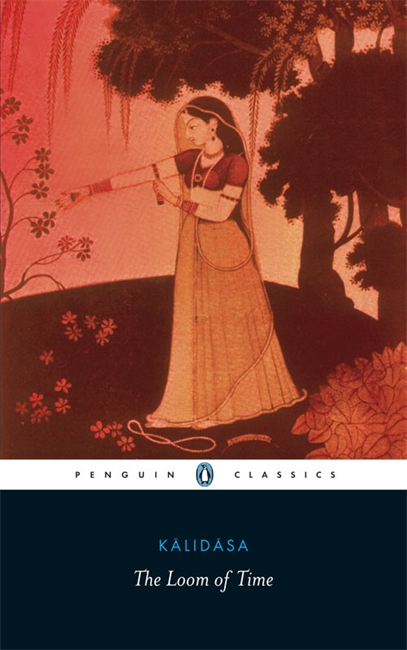
Kalidasa is the greatest poet and playwright in classical Sanskrit literature and one of the greatest in world literature. Kalidasa is said to have lived and composed his work at the close of the first millennium BC though his dates have not been conclusively established. In all, seven of his works have survived: three plays, three long poems and an incomplete epic. Of these, this volume offers, in a brilliant new translation, his two most famous works, the play Sakuntala, a beautiful blend of romance and fairy tale with elements of comedy; and Meghadutam (The Cloud Messenger), the many-layered poem of longing and separation. Also included is Rtusamharam (The Gathering of the Seasons), a much-neglected poem that celebrates the fulfillment of love and deserves to be known better. Taken together, these works provide a window to the remarkable world and work of a poet of whom it was said: Once, when poets were counted, Kalidasa occupied the little finger; the ring finger remains unnamed true to its name; for his second has not been found
An extraordinary detailed manual on statecraft and the science of living by one of classical India’s greatest minds; Kautilya; also known as Chanakya and Vishnugupta; wrote the Arthashastra not later than 150 AD though the date has not been conclusively established. Legend has it that he was either a Brahmin from Kerala or from north India; however; it is certain that Kautilya was the man who destroyed the Nanda dynasty and installed Chandragupta Maurya as the King of Magadha. A master strategist who was well-versed in the Vedas and adept at creating intrigues and devising political stratagems; Kautilya’s genius is reflected in his Arthashastra which is the most comprehensive treatise of statecraft of classical times.
The text contains fifteen books which cover numerous topics viz.; the King; a complete code of law; foreign policy; secret and occult practices and so on. The Arthashastra is written mainly in prose but also incorporates 380 shlokas.
Artha; literally wealth; is one of four supreme aims prescribed by Hindu tradition. However; it has a much wider significance and the material well-being of individuals is just a part of it. In accordance with this; Kautilya’s Arthashastra maintains that the state or government of a country has a vital role to play in maintaining the material status of both the nation and its people. Therefore; a significant part of the Arthashastra has to do with the science of economics. When it deals with the science of politics; the Arthashastra describes in detail the art of government in its widest sense-the maintenance of law and order as also of an efficient administrative machinery.

Ascribed to Kautilya (commonly identified as the prime minister of Chandragupta Maurya) and dating back more than 2,000 years, the Arthashastra is the world’s first manual in political economy. It has a pre-eminence in Indian thought that is akin to that of Machiavelli’s The Prince in Europe. Arthashastra (literally, ‘the science of wealth’) is a study of economic enterprise; specifically, Kautilya’s treatise advises the king on the business of creating prosperity. This ancient text provides a fascinating window into the social and economic structures of the time, and into the intricacies of statecraft—for the Arthashastra also addresses the question: what makes a good leader? This book is intended to be an introduction to the economic philosophy of the Arthashastra. Its goal is to analyse the relevance of this classic text in its own time—in a world in which kings were regulators of economic activities of their subjects, but also entrepreneurs themselves—in the conviction that it has much to teach us that has value in our own age
As a young boy, Amitav Ghosh’s narrator travels across time through the tales of those around him, traversing the unreliable planes of memory, unmindful of physical, political and chronological borders. But as he grows older, he is haunted by a seemingly random act of violence. Bits and pieces of stories, both half-remembered and imagined, come together in his mind until he arrives at an intricate, interconnected picture of the world where borders and boundaries mean nothing, mere shadow lines that we draw dividing people and nations.
Out of a complex web of memories, relationships and images, Amitav Ghosh builds an intensely vivid, funny and moving story. Exposing the idea of the nation state as an illusion, an arbitrary dissection of people, Ghosh depicts the absurd manner in which your home can suddenly become your enemy.