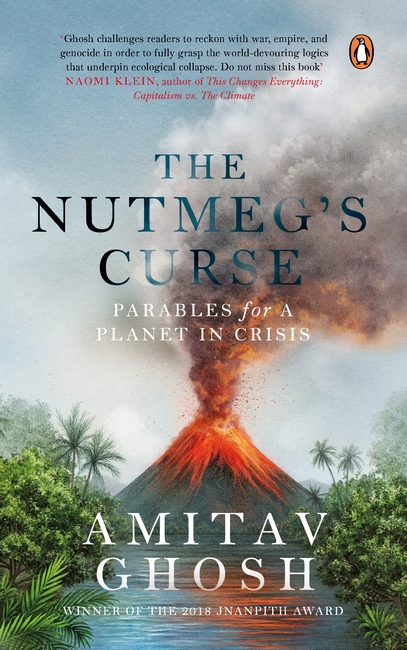
Before the 18th century, every single nutmeg in the world originated around a group of small volcanic islands east of Java, known as the Banda Islands. As the nutmeg made its way across the known world, they became immensely valuable – in 16th century Europe, just a handful could buy a house. It was not long before European traders became conquerors, and the indigenous Bandanese communities – and the islands themselves – would pay a high price for access to this precious commodity. Yet the bloody fate of the Banda Islands forewarns of a threat to our present day.
Amitav Ghosh argues that the nutmeg’s violent trajectory from its native islands is revealing of a wider colonial mindset which justifies the exploitation of human life and the natural environment, and which dominates geopolitics to this day.
Written against the backdrop of the pandemic and the Black Lives Matter protests, and interweaving discussions on everything from climate change, the migrant crisis, and the animist spirituality of indigenous communities around the world, The Nutmeg’s Curse offers a sharp critique of Western society, and reveals the profoundly remarkable ways in which human history is shaped by non-human forces.

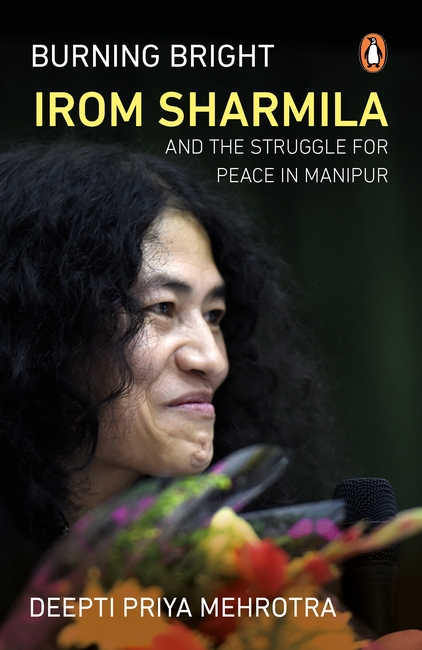
The true story of the ‘Iron Lady of Manipur’ who fasted for 16 years against AFSPA
Ten innocent people were mowed down by security forces in Malom, a village near Imphal, in November 2000. The perpetrators were not punished, protected under the Armed Forces Special Powers Act which empowers military and para-military personnel to arrest, shoot, even kill, anyone on the grounds of mere suspicion. In response to this tragedy–one among many such atrocities–Irom Sharmila, a young Manipuri, began an indefinite hunger strike. The government arrested her and force-fed her through nasal tubes. She was released and re-arrested innumerable times, but she stood by her demand. In July 2016, Irom brought her sixteen years of hunger strike to an end, and decided to contest the elections.
Burning Bright is a hard-hitting account of a people caught between the crossfire of militants and security forces; of a once-sovereign kingdom whose culture has been brutally violated; of the many voices of dissent-from underground groups to the Meira Paibis, a women’s movement opposed to all forms of violence whether by the state or insurgents and a moving portrait of ‘the Iron Lady of Manipur’.

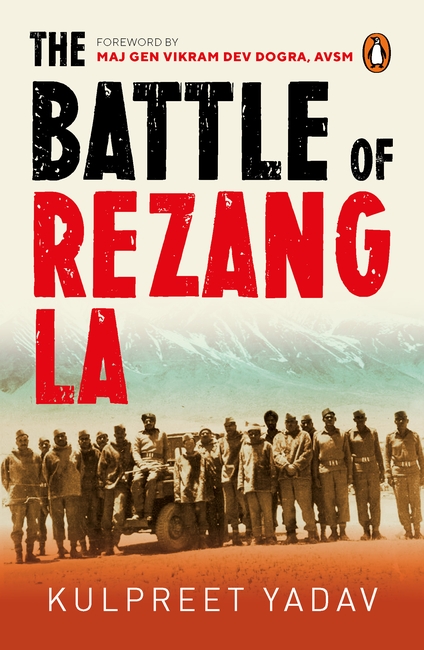
On 18 November 1962, the Charlie Company of the 13 Kumaon Battalion, Kumaon Regiment, fought a Chinese attack at Rezang La Pass in Ladakh, India. The company comprised 120 soldiers and was led by Maj. Shaitan Singh. Of these soldiers, 110 were martyred in the attack.
The Indian search party, which visited the battlefield on 10 February 1963, made a startling discovery-the frozen bodies of the men who had died were still holding guns in their hands, having taken bullets on their chests. One PVC (Param Vir Chakra), eight VCs (Vir Chakras), four SMs (Sena Medals) and one M-in-D (Mentioned-in-Dispatches) were awarded to the soldiers of the Charlie Company, making it one of the highest decorated companies of the Indian Army to this day. The valour of the Charlie Company not only successfully stopped China’s advance, but it also resulted in the Chushul airport being saved, thereby preventing a possible Chinese occupation of the entire Ladakh region in 1962. According to reports, a total of 1300 Chinese soldiers were killed trying to capture Rezang La. The Charlie Company was an all-Ahir company, and most of the soldiers who fought the battle at 18,000 feet came from the plains of Haryana. The Battle of Rezang La is their story.

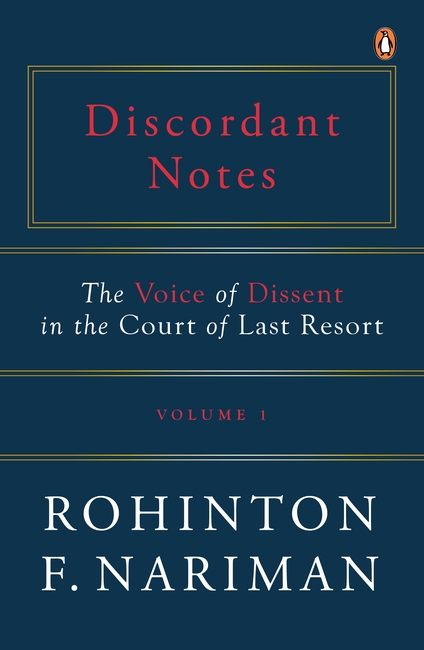
Comprehensive, definitive and authoritative, this is a must a must have for legal scholars and practitioners. Besides, the book will greatly interest policy makers as well as anyone, interested in India’s legal history.
A dissenting judgment, as ordinarily understood, is a judgment or an opinion of a judge, sitting as part of a larger bench, who ‘dissents’ (i.e. disagrees) with the opinion or judgment of the majority. Dissenting judgments or opinions appear in different ways.
Tracing, exploring and analysing all dissenting judgments in the history of the Supreme Court of India, from the beginning till date, Rohinton Fali Nariman brings to light the cases, which created a deep impact in India’s legal history. From the famous Bengal Immunity Co. Ltd. v. State of Bihar in 1955 to Bhagwandas Goverdhandas Kedia v. Girdharilal Pashottamdas and Co. in 1966, State of Bombay v. The United Motors (India) Ltd in 1953, Superintendent & Legal Remembrancer, State of West Bengal v. Corporation of Calcutta in 1967, Supreme Court Advocates-on-Record Association v. Union of India in 1993, Mafatlal Industries v. Union of India in 1997 and Pradeep Kumar Biswas v. Indian Institute of Chemical Biology in 2002, Keshava Madhava Menon v. State of Bombay in 1951, United Commercial Bank Ltd. v. Workmen and Ram Singh v. The State of Delhi in the same year and Union of India v. West Coast Paper Mills Ltd. in 2004 among others, this two-volume definitive work is a thorough examination of the important dissenting judgments of the Supreme Court of India, and of some of the Judges of the Supreme Court who have gone down as ‘Great Dissenters’, for having written dissents of legal and constitutional importance, some of which have gone on to be recognised as correct position of the law.
Comprehensive, definitive, and authoritative, this book brings to light the most significant dissenting judgments in the history of the Supreme Court of India. A must-have for all legal scholars and practitioners. Besides, the book will greatly interest policymakers as well as anyone, interested in India’s legal history.
A dissenting judgment, as ordinarily understood, is a judgment or an opinion of a judge, sitting as part of a larger bench, who ‘dissents’ (i.e. disagrees) with the opinion or judgment of the majority. Dissenting judgments or opinions appear in different ways.
Tracing, exploring and analysing all dissenting judgments in the history of the Supreme Court of India, from the beginning till date, Rohinton Fali Nariman brings to light the cases, which created a deep impact in India’s legal history. From the famous Bengal Immunity Co. Ltd. v. State of Bihar in 1955 to Bhagwandas Goverdhandas Kedia v. Girdharilal Pashottamdas and Co. in 1966, State of Bombay v. The United Motors (India) Ltd in 1953, Superintendent & Legal Remembrancer, State of West Bengal v. Corporation of Calcutta in 1967, Supreme Court Advocates-on-Record Association v. Union of India in 1993, Mafatlal Industries v. Union of India in 1997 and Pradeep Kumar Biswas v. Indian Institute of Chemical Biology in 2002, Keshava Madhava Menon v. State of Bombay in 1951, United Commercial Bank Ltd. v. Workmen and Ram Singh v. The State of Delhi in the same year and Union of India v. West Coast Paper Mills Ltd. in 2004 among others, this two-volume definitive work is a thorough examination of the important dissenting judgments of the Supreme Court of India, and of some of the Judges of the Supreme Court who have gone down as ‘Great Dissenters’, for having written dissents of legal and constitutional importance, some of which have gone on to be recognised as correct position of the law.

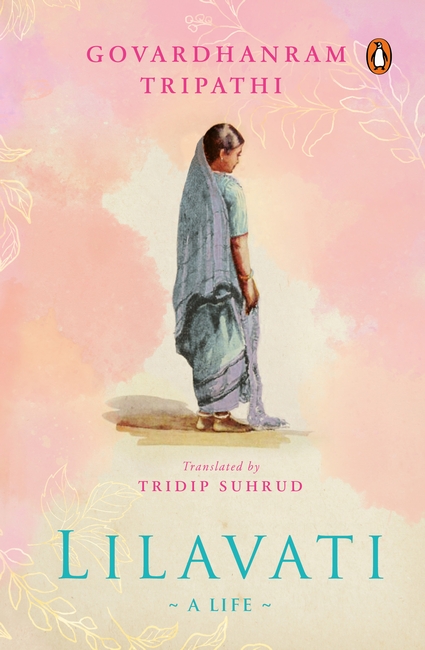
An exemplar of Indian literature-the only and heart-rending biography of a daughter by her father
In a moment of rare passion Govardhanram Madhavram Tripathi, author of Sarasvatichandra, exclaimed ‘I only want their souls’. He was referring to the souls of his countrymen and women, which he sought to cultivate through his literary writings. Lilavati was his and Lalitagauri’s eldest daughter. Her education and the writing of Sarasvaticandra were intertwined. She was raised to be the perfect embodiment of virtue, and died at the age of twenty-one, consumed by tuberculosis. In moments of ‘lucidity’ , she spoke of her suffering and that challenged the very foundations of Govardhanram’s life. In 1905 he wrote her biography, Lilavati Jivankala. This is a rare work in biographical literature, a father writing about the life of a deceased daughter. Despite Govardhanram’s attempts to contain Lilavati as a unidimensional figure of his imagination, she goes beyond that, sometimes by questioning the fundamental tenets of Brahminical beliefs, and at others by being so utterly selfless as to be unreal even to him.
Lilavati: A Life is a cross between literature in translation, social and political history, and women’s studies. Tridip Suhrud’s introduction dwells on the themes of the cultivation of selfhood, of nation and the ideal of sacrifice, which is sure to resonate with contemporary readership, especially women.
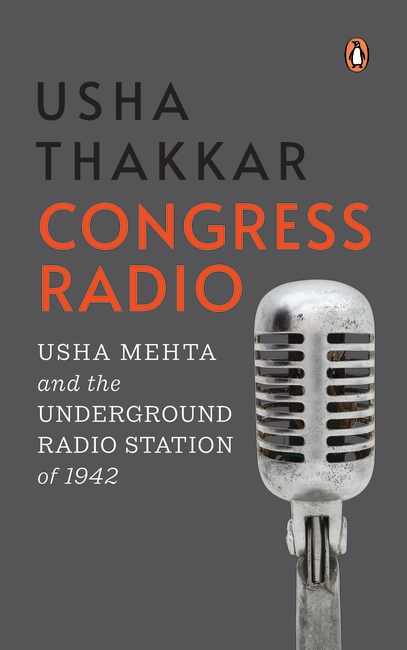
‘This is the Congress Radio calling on 42.34 metres from somewhere in India,’ Usha Mehta’s voice rang defiant and clear to the entire country on a ghost transmitter. These words would come to reverberate across the struggle for Indian independence.
It was August 1942. The Quit India Movement had just been launched at the Bombay session of the All-India Congress Committee by Mahatma Gandhi. Inspired by his rallying cry, the twenty-two-year-old student of Wilson College stumbled upon the idea to start an underground radio station to cut through the imperial din of the government’s mouthpiece, the All India Radio. Risking it all for country in the face of crackdown, Mehta and her intrepid co-conspirators filled Indian airwaves with the heady zeal of rebellion.
The clandestine station-Congress Radio-broadcast recorded messages from Gandhi and other prominent leaders to devoted followers of the freedom struggle. Moving from location to location to dodge authorities, reporting on events from Chittagong to Jamshedpur, the radio station fought the propaganda and disinformation of the colonial government for three months-until their arrest and imprisonment in November of the same year.
In this riveting account, Usha Thakkar brings to life this high-voltage tale of derring-do, complete with stouthearted revolutionaries, thrilling escapes and a cruel betrayal, through the extraordinary story of Usha Mehta, the woman who briefly became, quite literally, the voice of the resistance.

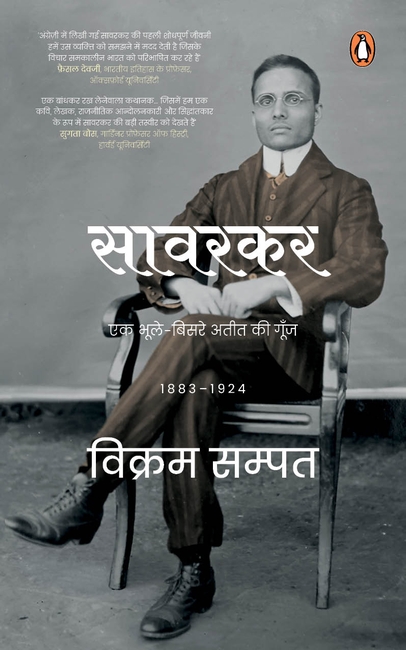
As the intellectual fountainhead of the ideology of Hindutva, which is in political
ascendancy in India today, Vinayak Damodar Savarkar is undoubtedly one of
the most contentious political thinkers and leaders of the twentieth century.
Accounts of his eventful and stormy life have oscillated from eulogizing
hagiographies to disparaging demonization. The truth, as always, lies
somewhere in between and has unfortunately never been brought to light.
Savarkar and his ideology stood as one of the strongest and most virulent
opponents of Gandhi, his pacifist philosophy and the Indian National Congress.
An alleged atheist and a staunch rationalist who opposed orthodox Hindu
beliefs, encouraged inter-caste marriage and dining, and dismissed cow worship
as mere superstition, Savarkar was, arguably, the most vocal political voice for
the Hindu community through the entire course of India’s freedom struggle. From
the heady days of revolution and generating international support for the cause
of India’s freedom as a law student in London, Savarkar found himself arrested,
unfairly tried for sedition, transported and incarcerated at the Cellular Jail, in the
Andamans, for over a decade, where he underwent unimaginable torture.
From being an optimistic advocate of Hindu-Muslim unity in his treatise on the
1857 War of Independence, what was it that transformed him in the Cellular Jail
to a proponent of ‘Hindutva’, which viewed Muslims with suspicion?
Drawing from a vast range of original archival documents across India and
abroad, this biography in two parts-the first focusing on the years leading up to
his incarceration and eventual release from the Kalapani-puts Savarkar, his life
and philosophy in a new perspective and looks at the man with all his
achievements and failings.
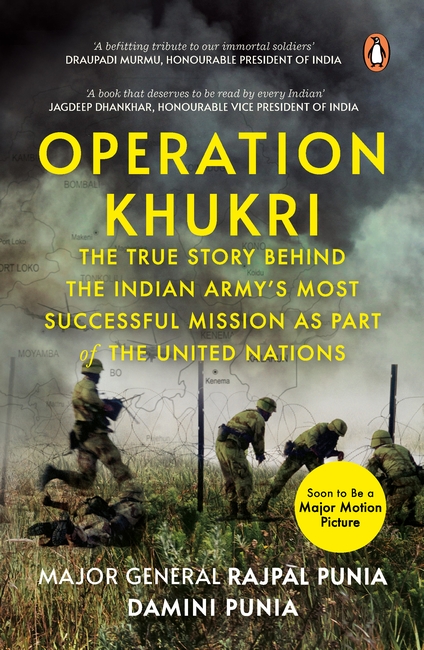
Did you know that 233 soldiers of the Indian Army were cordoned off for almost three months without food in the jungles of Africa?
How did a UN peacekeeping mission turn into a war for dignity, a war for the Indian tricolour?
The year was 2000. Sierra Leone, in West Africa, had been ravaged by years of civil strife. With the intervention of the United Nations, two companies of the Indian Army were deployed in Kailahun as part of a United Nations peacekeeping mission.
Soon, the peaceful mission turned into a war-like standoff between Major Punia’s company and the Revolutionary United Front (RUF) rebels in Kailahun, with the Indian peacekeepers cordoned off for seventy-five days without supplies. The only way home was by laying down their weapons.
Operation Khukri was one of Indian Army’s most successful international missions, and this book is a first-hand account by Major Rajpal Punia, who, after three months of impasse and failed diplomacy, orchestrated the operation, surviving the ambush of the RUF in a prolonged jungle warfare twice, and returning with all 233 soldiers standing tall.

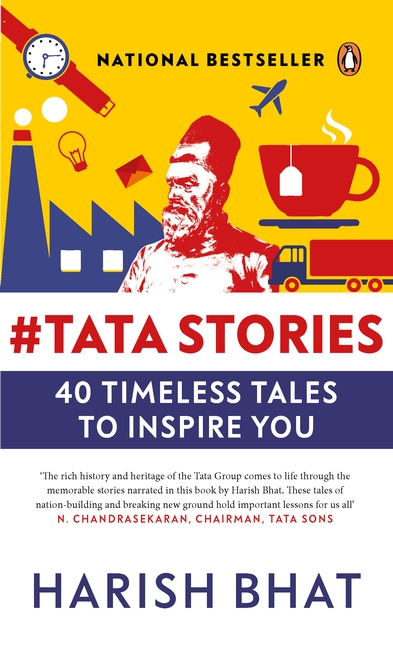
The Tatas have a legacy of nation-building over 150 years. Dancing across this long arc of time are thousands of beautiful, astonishing stories, many of which can inspire and provoke us, even move us to meaningful action in our own lives.
A diamond twice as large as the famous Kohinoor pledged to survive a financial crisis; a meeting with a ‘relatively unknown young monk’ who later went on to be known as Swami Vivekananda; the fascinating story of the first-ever Indian team at the Olympics; the making of India’s first commercial airline and first indigenous car; how ‘OK TATA’ made its way to the backs of millions of trucks on Indian highways; a famous race that was both lost and won; and
many more.
#TataStories is a collection of littleknown tales of individuals, events and places from the Tata Group that have shaped the India we live in today.