



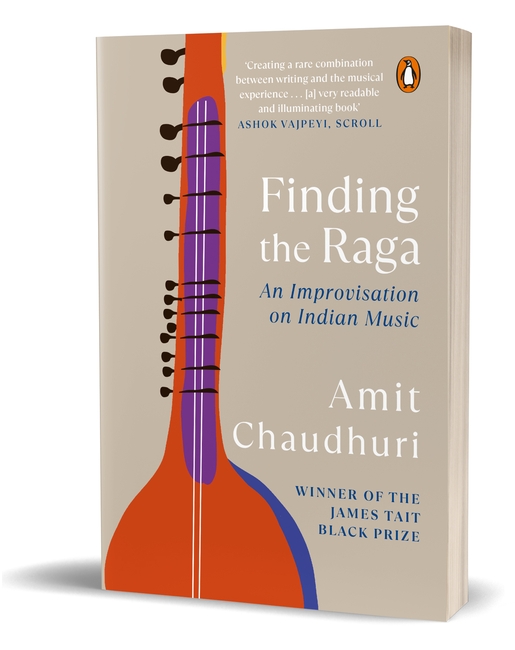
By turns essay, memoir and cultural study, Finding the Raga is Amit Chaudhuri’s singular account of his discovery of, and enduring passion for, North Indian music: an ancient, evolving tradition whose principles and practices will alter the reader’s notion of what music might – and can – be. Tracing the music’s development, Finding the Raga dwells on its most distinctive and mysterious characteristics: its extraordinary approach to time, language and silence; its embrace of confoundment, and its ethos of evocation over representation. The result is a strange gift of a book, for musicians and music lovers, and for any creative mind in search of diverse and transforming inspiration.
Catagory: History
Indians
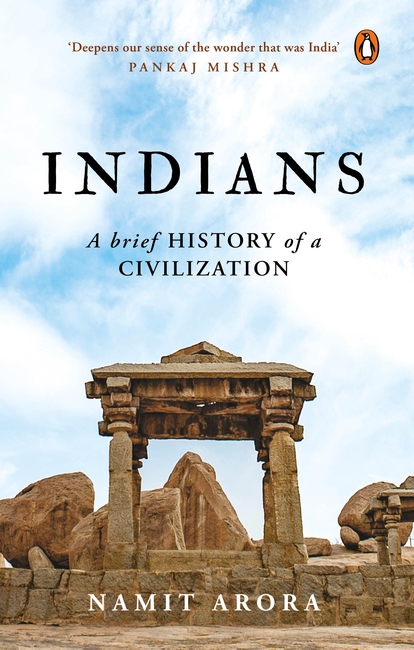
‘Deepens our sense of the wonder that was India’ ~ Pankaj Mishra
‘A gem of a book that is a joy to read . . . You can almost touch and feel the centuries and millennia as they pass by’ ~ Tony Joseph
‘Arora explores how Indians lived, ate, loved, built, fought and made sense of the material, rational and spiritual world down the ages . . . [A] mega-ambitious project’ ~ The Hindu
‘A wonderfully evocative book. Arora invites the reader to reflect on the past, without overwhelming her with dry historical facts but luring her in with vivid human stories’ ~ Prof. Mohan Rao
A BRILLIANT, ORIGINAL BOOK THAT REVEALS INDIA’S RICH AND DIVERSE HISTORIES
What do we really know about the Aryan migration theory and why is that debate so hot?
Why did the people of Khajuraho carve erotic scenes on their temple walls?
What did the monks at Nalanda eat for dinner?
Did our ideals of beauty ever prefer dark skin?
Indian civilization is an idea, a reality, an enigma. In this riveting book, Namit Arora takes us on an unforgettable journey through 5000 years of history, reimagining in rich detail the social and cultural moorings of Indians through the ages. Drawing on credible sources, he discovers what inspired and shaped them: their political upheavals and rivalries, customs and vocations, and a variety of unusual festivals. Arora makes a stop at six iconic places — the Harappan city of Dholavira, the Ikshvaku capital at Nagarjunakonda, the Buddhist centre of learning at Nalanda, enigmatic Khajuraho, Vijayanagar at Hampi, and historic Varanasi — enlivening the narrative with vivid descriptions, local stories and evocative photographs. Punctuating this are chronicles of famous travellers who visited India — including Megasthenes, Xuanzang, Alberuni and Marco Polo — whose dramatic and idiosyncratic tales conceal surprising insights about our land.
In lucid, elegant prose, Arora explores the exciting churn of ideas, beliefs and values of our ancestors through millennia — some continue to shape modern India, while others have been lost forever. An original, deeply engaging and extensively researched work, Indians illuminates a range of histories coursing through our veins.
Ghalib: A Wilderness at My Doorstep
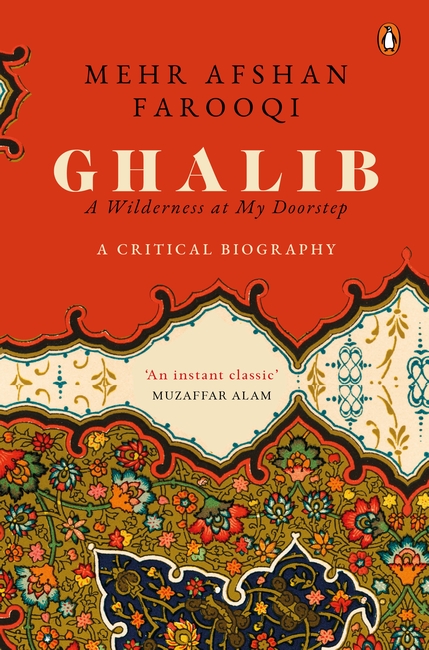
Mirza Asadullah Khan Ghalib was born in Agra in the closing years of the eighteenth century. A precocious child, he began composing verses at an early age and gained recognition while he was still very young. He wrote in both Urdu and Persian and was also a great prose stylist. He was a careful, even strict, editor of his work who took to publishing long before his peers. His predilection for writing difficult, obscure poetry peppered with complex metaphors produced a unique commentarial tradition that did not extend beyond his work. Commentaries on his current Urdu divan have produced a field of critical writing that eventually lead to the crafting of a critical lens with which to view the classical ghazal.
The nineteenth century was the height of European colonialism. British colonialism in India produced definitive changes in the ways literature was produced, circulated and consumed. Ghalib responded to the cultural challenge with a far-sightedness that was commendable. His imagination sought engagement with a wider community of readers. His deliberate switch to composing in Persian shows that he wanted his works to reach beyond political boundaries and linguistic barriers.
Ghalib’s poetic trajectory begins from Urdu, then moves to composing almost entirely in Persian and finally swings back to Urdu. It is nearly as complex as his poetry. However, his poetic output in Persian is far more than what he wrote in Urdu. More important is that he gave precedence to Persian over Urdu. Ghalib’s voice presents us with a double bind, a linguistic paradox. Exploring his life, works and philosophy, this authoritative critical biography of Ghalib opens a window to many shades of India and the subcontinent’s cultural and literary tradition.
Pakistan’s Terror Conundrum
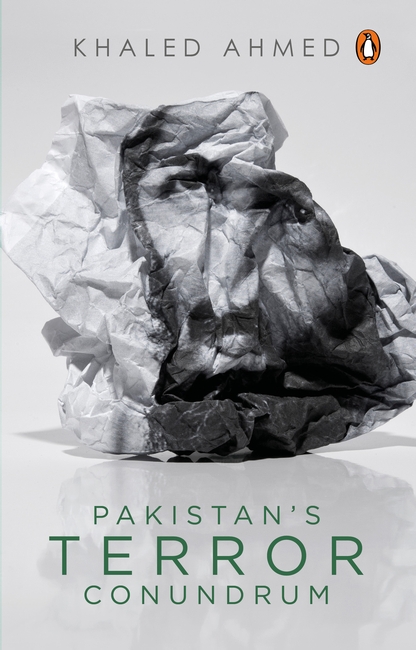
Pakistan was born amid communal violence and a collective consciousness of danger. Right from the outset, democracy was up for debate between the politicians nurtured by the British Raj and an orthodox clergy that advocated a utopia in which Islam was to be the ideological guide. Today, the threat of religion as an extra-legal force is causing many Pakistanis to think if the state can move forward into the future with Islam as its credo.
In this carefully curated collection of his writings in several publications, senior journalist Khaled Ahmed examines Pakistan’s policies regarding terrorism against the backdrop of increasing pressure from international organizations. Despite joining the US in its war against terror after 9/11, the country has been perceived as a safe haven and breeding ground for terrorists. Ahmed looks at the origins and activities of the various terrorist organizations, the role of the state and the ideology of its founding figures, some of whom seem to have been forgotten.
The Mahabharata
This definitive and magnificent 10-volume unabridged translation is one of the rare English translations of full of the epic. Bibek Debroy makes the Mahabharata marvelously accessible to contemporary readers. Dispute over land and kingdom may lie at the heart of this story of war between cousins-the Pandavas and the Kouravas-but the Mahabharata is about conflicts of dharma. These conflicts are immense and various, singular and commonplace. Throughout the epic, characters face them with no clear indications of what is right and what is wrong; there are no absolute answers. Thus every possible human emotion features in the Mahabharata, the reason the epic continues to hold sway over our imagination.
In this superb and widely acclaimed translation of the complete Mahabharata, Bibek Debroy takes on a great journey with incredible ease. This is the second volume in the series.
The Mahabharata
The Mahabharata is one of the greatest stories ever told. Though the basic plot is widely known, there is much more to the epic than the dispute between the Kouravas and Pandavas that led to the battle in Kurukshetra. It has innumerable sub-plots that accommodate fascinating meanderings and digressions, and it has rarely been translated in full, given its formidable length of 80,000 shlokas or couplets. This magnificent 10- volume unabridged translation of the epic is based on the Critical Edition compiled at the Bhandarkar Oriental Research Institute. Volume 1 consists of most of Adi Parva, in which much happens before the Kouravas and the Pandavas actually arrive on the scene. This volume covers the origins of the Kuru clan; the stories of Poushya, Poulama and Astika; the births of the Kouravas and the Pandavas; the house of lac; the slaying of Hidimba and Baka; Droupadi’s marriage; and ends with the Pandavas obtaining their share of the kingdom. Every conceivable human emotion figures in the Mahabharata, the reason why the epic continues to hold sway over our imagination. In this lucid, nuanced and confident translation, Bibek Debroy makes the Mahabharata marvellouly accessible to contemporary readers.
The Mahabharata
This definitive and magnificent 10-volume unabridged translation is one of the rare English translations of full of the epic. Bibek Debroy makes the Mahabharata marvelously accessible to contemporary readers. Dispute over land and kingdom may lie at the heart of this story of war between cousins-the Pandavas and the Kouravas-but the Mahabharata is about conflicts of dharma. These conflicts are immense and various, singular and commonplace. Throughout the epic, characters face them with no clear indications of what is right and what is wrong; there are no absolute answers. Thus every possible human emotion features in the Mahabharata, the reason the epic continues to hold sway over our imagination.
In this superb and widely acclaimed translation of the complete Mahabharata, Bibek Debroy takes on a great journey with incredible ease. This is the eighth volume in the series. It is the aftermath of the war. Ashvatthama kills all the remaining Pandavas-with the exception of the five Pandava brothers-and Panchalas. The funeral ceremonies for the dead warriors are performed. Bhishma’s teachings in the Shanti Parva, after Yudhishthira is crowned, is about duties to be followed under different circumstances.
The Mahabharata
This definitive and magnificent 10-volume unabridged translation is one of the rare English translations of full of the epic. Bibek Debroy makes the Mahabharata marvelously accessible to contemporary readers. Dispute over land and kingdom may lie at the heart of this story of war between cousins-the Pandavas and the Kouravas-but the Mahabharata is about conflicts of dharma. These conflicts are immense and various, singular and commonplace. Throughout the epic, characters face them with no clear indications of what is right and what is wrong; there are no absolute answers. Thus every possible human emotion features in the Mahabharata, the reason the epic continues to hold sway over our imagination.
In this superb and widely acclaimed translation of the complete Mahabharata, Bibek Debroy takes on a great journey with incredible ease. This is the seventh volume in the series.
Till We Win
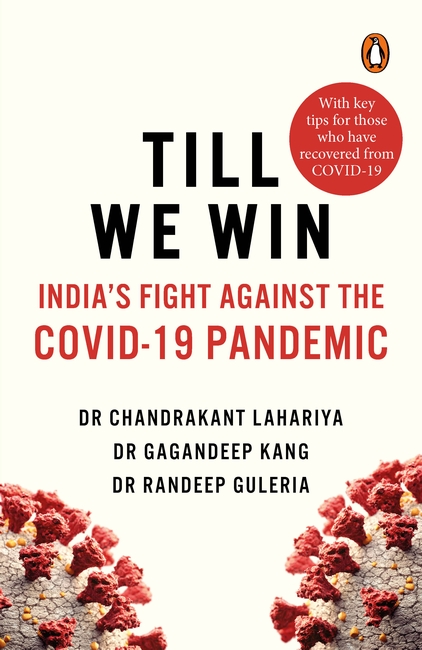
When will India win the fight against the COVID-19 pandemic?
How long do we have to use masks?
When can we expect a safe and effective vaccine? Do we need to wear masks even after we get a vaccine?
What if there is no definitive treatment against COVID-19?
How can we protect our family form this disease?
How should we respond to this ‘new normal’ as an individual and as a community?
What is the way forward?
Offering insights on how India continues to fight the pandemic, Till We Win is a must-read for everyone. It is a book for the people, for political leaders, policymakers and physicians, with the promise and potential to transform public health in India.
The Mahabharata (Box Set)
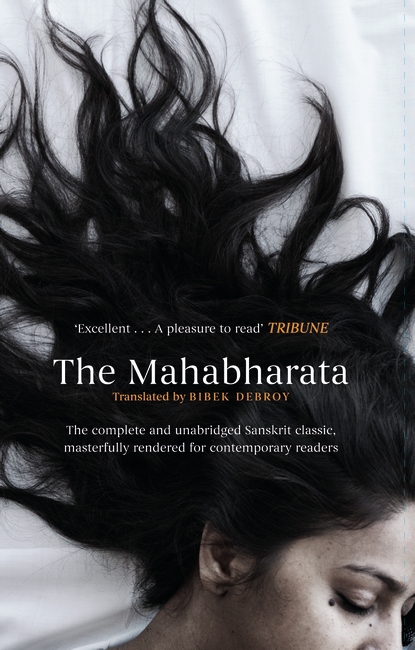
The greatest Indian story ever told of a war between two factions of a family, The Mahabharata has continued to sway the imagination of its readers over the past centuries.
While the dispute over land and kingdom between the warring cousins-the Pandavas and the Kauravas-forms the chief narrative, the primary concern of The Mahabharata is about the conflict of dharma. These conflicts are immense and various, singular and commonplace. Throughout the epic, characters face them with no clear indications of what is right and what is wrong; there are no absolute answers. Thus every possible human emotion features in The Mahabharata, the reason the epic continues to hold sway over our imagination.
The complete and unabridged Sanskrit classic, now masterfully and accessibly rendered for contemporary readers by Bibek Debroy.