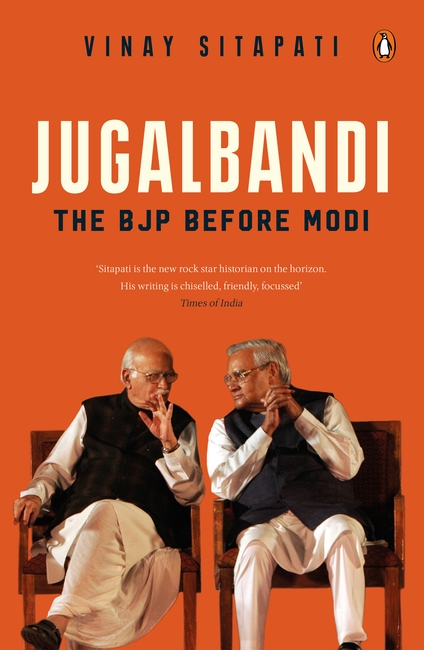
Narendra Modi has been a hundred years in the making. Vinay Sitapati’s Jugalbandi provides this backstory to his current dominance in Indian politics. It begins with the creation of Hindu nationalism as a response to British-induced elections in the 1920s, moves on to the formation of the Bharatiya Janata Party (BJP) in 1980, and ends with its first national government, from 1998 to 2004. And it follows this journey through the entangled lives of its founding jugalbandi: Atal Bihari Vajpayee and Lal Krishna Advani.
Over their six-decade-long relationship, Vajpayee and Advani worked as a team despite differences in personality and beliefs. What kept them together was fraternal love and professional synergy, of course, but also, above all, an ideology that stressed on unity. Their partnership explains what the BJP before Modi was, and why it won.
In supporting roles are a cast of characters-from the warden’s wife who made room for Vajpayee in her family to the billionaire grandson of Pakistan’s founder who happened to be a major early funder of the BJP. Based on private papers, party documents, newspapers and over two hundred interviews, this is a must-read for those interested in the ideology that now rules India & Indian politics & government

Caste, and caste-based discrimination, are not just Indian issues. They are experienced throughout the world, from Britain to Bahrain, Canada to South Africa. This is a global phenomenon, demanding global solutions.
Leading scholar Suraj Milind Yengde shines a light on the Dalit experience internationally, from indentured labourers in the nineteenth-century Caribbean to present-day migrant workers in the Middle East. Combining history, ethnography and archival research, he offers a compelling, comparative approach to caste and race from ancient times to today. What have been the impacts of colonialism, religion and nationalism on caste-based hierarchies worldwide? What can we learn from caste-related movements in India and internationally? Why hasn’t the South Asian diaspora embraced the anti-caste struggles of the homeland? And what are the limits of Dalit–Black solidarity?
Exploring the global footprint of the anti-caste struggle—from its links with Black Lives Matter to the work of international Ambedkarite organisations—this is a powerful analysis of world politics from the perspective of one of the most oppressed communities on Earth. Asking probing questions about the nature of inequality, Yengde issues an energetic call for a cosmopolitan Dalit universalism, as a vital part of today’s fight for social justice and equality.

The Partition of India in 1947 caused one of the great human convulsions of history. The statistics are staggering. Twelve million people were displaced; a million died; seventy-five thousand women are said to have been abducted and raped; families were divided; properties lost; homes destroyed. In public memory, however, the violent, disturbing realities that accompanied Partition have remained blanketed in silence. And yet, in private, the voices of Partition have never been stilled and its ramifications have not yet ended. Urvashi Butalia’s remarkable book, the outcome of a decade of interviews and research, looks at what Partition was intended to achieve, and how it worked on the ground, and in people’s lives. Pieced together from oral narratives and testimonies, in many cases from women, children and dalits- marginal voices never heard before- and supplemented by documents, reports, diaries, memoirs and parliamentary records, this is a moving, personal chronicle of Partition that places people, instead of grand politics, at the centre. These are the untold stories of Partition, stories that India has not dared to confront even after fifty years of independence.
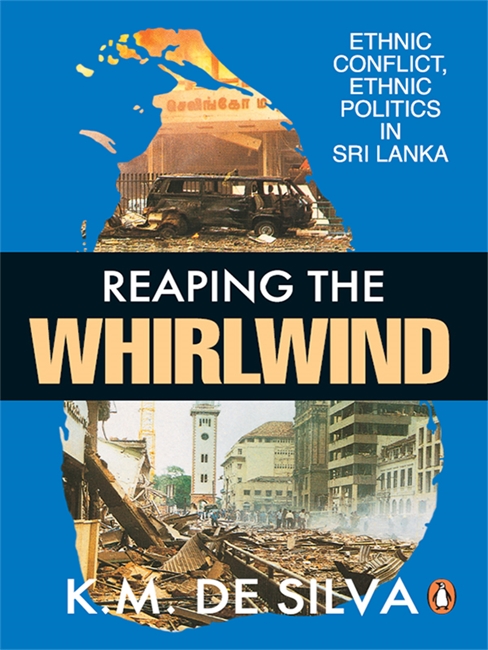
A critical analysis of the ethnic conflict in Sri Lanka In the eighties, Sri Lanka, once considered the ‘model’ colony, was torn apart by ethnic strife between the predominantly Buddhist Sinhalas, constituting almost threequarters of the island’s inhabitants, and the numerically fewer Tamils, who were a mix of Hindus, Christians and Muslims. Massacres occurred after the riots of May 1983, and over time about 1,25,000 Tamils entered India as refugees, fleeing from a virtual civil war which still afflicts the north of the island. The author, a renowned Sri Lankan analyst of global ethnic conflict, discusses the historical reasons behind the ethnic violence, especially the growth of the Sinhalas’ feeling of being a beleagured minority despite their numerical strength. Analysing the present conflict, he shows how the language policy of ‘Sinhala Only’, followed by the government in the sixties, supplanted religion as a divisive factor and how rivalry over educational and employment opportunities fuelled the schism. Bringing the story up to the present, de Silva examines the role played by Indian and Tamil Nadu politicians, and President Kumaratunga’s efforts towards a devolution of power to the Tamil Provinces. But given the LTTE’s acceptance of nothing less than Eelam, he sees little hope of an early end to the violence that has racked Sri Lanka for almost two decades now.
Frontline Reports From Sri Lanka And Other South Asian Flashpoints.
Island Of Blood Is A Distillation Of The Experiences And Insights Of One Of The Finest Journalists India Has Ever Produced. During The Eighties And Nineties, When The Indian Media Rarely Ventured Into Flashpoints Like Sri Lanka And Afghanistan, Anita Pratap Braved The Odds To Send In Reports From The Front, Over And Over Again. War, Ethnic Conflict, Earthquakes, Cyclones And Droughts, Wherever There Was A Story To Be Told, She Would Track It Down. First In India, Then In Sri Lanka, Anita Managed To Gain Access To Ltte Chief Pirabhakaran, And Her Interviews With Him Made Headlines Around The World. In Afghanistan, She Eluded The Taliban Militia To Discover The Frightening Reality Of Women&Rsquo;S Lives Under A Terrifying Fanatical Regime.
Wherever She Went, Anita Saw And Faithfully Reported The Consequences Of Racial And Historical Prejudice, Religious And Sexual Discrimination, And Mindless Hatred And Fear. And Each Time, She Returned To The Comfort Of Home And Family With A Renewed Determination To Appreciate And Celebrate The Ordinary.

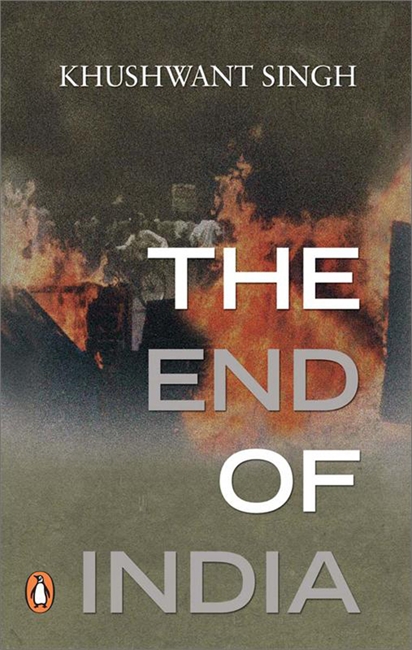
‘I thought the nation was coming to an end,’ wrote Khushwant Singh, looking back on the violence of Partition that he witnesses over half a century ago. He believed then, and for years afterwards, that he had seen the worst that India could do to itself. Over the last few years, however, he has had reason to feel that the worst, perhaps, is still to come.
In this fierce, uncompromising book, he shows us what few of us wish to see: why it is entirely likely that India will come undone in the foreseeable future. Analysing the communal violence in Gujarat in 2002, the anti-Sikh riots of 1984, the burning of Graham Staines and his children, the targeted killings by terrorists in Punjab and Kashmir, Khushwant Singh forces us to confront the absolute corruption of religion that has made us among the most brutal people on earth. He also points out that fundamentalism has less to do with religion than with politics. And communal politics, he reminds us, is only the most visible of the demons we have nurtured and let loose upon ourselves.
Insurgencies in Kashmir and the North-East, caste wars in Bihar, scattered Naxalite movements, and the ghettoization of minorities are proof that our obsession with caste and regional and racial identity has also splintered the nation, perhaps beyond repair. A brave and passionate book, The End of India is a wake-up call for every citizen concerned about his or her own future, if not the nation’s.
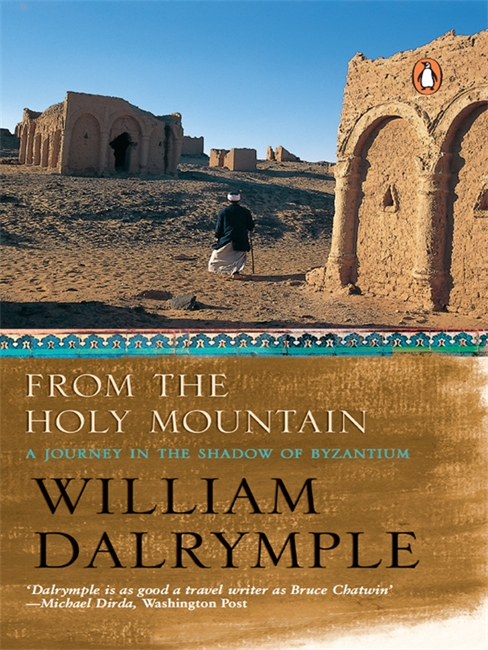
A Journey in the Shadow of Byzantium
‘In his third book William Dalrymple has dug deep to present the case of the Middle East’s downtrodden Christians. More hard-hitting than either of his previous books, From the Holy Mountain is driven by indignation. While leavened with his characteristic jauntiness and humour, it is also profoundly shocking. Time and time again in the details of Dalrymple’s discoveries I found myself asking: why do we not know this?
The sense of unsung tragedy accumulates throughout the chapters of this book…From the Holy Mountain is the most rewarding sort of travel book, combining flashes of lightly-worn scholarship with a powerful sense of place and the immediacy of the best journalism. But more than that it is a passionate cri de coeur for a forgotten people which few readers will be able to resist’—Philip Marsden, Spectator.

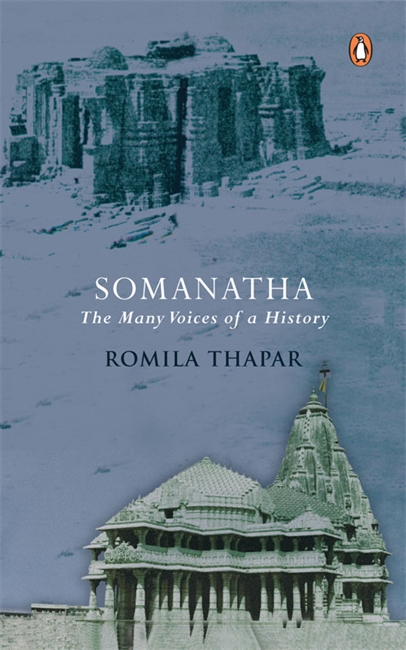
It was first depicted as a trauma for the Hindu population not in India, but in the House of Commons. The triumphalist accounts of the event in Turko-Persian chronicles became the main source for most eighteenth-century historians. It suited everyone and helped the British to divide and rule a multi-millioned subcontinent. In her new book, Romila Thapar, the doyenne of Indian historians, reconstructs what took place by studying other sources, including local Sanskrit inscriptions, biographies of kings and merchants of the period, court epics and popular narratives that have survived. The result is astounding and undermines the traditional version of what took place. What makes her findings explosive is the fact that the current Hindu nationalist regime in India constantly utilizes a particular version of history