



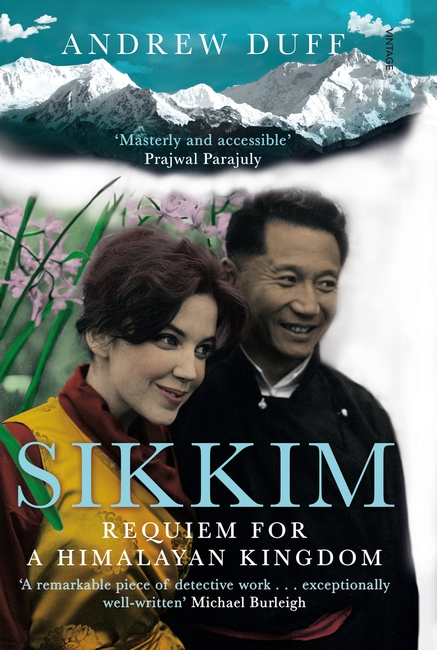
This is the incredible true story of Sikkim, a fairy-tale kingdom in the Himalayas that survived the end of the British Empire in India only to be annexed by India in 1975. Sikkim: Requiem for a Himalayan Kingdom tells the remarkable story of Thondup, the handsome last King of Sikkim, and his young and beautiful American queen, Hope Cooke, thrust unwittingly into the spotlight as they sought support for Sikkim’s independence after their wedding in 1963. But as tensions between India and China spilled over into war in the Himalayas, Sikkim became a pawn in the Cold War ideological battle that played out in Asia during the 1960s and 1970s.
Rumours circulated that Hope was a CIA spy. Meanwhile, a shadowy Scottish adventuress, the Kazini of Chakung, married to Sikkim’s leading political figure, coordinated opposition to the Palace. As the geopolitical tectonic plates of the Himalayas ground together, Sikkim never stood a chance. Thondup died a broken man in 1982; Hope returned to New York; Sikkim began a new phase as India’s twenty-second state.Based on exclusive interviews and new archival research, this is a thrilling, romantic and informative glimpse of life in a lost paradise.
Catagory: History
Sikkim
How to Read Amartya Sen
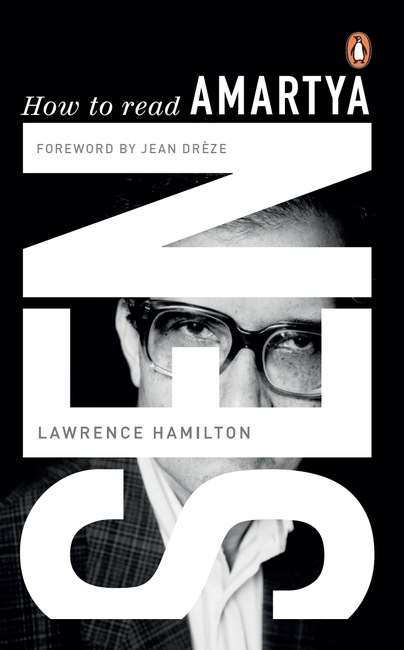
Nobel Laureate Amartya Sen is one of the world’s best-known voices for the poor and the downtrodden, and an inspiration for the proponents of justice across the globe. He has contributed almost without peer to the study of economics, philosophy and politics, transforming social choice theory, development economics, ethics, political philosophy and Indian political economy, to list but a few.
This book offers a much-needed introduction to Amartya Sen’s extraordinary variety of ideas. Lawrence Hamilton provides an excellent, accessible guide to the full range of Sen’s writings, contextualizing his ideas and summarizing the associated debates. In elegant prose, Hamilton reconstructs Sen’s critiques of the major philosophies of his time, assesses his now famous concern for capabilities as an alternative for thinking about poverty, inequality, gender discrimination, development, democracy and justice, and unearths some overlooked gems. Throughout, these major theoretical and philosophical achievements are subjected to rigorous scrutiny.
How to Read Amartya Sen is a major work on one of the most influential economists and philosophers of the last few centuries. It will be illuminating for readers keen to understand the breadth of Sen’s vision, and an invaluable resource for scholars, policy makers and global activists.
A History Of Sri Lanka
The Mahabharata
The Mahabharata is one of the greatest stories ever told. Though the basic plot is widely known, there is much more to the epic than the dispute between Kouravas and Pandavas that led to the battle in Kurukshetra. It has innumerable sub-plots that accommodate fascinating meanderings and digressions and it has rarely been translated in full, given its formidable length of 80,000 shlokas or couplets. This magnificent 10-volume unabridged translation of the epic is based on the Critical Edition compiled at the Bhandarkar Oriental Research Institute.
The final volume ends the instructions of the Anushasana Parva. The horse sacrifice is held and Dhritarashtra, Gandhari, Kunti, Vidura and Sanjaya leave for the forest. Krishna and Balarama die as the Yadavas fight among themselves. The Pandavas leave on the great journey with the famous companion – Dharma disguised as a dog. Refusing to abandon the dog, Yudhishthira goes to heaven in his physical body and sees all the Kurus and the Pandavas are already there.
Every conceivable human emotion figures in the Mahabharata, the reason why the epic continues to hold sway over our imagination. In this lucid, nuanced and confident translation, Bibek Debroy makes the Mahabharata marvellously accessible to contemporary readers.
The Mahabharata
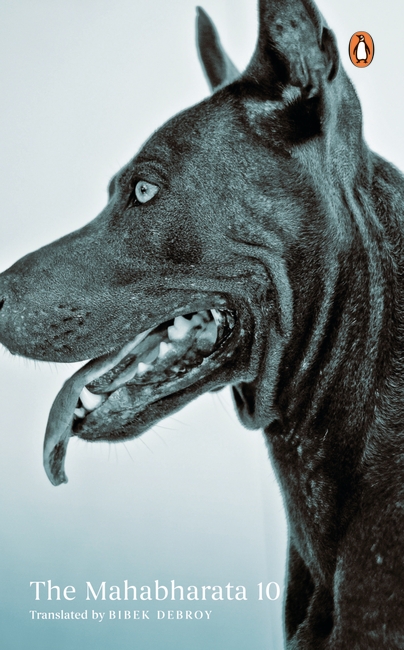
The Mahabharata is one of the greatest stories ever told. Though the basic plot is widely known, there is much more to the epic than the dispute between Kouravas and Pandavas that led to the battle in Kurukshetra. It has innumerable sub-plots that accommodate fascinating meanderings and digressions, and it has rarely been translated in full, given its formidable length of 80,000 shlokas or couplets. This magnificent 10-volume unabridged translation of the epic is based on the Critical Edition compiled at the Bhandarkar Oriental Research Institute.
*
The final volume ends the instructions of the Anushasana Parva. The horse sacrifice is held, and Dhritarashtra, Gandhari, Kunti, Vidura and Sanjaya leave for the forest. Krishna and Balarama die as the Yadavas fight among themselves. The Pandavas leave on the great journey with the famous companion-Dharma disguised as a dog. Refusing to abandon the dog, Yudhishthira goes to heaven in his physical body and sees all the Kurus and the Pandavas are already there.
*
Every conceivable human emotion figures in the Mahabharata, the reason why the epic continues to hold sway over our imagination. In this lucid, nuanced and confident translation, Bibek Debroy makes the Mahabharata marvellously accessible to contemporary readers.
The Hanging of Afzal Guru
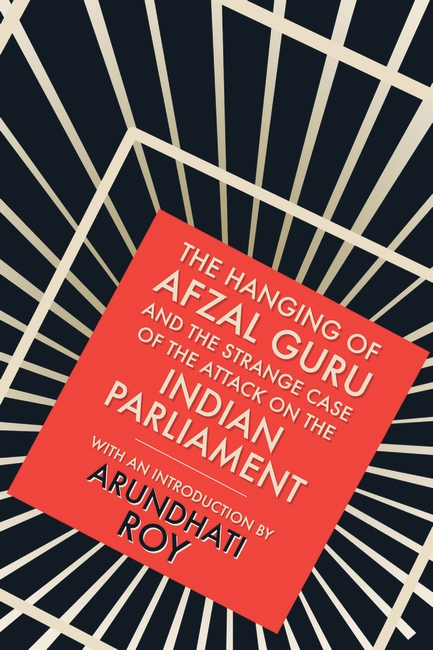
A comprehensive, sensitive view of one of the most controversial hangings of modern India
On 13 December 2001, the Indian Parliament was attacked by a few heavily armed men. Eleven years later, we still do not know who was behind the attack, nor the identity of the attackers. Both the Delhi high court and the Supreme Court of India have noted that the police violated legal safeguards, fabricated evidence and extracted false confessions. Yet, on 9 February 2013, one man, Mohammad Afzal Guru, was hanged to ‘satisfy’ the ‘collective conscience’ of society.
This updated reader brings together essays by lawyers, academics, journalists and writers who have looked closely at the available facts and who have raised serious questions about the investigations and the trial. This new version examines the implications of Mohammad Afzal Guru’s hanging and what it says about the Indian government’s relationship with Kashmir
The Shape of the Beast
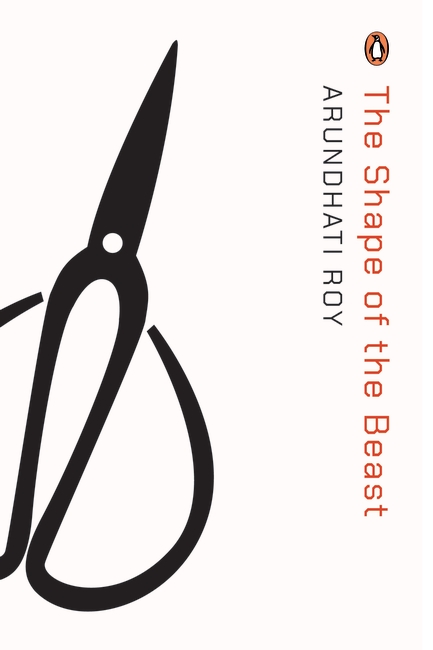
The Shape of the Beast is our world laid bare by a mind that has consistently and unhesitatingly engaged with its changing realities and often anticipated the way things have moved in the last decade.
In the fourteen interviews collected here, conducted between January 2001 and March 2008, Arundhati Roy examines the nature of state and corporate power as it has emerged during this period, and the shape that resistance movements are taking. As she speaks about people displaced by dams and industry, the genocide in Gujarat, Maoist rebels, the war in Kashmir and the global War on Terror, she raises fundamental questions about democracy, justice and non-violent protest.
Unabashedly political, this is also a deeply personal collection that talks about the necessity of taking a stand and about the dilemma of guarding the private space necessary for writing in a world that demands urgent, unequivocal intervention.
Listening to Grasshoppers
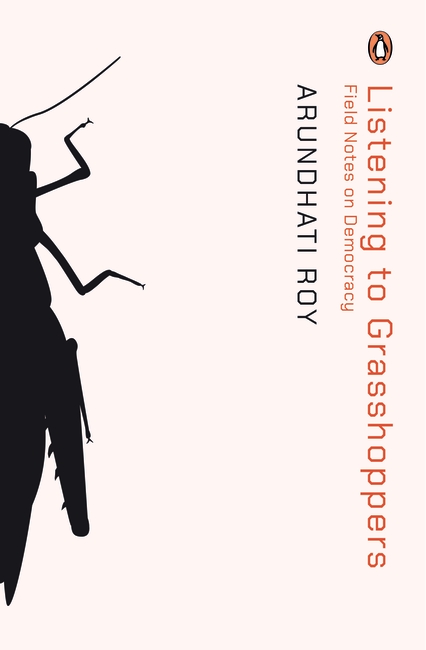
Now with a new introduction by the author discussing the election of India’s new prime minister, Narendra Modi.
In eleven powerful, and closely argued, linked essays, Arundhati Roy takes a hard look at the underbelly of the world’s largest democracy. Beginning with the state-backed killing of Muslims in Gujarat in 2002, she writes about how ‘progress’ and genocide have historically gone hand in hand; about the murky investigations into the 2001 attack on the Indian Parliament; about the dangers of an increasingly powerful and entirely unaccountable judiciary; and about the collusion between large corporations, the government and the mainstream media. The volume ends with an account of the August 2008 uprising in Kashmir and an analysis of the November 2008 attacks on Mumbai. ‘The Briefing’, included as an appendix, is a compelling fictional text that brings together many of the issues central to the collection.
An Ordinary Person’s Guide to Empire
This second volume of Arundhati Roy’s collected non-fiction writing brings together fourteen essays written between June 2002 and November 2004. In these essays she draws the thread of empire through seemingly unconnected arenas, uncovering the links between America’s War on Terror, the growing threat of corporate power, the response of nation states to resistance movements, the role of NGOs, caste and communal politics in India, and the perverse machinery of an increasingly corporatized mass media. Meticulously researched and carefully argued, this is a necessary work for our times.